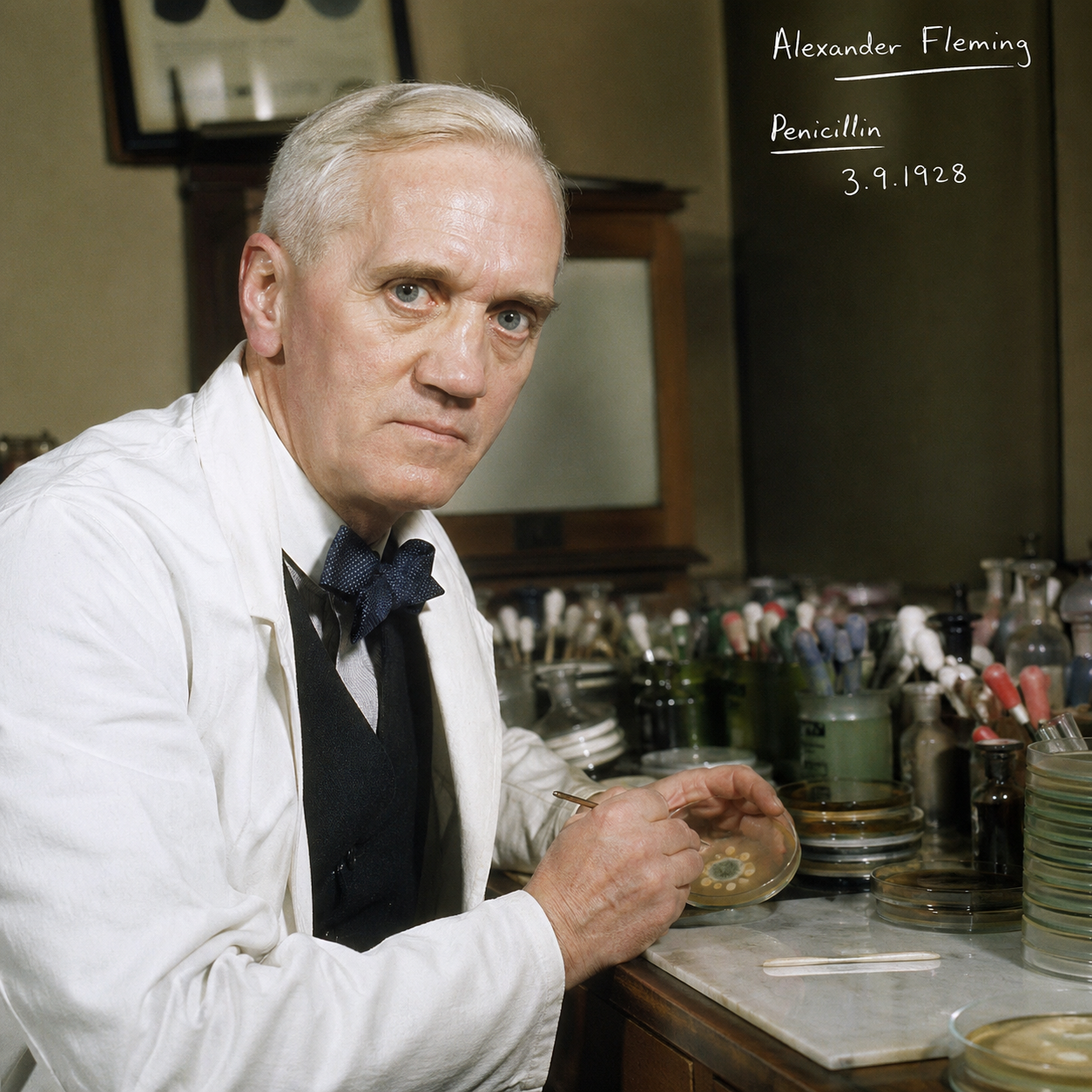
Alexander Fleming — "I often wonder how many other useful molds have been thrown away by bacteriologi…"
I often wonder how many other useful molds have been thrown away by bacteriologists.
I often wonder how many other useful molds have been thrown away by bacteriologists.
Click any product to generate a realistic preview. Up to 3 at a time.
* Initial load can take up to 90 seconds — revising the preview in another color is nearly instant.
"I am very grateful for the recognition I have received, but the real credit belongs to the mould."
"I had no idea that I had stumbled on to a subject that would prove to be of such immense importance."
"The mould was very interesting. I cultured it and found it produced a powerful antibacterial substance. It was very effective against staphylococci and other Gram-positive pathogenic bacteria."
"I never sought fame or fortune, only to contribute to human knowledge."
"I was not looking for penicillin when I discovered it. I was looking for a better antiseptic."
Found in 1 providers: grok
1 source checked
Fleming observes that scientists, focused on their intended experiments, routinely discard contaminated samples without considering whether the contaminant itself might be medically valuable. He's lamenting missed scientific discoveries — the next breakthrough antibiotic might already be in a laboratory waste bin. The quote is a quiet challenge to procedural rigidity: curiosity about the unexpected, not just discipline in pursuing the expected, is what drives transformative science.
Fleming discovered penicillin in 1928 because he kept a contaminated culture dish rather than discarding it. Penicillium mold had killed surrounding staphylococcus colonies — most bacteriologists would have binned it as a ruined experiment. His Nobel Prize-winning discovery emerged from treating contamination as data rather than failure. This quote reveals that same characteristic curiosity: he knew his breakthrough was accidental, and suspected colleagues had unknowingly discarded equally significant accidents.
Fleming worked during an era when bacterial infections — wound sepsis, pneumonia, meningitis — killed millions annually without effective treatment. Early 20th-century bacteriology was built on rigorous sterile technique; contaminated plates were procedural failures to discard quickly. World War II then demonstrated penicillin's life-saving scale, salvaging countless infected war wounds. His comment carries added weight knowing that before antibiotics, surgeons watched patients die from infections now cured by a single pill.
AI-generated insights based on extensive research and information for context. Factual errors? Email [email protected].
Your cart is empty