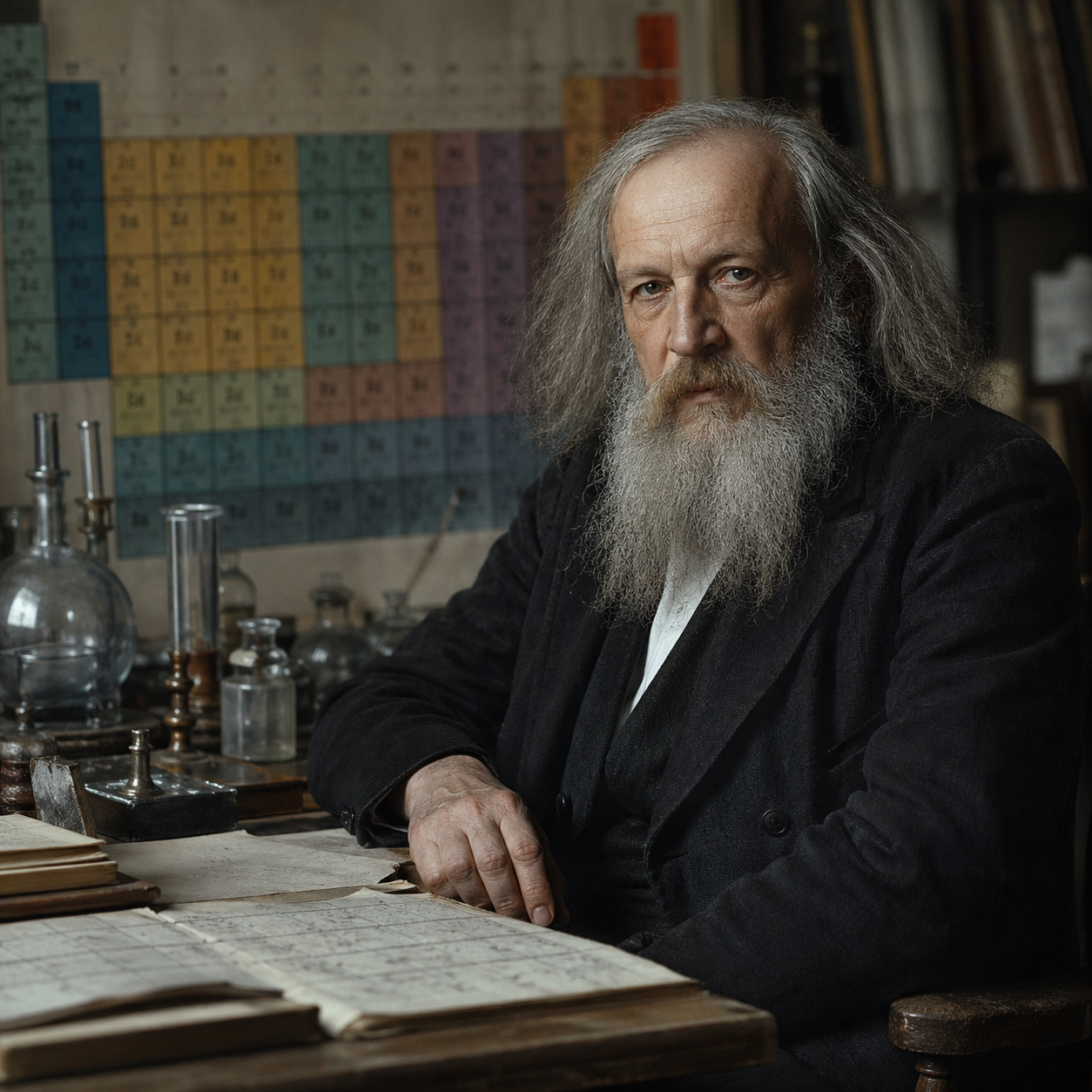
Dmitri Mendeleev — "I have always been a practical man, and my science is for the benefit of mankind…"
I have always been a practical man, and my science is for the benefit of mankind.
I have always been a practical man, and my science is for the benefit of mankind.
Click any product to generate a realistic preview. Up to 3 at a time.
* Initial load can take up to 90 seconds — revising the preview in another color is nearly instant.
"The law of periodicity was a result of the accumulation of a large number of facts."
"The capital fact to note is that petroleum was born in the depths of the earth, and it is only there that we must seek its origin."
"The periodic law is now so firmly established that no one can gainsay its fundamental truth."
"There will be new elements discovered, and they will fit into the empty spaces in my table."
"A well-made theory is like a good overcoat; Eloquent words are like a beautiful tie."
Found in 1 providers: grok
1 source checked
The speaker identifies as grounded and results-focused rather than lost in pure theory. Their work in science isn't pursued for its own sake or personal glory, but aimed at producing real, tangible improvements in people's lives. Knowledge, in this view, is valuable when it serves humanity by solving actual problems, improving industry, agriculture, or daily living. It rejects ivory-tower detachment in favor of useful, applied outcomes.
Mendeleev lived this ethic directly. Beyond formulating the periodic table in 1869, he advised the Russian government on oil, agriculture, tariffs, and metrology, and ran the Bureau of Weights and Measures. He studied petroleum fields, promoted Russian industrial development, and wrote on economics and farming. He saw chemistry as a tool for national progress, not abstract puzzle-solving, and applied his expertise wherever practical problems met scientific reasoning.
Mendeleev worked in late-19th-century Russia, a nation racing to industrialize behind Western Europe. Serfdom had just ended in 1861, railroads were expanding, and oil production in Baku was booming. Tsarist reformers needed scientists who could translate research into factories, fuel, and food. Universities were producing a new technical intelligentsia expected to modernize the empire, making an applied, service-to-mankind framing of science both culturally resonant and politically useful.
AI-generated insights based on extensive research and information for context. Factual errors? Email [email protected].
Your cart is empty