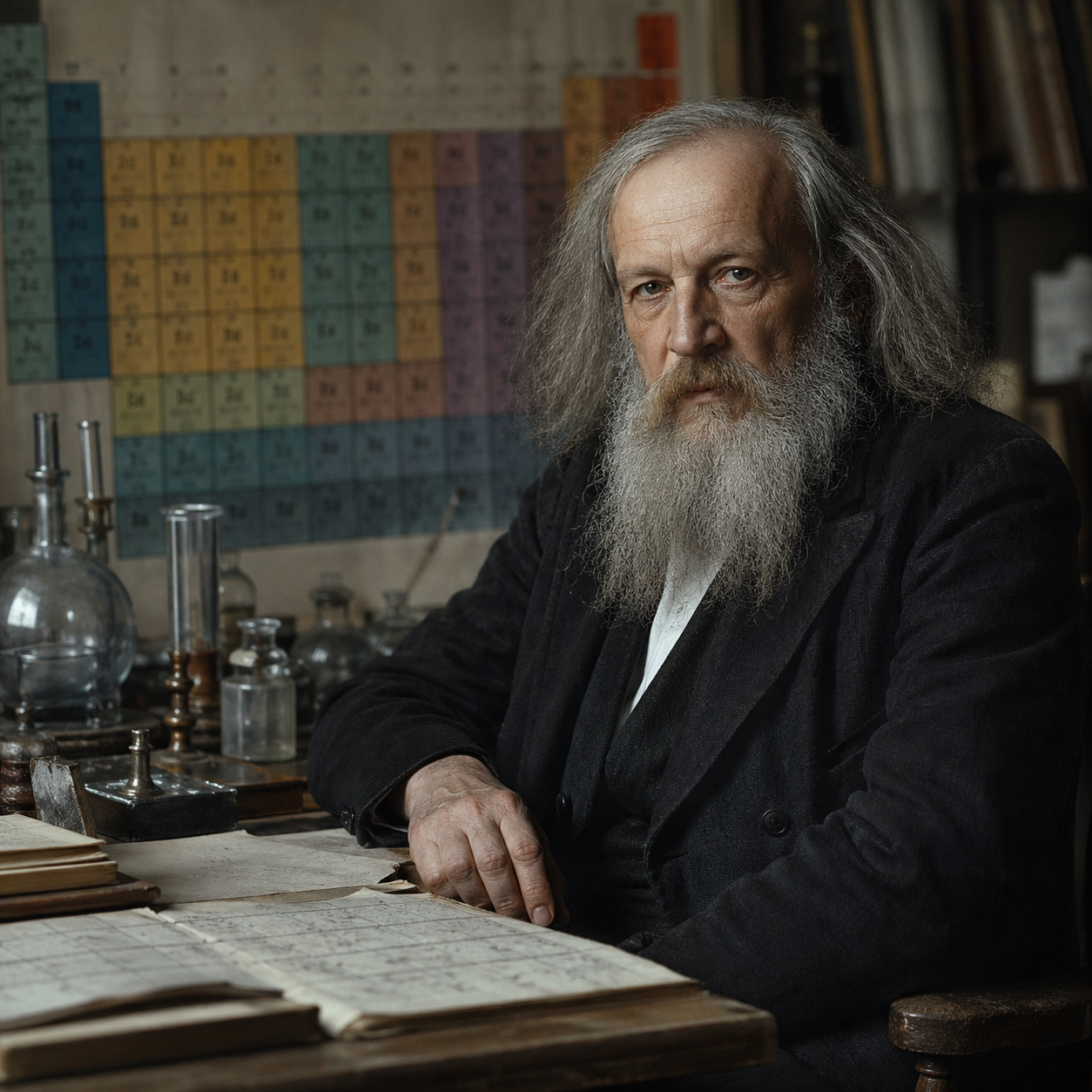
Dmitri Mendeleev — "Pleasures flit by -- they are only for yourself; work leaves a mark of long-last…"
Pleasures flit by -- they are only for yourself; work leaves a mark of long-lasting joy, work is for others.
Pleasures flit by -- they are only for yourself; work leaves a mark of long-lasting joy, work is for others.
Click any product to generate a realistic preview. Up to 3 at a time.
* Initial load can take up to 90 seconds — revising the preview in another color is nearly instant.
"The greatest good is the knowledge of the truth."
"It is the function of the scientist to do 3 things: to observe, to generalize, and to predict."
"It is the duty of the chemist to teach the world how to use the elements wisely."
"Work, look for peace and calm in work: you will find it nowhere else."
"The whole essence of science is to make predictions."
Reflecting on the lasting value of work over fleeting personal pleasures.
Date: Undated
PhilosophicalFound in 1 providers: gemini
1 source checked
Personal pleasures are fleeting and benefit only the person experiencing them, vanishing quickly once the moment ends. Meaningful work, by contrast, creates something that outlasts the individual and serves other people. The deeper and more durable satisfaction comes not from self-indulgence but from contributing something useful to society. Real joy is found in labor directed outward, toward a purpose larger than one's own immediate gratification.
Mendeleev embodied this ethic. He devoted decades to chemistry, teaching, and public service, producing the periodic table in 1869 as a gift to science rather than for personal gain. He advised the Russian government on agriculture, petroleum, and weights and measures, and wrote textbooks to educate students he would never meet. His relentless output, often at personal cost, reflected his conviction that lasting worth comes from work that benefits generations beyond oneself.
Mendeleev worked during late 19th-century Russia, an era of rapid industrialization under Alexander II and Alexander III, serf emancipation in 1861, and intense debate over Russia's modernization. Scientists were expected to serve the state and advance national development. The Protestant-style work ethic and utilitarian ideals of the age, combined with Russian intelligentsia traditions of duty to the narod (people), framed productive labor as a moral obligation rather than mere economic activity.
AI-generated insights based on extensive research and information for context. Factual errors? Email [email protected].
Your cart is empty