Johannes Kepler — "I have been a scientist, and I have sought to understand the mysteries of the un…"
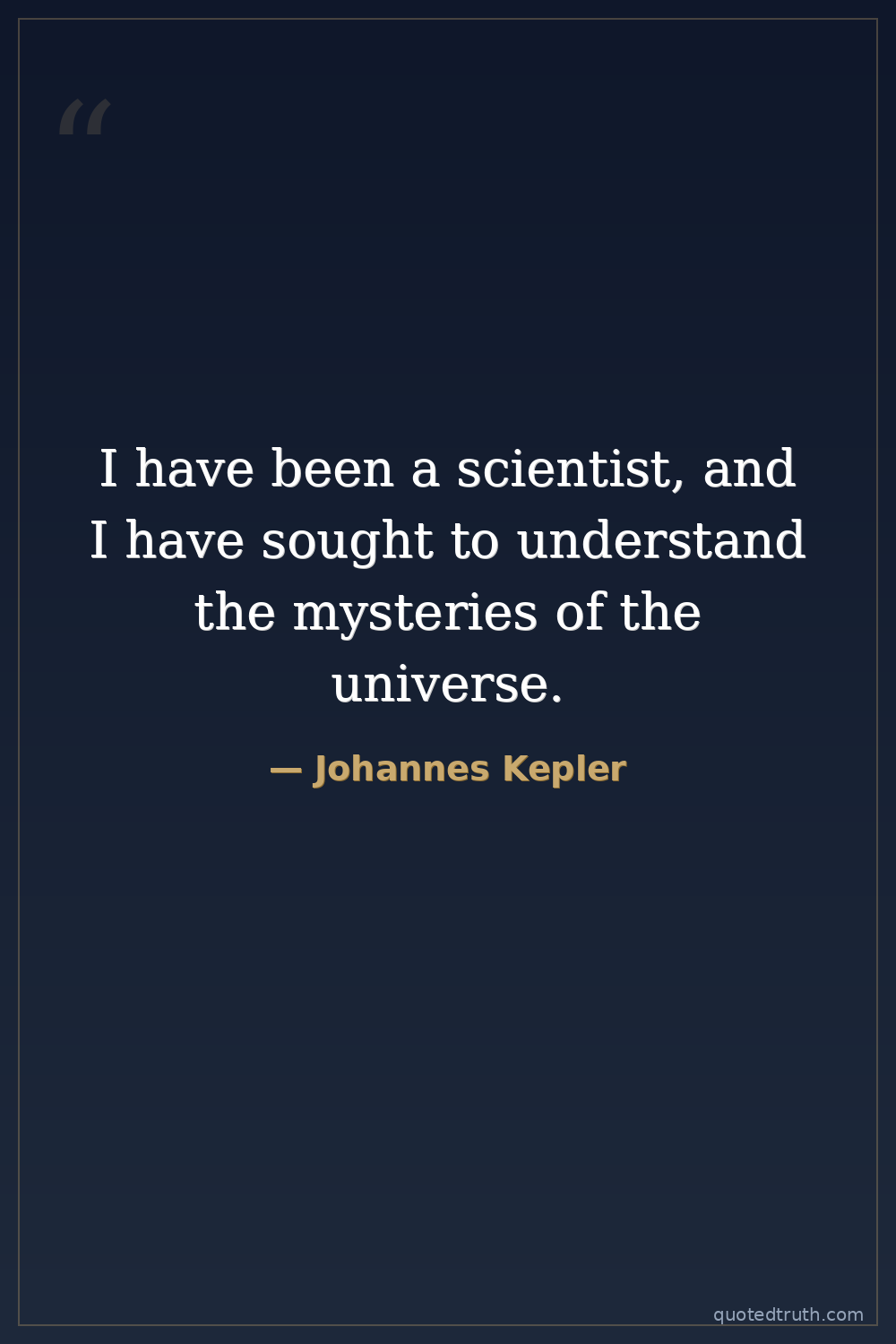
I have been a scientist, and I have sought to understand the mysteries of the universe.
I have been a scientist, and I have sought to understand the mysteries of the universe.
Click any product to generate a realistic preview. Up to 3 at a time.
* Initial load can take up to 90 seconds — revising the preview in another color is nearly instant.
"See, I cast the die, and I write the book. Whether it is to be read by the people of the present or of the future makes no difference: let it await its reader for a hundred years, if God himself has s…"
"God gives every animal the means of saving its life—why object if he gives astrology to the astronomer?"
"I have been tormented by the desire to understand the celestial motions."
"My stars were not Mercury rising in the seventh angle, but Copernicus and Tycho Brahe."
"I have been a wanderer, but I have always found my way back to God."
Found in 1 providers: grok
1 source checked
The speaker identifies themselves through their lifelong work of investigating nature and states a driving purpose: to uncover how the cosmos operates. It frames scientific inquiry not as a job but as a personal quest to grasp realities hidden behind appearances. The phrase 'mysteries of the universe' signals that many truths remain unknown, and the speaker has devoted their career to pulling back that veil through careful study.
Kepler spent decades decoding planetary motion, ultimately producing three mathematical laws that replaced centuries of guesswork about orbits. A devout Lutheran, he believed he was reading God's geometric blueprint, calling astronomy a priestly vocation. He endured his mother's witchcraft trial, religious exile, and poverty, yet kept computing Mars's orbit from Tycho Brahe's data. The quote captures his self-image as a seeker whose tools were mathematics, observation, and relentless curiosity about celestial order.
Kepler worked during the early 1600s Scientific Revolution, when Copernicus's sun-centered model was still contested and Galileo faced the Inquisition. The Thirty Years' War devastated Central Europe, blending religious conflict with political upheaval. Patronage from emperors funded astronomers who doubled as astrologers, and the printing press spread new ideas faster than authorities could suppress them. Calling oneself a scientist who probes universal mysteries was a bold claim in an age when theology still arbitrated truth about the heavens.
AI-generated insights based on extensive research and information for context. Factual errors? Email [email protected].
Your cart is empty