Alexander Fleming — "I have been asked by many people how I came to discover penicillin. The answer i…"
I have been asked by many people how I came to discover penicillin. The answer is that I did not discover it. I just happened to notice it.
I have been asked by many people how I came to discover penicillin. The answer is that I did not discover it. I just happened to notice it.
Click any product to generate a realistic preview. Up to 3 at a time.
* Initial load can take up to 90 seconds — revising the preview in another color is nearly instant.
"Penicillin cures, but wine makes people happy."
"The scientist has to be a perpetual child, always asking 'Why?'"
"If penicillin can cure those that are ill, Spanish sherry can bring the dead back to life."
"I had no idea that I would be involved in such a great discovery. It was purely accidental."
"The mold was a lucky accident, but the observation was not."
Found in 1 providers: grok
1 source checked
Discovery often comes not from deliberate pursuit but from open-eyed observation of the unexpected. Fleming is saying that the greatest breakthroughs can arrive through attentiveness and curiosity rather than calculated effort — that noticing something others would ignore or discard is itself a profound scientific act, and that humility about the role of chance is essential to understanding how knowledge actually advances.
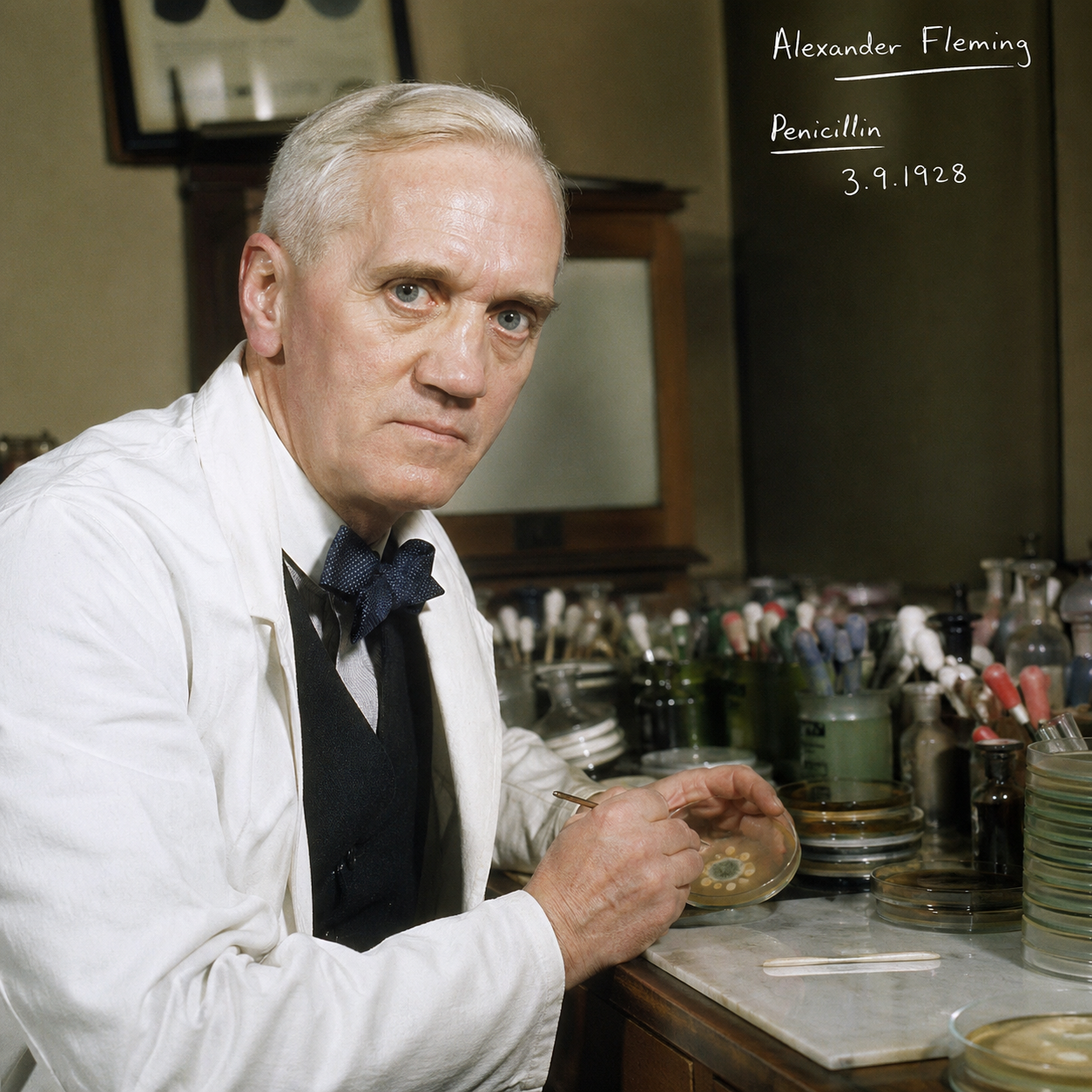
Fleming was a bacteriologist whose 1928 discovery came when he noticed mold contaminating a petri dish had killed surrounding bacteria — an observation most researchers would have discarded as ruined work. His career was defined by meticulous observation and intellectual humility. He repeatedly credited accident and attentiveness over genius, consistent with his modest Scottish character and his practical, laboratory-grounded approach to medicine.
Fleming worked in the early-to-mid 20th century, a period when germ theory was maturing and laboratory medicine was transforming from craft into rigorous science. World War I had shown the catastrophic cost of infected wounds, making antibacterial research urgent. The interwar scientific culture increasingly valorized systematic method over serendipity, making Fleming's insistence on chance's role both countercultural and foundational to understanding how penicillin — saving millions in WWII — actually emerged.
AI-generated insights based on extensive research and information for context. Factual errors? Email [email protected].
Your cart is empty