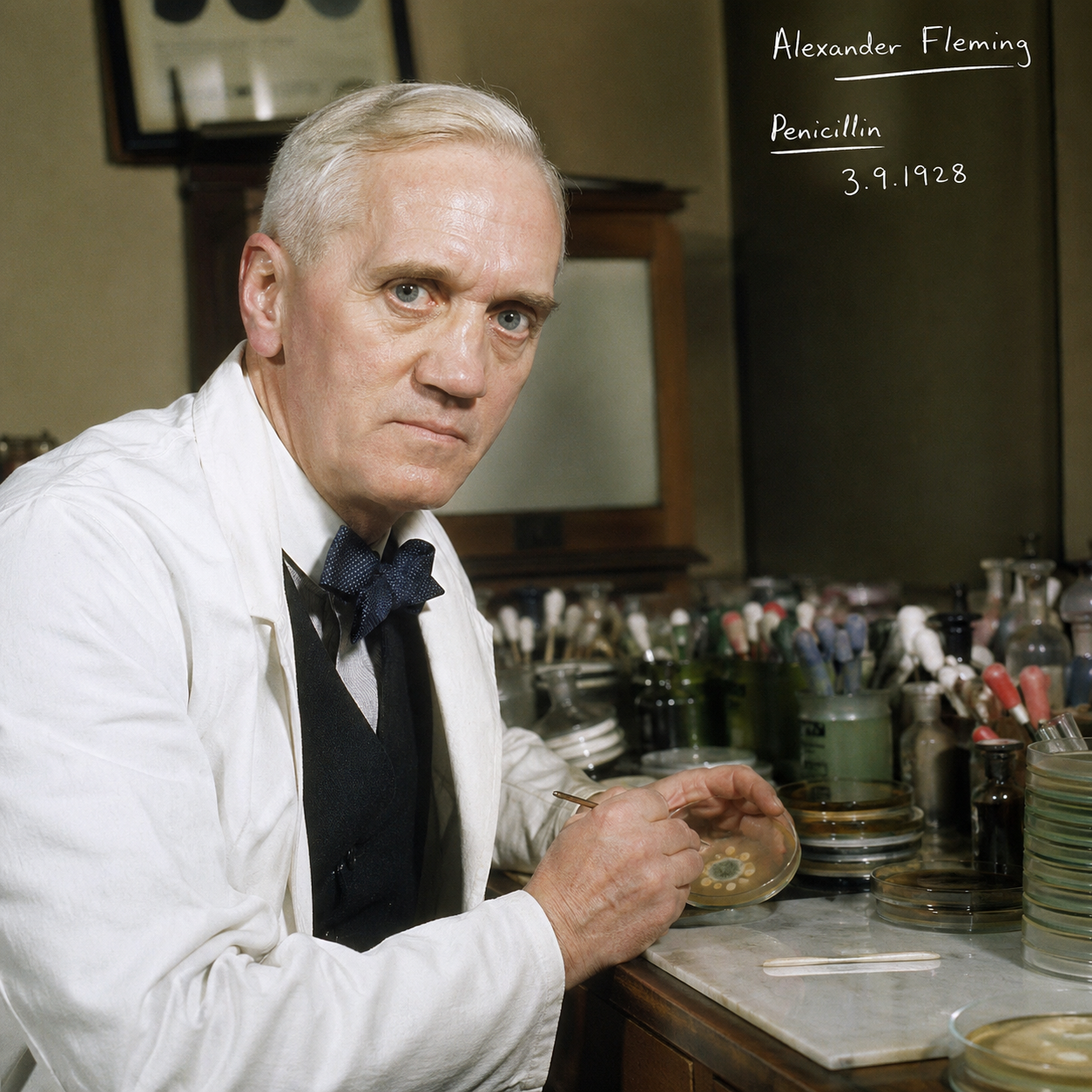
Alexander Fleming — "The story of penicillin has been told so often that it is almost a cliché."
The story of penicillin has been told so often that it is almost a cliché.
The story of penicillin has been told so often that it is almost a cliché.
Click any product to generate a realistic preview. Up to 3 at a time.
* Initial load can take up to 90 seconds — revising the preview in another color is nearly instant.
"I found penicillin and have given it free for the benefit of humanity. Why should it become a profit-making monopoly of manufacturers in another country?"
"I did not invent penicillin. Nature did. I just found it."
"The greatest reward for a scientist is the advancement of knowledge."
"The story of penicillin is a lesson in serendipity and perseverance."
"The mold was a lucky accident, but the observation was not."
Found in 1 providers: grok
1 source checked
A remarkable achievement, retold so many times, starts to feel routine — even to the person who lived it. Fleming is noting the paradox of fame: a story's importance doesn't diminish, but familiarity dulls the audience's sense of wonder. When a breakthrough gets packaged into a standard narrative and repeated endlessly, it risks becoming background noise rather than something people genuinely absorb and appreciate.
Fleming was famously self-deprecating about a discovery that was partly accidental — he left a contaminated petri dish unattended in 1928 and returned to find mold destroying bacteria. After winning the 1945 Nobel Prize alongside Florey and Chain, he endured decades of interviews, speeches, and retellings. His wry acknowledgment that the story had become a cliché reflects a modest scientist more comfortable in the lab than in the spotlight.
Penicillin's mass production during World War II saved an estimated 12–15% more wounded soldiers than would have survived otherwise, making it one of history's most celebrated medical achievements. By the late 1940s and early 1950s, the antibiotic revolution had sparked enormous public enthusiasm for science and medicine. Fleming's discovery was a cornerstone of that optimism — retold in newspapers, schools, and ceremonies so frequently it had genuinely worn thin.
AI-generated insights based on extensive research and information for context. Factual errors? Email [email protected].
Your cart is empty