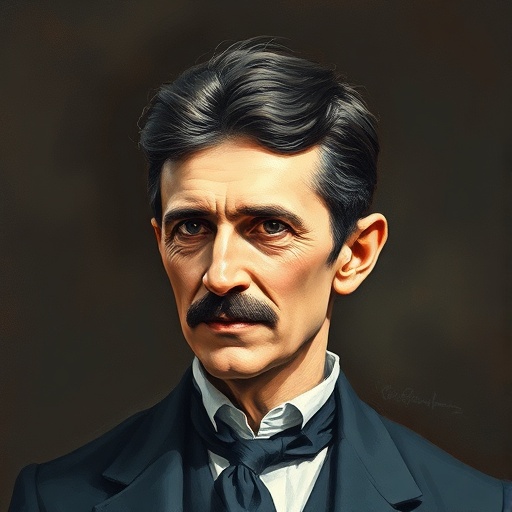
Nikola Tesla — "I have been called by some a visionary, by others a dreamer, but I am a practica…"
I have been called by some a visionary, by others a dreamer, but I am a practical man.
I have been called by some a visionary, by others a dreamer, but I am a practical man.
Click any product to generate a realistic preview. Up to 3 at a time.
* Initial load can take up to 90 seconds — revising the preview in another color is nearly instant.
"Every living being is an engine geared to the wheelwork of the universe. Though seemingly affected only by its immediate surrounding, the sphere of external influence extends to infinite distance."
"The ideal of a true man is to lead a life of self-sacrifice and devotion to the welfare of others."
"The opinion of the world does not affect me. I have placed as the real values in my life what follows when I am dead."
"I would give a thousand secrets of nature upon which I stumbled by accident, in exchange for this one which I extracted from nature, in spite of all the miracles and dangers which I faced."
"I consider myself a very fortunate man, because I have been able to devote my entire life to the pursuit of knowledge and the service of humanity."
Serbian-American inventor and electrical engineer whose alternating-current designs powered the modern electrical grid; died poor and largely forgotten. Closely associated with George Westinghouse (his AC-power business partner) and Mihajlo Pupin (fellow Serbian-American physicist at Columbia). For an intellectual contrast, see Thomas Edison, American inventor and direct-current advocate — Edison's direct-current power-distribution scheme was displaced by Tesla-Westinghouse AC in the 1890s 'War of Currents'. Edison ran a public-relations campaign electrocuting animals to discredit AC — the most famous engineering-ethics rivalry in American history. Tesla's AC won and powers nearly every electrical grid on Earth.
Found in 1 providers: grok
1 source checked
The speaker pushes back against being dismissed as an impractical idealist. Visionary and dreamer sound like compliments but carry a subtle dismissal — implying the ideas won't work. The speaker insists their imagination is grounded in real engineering and tangible results, not wishful thinking. Big ideas and practical execution aren't opposites; this person lives at their intersection.
Tesla's entire career embodied this tension. Contemporaries including Edison dismissed his AC power system as dangerous fantasy, yet Tesla engineered it into reality at Niagara Falls in 1895, powering cities. He held over 300 patents — blueprints, not dreams. His polyphase motor, transformer designs, and radio patents were working hardware, constantly underestimated by those who confused ambition with impracticality.
The late 19th century was the War of Currents — Edison's DC infrastructure versus Tesla and Westinghouse's AC system. Industrialists and financiers routinely dismissed radical inventors as crackpots while backing incremental improvements. The Gilded Age rewarded showmanship and profit over pure science, making it critical for serious engineers like Tesla to defend their practical credentials against a culture quick to romanticize and simultaneously marginalize genuine visionaries.
AI-generated insights based on extensive research and information for context. Factual errors? Email [email protected].
Your cart is empty