John Wesley — "I have often thought, that if I were to choose a language to speak, it should be…"
I have often thought, that if I were to choose a language to speak, it should be Greek.
I have often thought, that if I were to choose a language to speak, it should be Greek.
Click any product to generate a realistic preview. Up to 3 at a time.
* Initial load can take up to 90 seconds — revising the preview in another color is nearly instant.
"The best of all is, God is with us."
"I do not love to dispute about religion. I had rather feel it."
"I have no time to be little."
"I conceive slavery to be such a thing as is odious to the God of love."
"I found myself much out of order, and apprehended that my end was near. I had no fear of death, but I was concerned for the cause of God, which I apprehended would suffer by my removal."
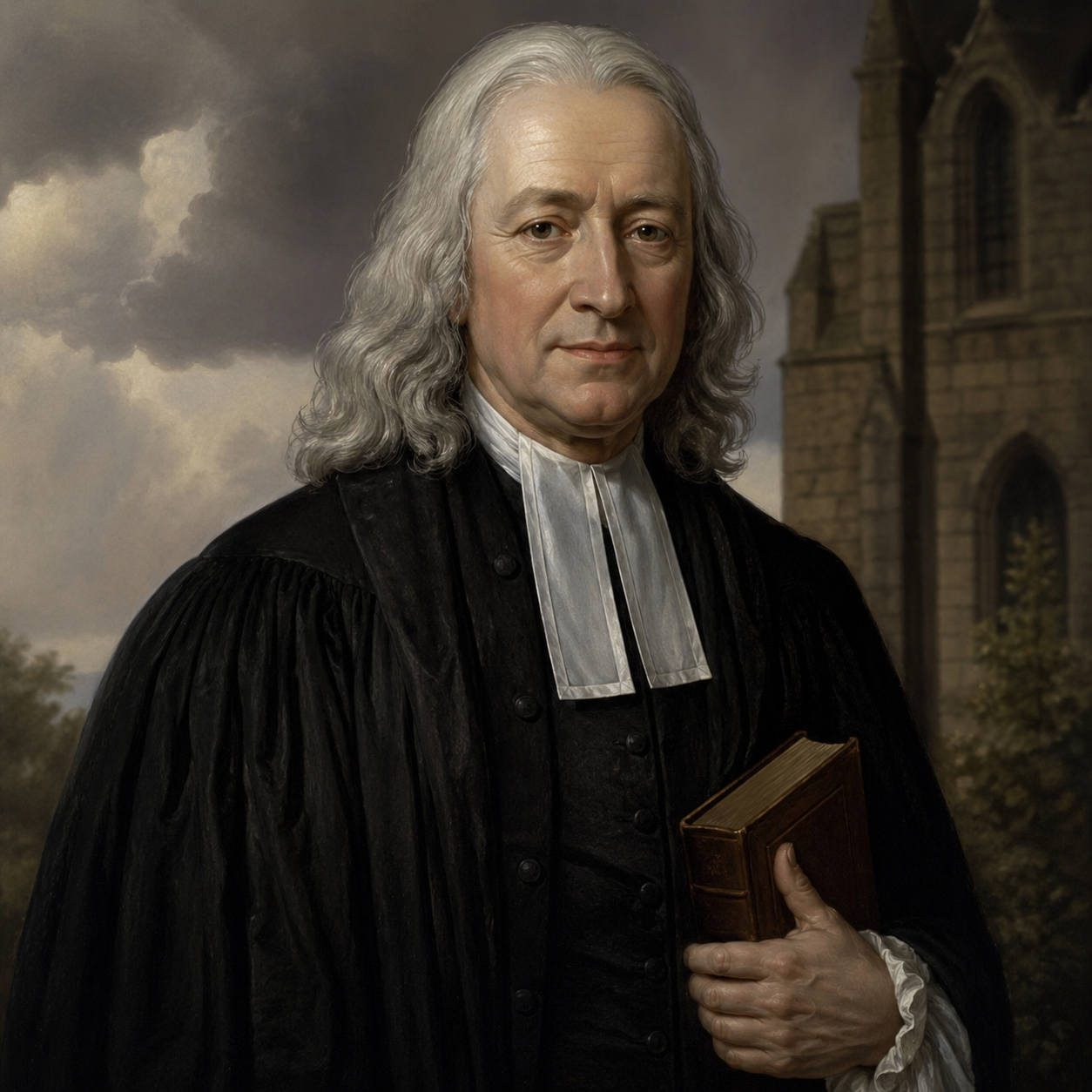
English Anglican cleric and founder of Methodism, whose open-air preaching and class-meeting structure created the largest 18th-century evangelical revival. Closely associated with Charles Wesley (his hymn-writing brother) and George Whitefield (early co-revivalist, later doctrinal opponent). For an intellectual contrast, see George Whitefield, Calvinist evangelical revivalist — Whitefield's predestinarian Calvinism vs Wesley's free-grace Arminian theology split the early Methodist movement permanently in the 1739-41 break. The founding evangelical Calvinist-Arminian schism — the two parallel evangelical traditions American Christianity descends from.
Found in 1 providers: grok
1 source checked
Wesley expresses a preference for ancient Greek above all other languages for speaking and communication. He values Greek for its precision, philosophical richness, and expressive range — qualities that make it uniquely suited for conveying complex theological and intellectual ideas with clarity and nuance that other languages struggle to match.
Wesley was a classically trained Oxford scholar who read the New Testament in its original Koine Greek daily. His theological precision depended on accessing scripture without translation intermediaries. Greek mastery allowed him to interpret scripture directly, forming the exegetical foundation of Methodist doctrine and his meticulous sermon-writing that reached millions.
In 18th-century England, classical education centered on Latin and Greek, but vernacular preaching was transforming religion. Wesley bridged both worlds — using scholarly Greek expertise while preaching in plain English to common people. The Enlightenment elevated rational inquiry, and Greek remained the prestige language of philosophy, medicine, and original Christian scripture.
AI-generated insights based on extensive research and information for context. Factual errors? Email [email protected].
Your cart is empty