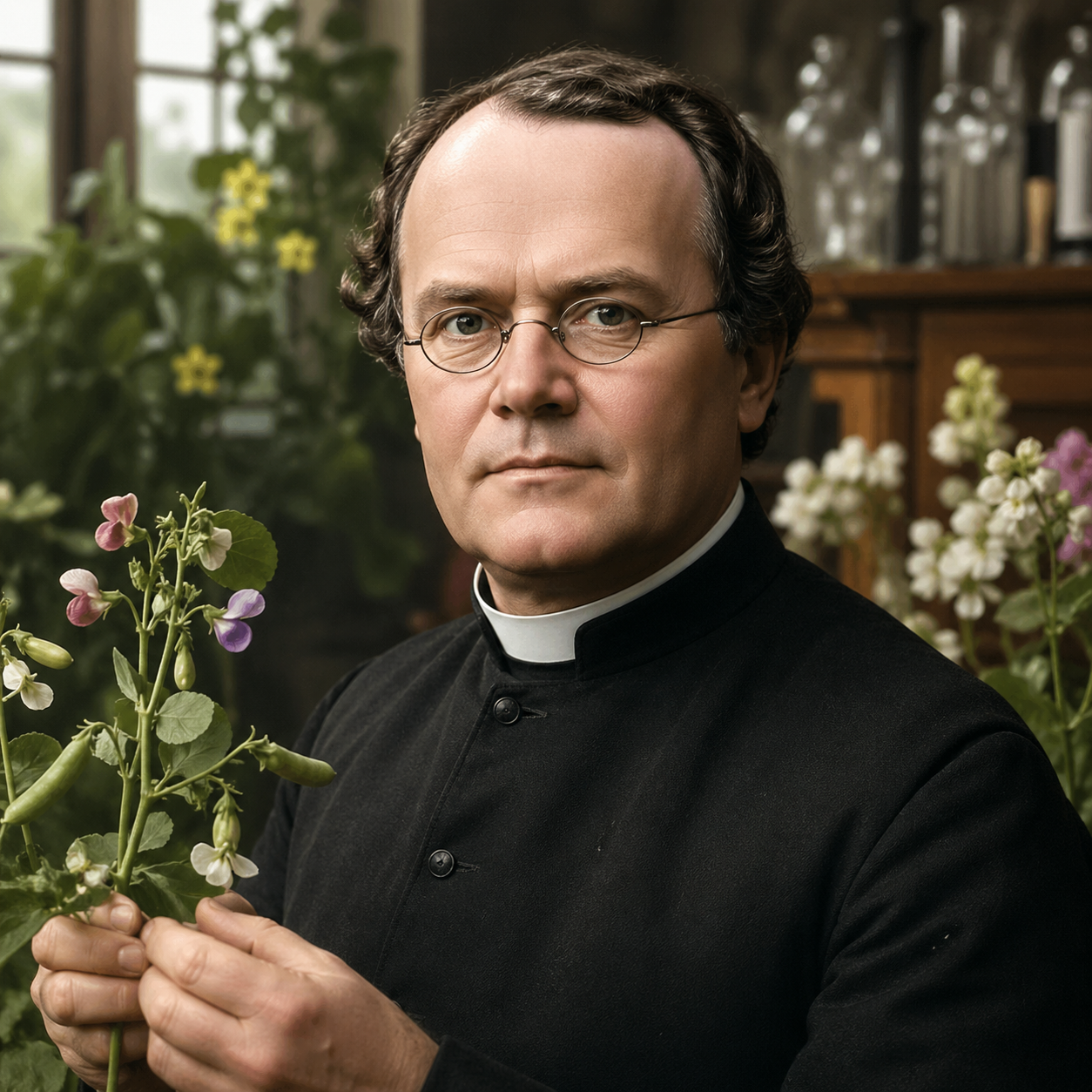
Gregor Mendel — "The characters of the two parental forms are transmitted to the hybrid in an unc…"
The characters of the two parental forms are transmitted to the hybrid in an unchanged form.
The characters of the two parental forms are transmitted to the hybrid in an unchanged form.
Click any product to generate a realistic preview. Up to 3 at a time.
* Initial load can take up to 90 seconds — revising the preview in another color is nearly instant.
"It is willingly granted that by cultivation the origination of new varieties is favored, and that by man's labor many varieties are acquired which, under natural conditions, would be lost; but nothing…"
"The experiments described were begun in 1856. The plants were grown in the garden of the monastery."
"I have been treated as a heretic in my own time, but truth will prevail."
"The experiments lead to the conclusion that the characters of the two parental forms are transmitted to the hybrid unchanged."
"The future will judge my work more fairly than the present."
Found in 1 providers: grok
1 source checked
Traits from both parents pass to offspring exactly as they are — they don't blend or get diluted. Even when a characteristic appears absent in the offspring, it survives in hidden form, capable of reappearing in later generations. Heredity operates through discrete, stable units that transmit unchanged across generations, not through a blended mixture of parental qualities gradually diluted out of existence.
Mendel spent nearly a decade cultivating over 28,000 pea plants in his Augustinian monastery garden in Brno, Austria. A trained physicist and mathematician, he applied rigorous statistical analysis to biology — radical for his era. His monastic discipline cultivated the patience and precision his work demanded. Observing seven distinct traits across pea generations, he documented exactly this: parental traits persisted intact, unblended, generation after generation.
Mendel published his findings in 1866, seven years after Darwin's On the Origin of Species upended biology. The era's prevailing blending-inheritance theory actually undermined Darwin's natural selection, since blending dilutes advantageous variations into mediocrity. Mendel's particulate inheritance directly resolved that contradiction — though no one recognized the connection until 1900. Meanwhile, industrializing Europe drove urgent agricultural interest in reliably breeding productive, consistent crop varieties.
AI-generated insights based on extensive research and information for context. Factual errors? Email [email protected].
Your cart is empty