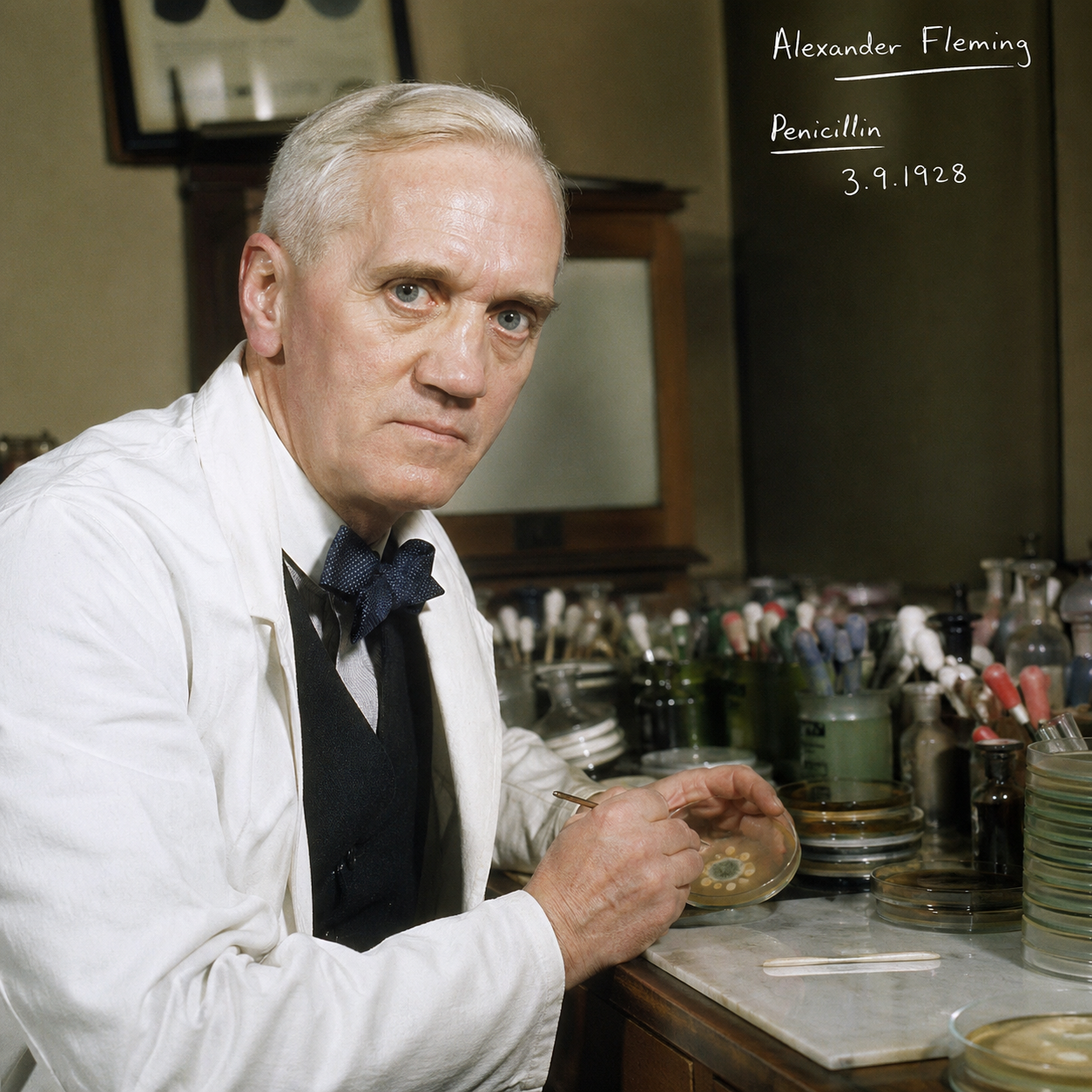
Alexander Fleming — "My own work was really quite simple. I just observed what was happening."
My own work was really quite simple. I just observed what was happening.
My own work was really quite simple. I just observed what was happening.
Click any product to generate a realistic preview. Up to 3 at a time.
* Initial load can take up to 90 seconds — revising the preview in another color is nearly instant.
"My work was not a flash of genius, but a gradual unfolding of facts."
"I did not invent penicillin. Nature did that. I only discovered it by accident."
"The greatest discovery of my life was not penicillin, but the fact that I was wrong about something."
"The bacteriologist is a detective. He must follow every clue, however small."
"The discovery of penicillin was a series of small observations, not a single eureka moment."
Found in 1 providers: grok
1 source checked
Genuine breakthroughs often require not grand effort but sharp attention. Fleming claims his method was simply watching what unfolded before him — no elaborate theory, no forced experiment. The quote valorizes observation as the core scientific skill: the willingness to notice what others dismiss as contamination or accident, and to ask why. Humility about one's own role, paired with relentless curiosity about nature, drives real discovery.
Fleming's 1928 penicillin discovery happened precisely because he noticed a contaminated petri dish rather than discarding it — a mold had killed surrounding bacteria. Earlier he discovered lysozyme after a tear accidentally fell on a culture plate. Both breakthroughs came from pausing on 'accidents' others would ignore. A quiet, methodical man at St. Mary's Hospital, Fleming trusted his eyes over prevailing theory, embodying exactly the patient, humble observation he describes.
In the 1920s–1940s, bacterial infections — pneumonia, sepsis, infected wounds — killed millions with no reliable cure. WWI demonstrated how infection claimed more soldiers than combat injuries. Scientific culture celebrated the lone heroic genius making dramatic breakthroughs. Against this backdrop, Fleming's modesty reframes discovery: not as dramatic invention but as disciplined attention. His observation led to penicillin's mass production during WWII, transforming medicine and saving an estimated 200 million lives since.
AI-generated insights based on extensive research and information for context. Factual errors? Email [email protected].
Your cart is empty