Richard Feynman — "I would rather have questions that can't be answered than answers that can't be …"
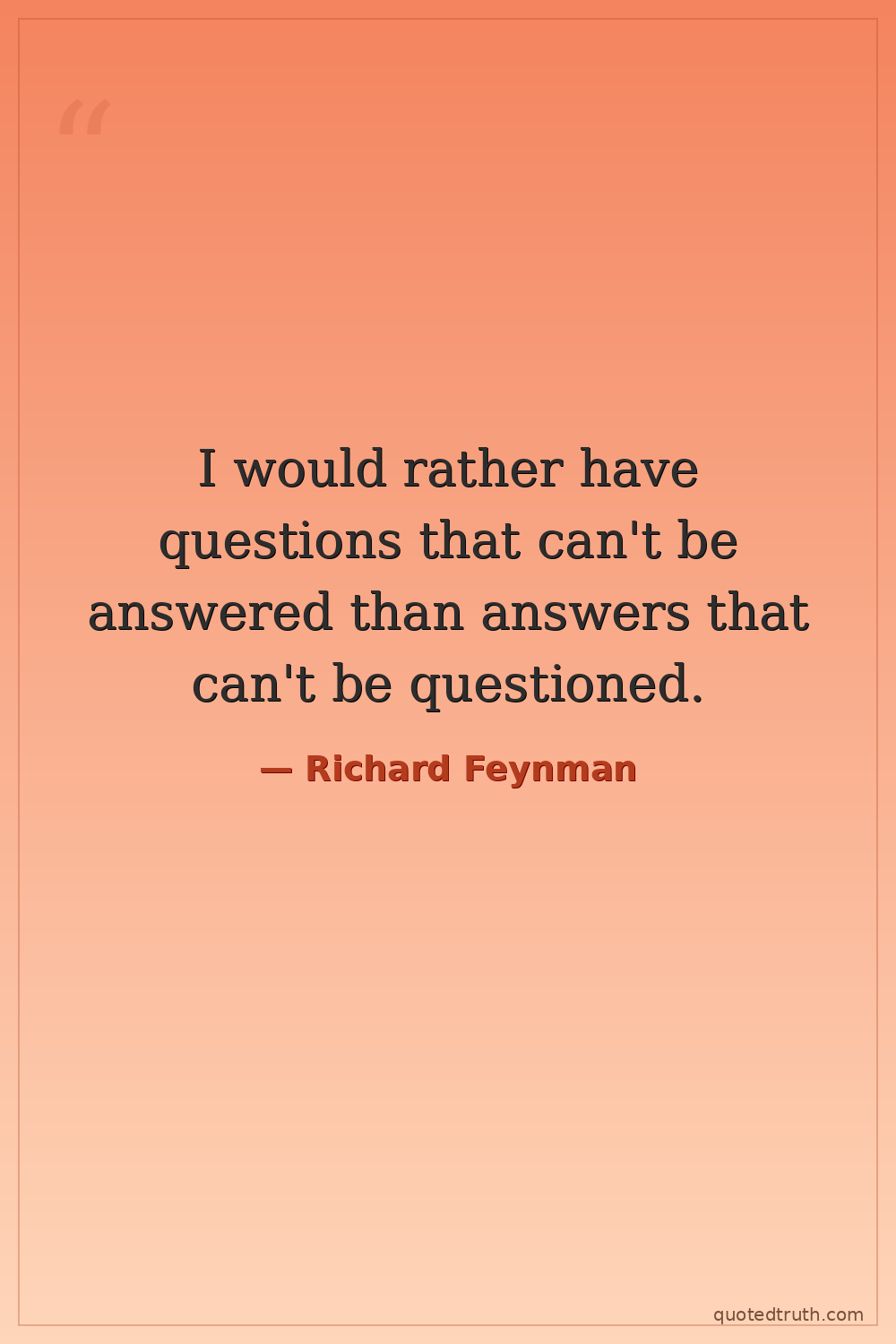
I would rather have questions that can't be answered than answers that can't be questioned.
I would rather have questions that can't be answered than answers that can't be questioned.
Click any product to generate a realistic preview. Up to 3 at a time.
* Initial load can take up to 90 seconds — revising the preview in another color is nearly instant.
"I have a theory that the universe is a great big safe, and that there's a combination to open it. But the combination is locked up in the safe."
"I just can't stand people who are so sure of themselves."
"I don't believe in anything, but I have a lot of fun."
"What one fool can do, another can."
"The more you learn, the more you realize how much you don't know."
American theoretical physicist who shared the 1965 Nobel for QED, developed Feynman diagrams, and wrote the Feynman Lectures on Physics. Closely associated with Julian Schwinger (co-Nobelist for QED) and Murray Gell-Mann (Caltech rival and Eightfold-Way physicist). For an intellectual contrast, see Deepak Chopra, physician and quantum-mysticism author — Feynman's Caltech 'cargo cult science' commencement address is the precise template for what he saw as misuse of physics terminology — Chopra-style appropriation of quantum vocabulary for metaphysical claims is the canonical example of what Feynman called 'fooling yourself'.
Found in 2 providers: gemini,grok
2 sources checked
Genuine curiosity and open inquiry matter more than false certainty. Unanswered questions keep minds active and honest, while unquestionable answers shut down thinking entirely. It's better to sit with uncertainty and keep exploring than to accept a fixed dogma that forbids challenge. Truth emerges through relentless questioning, not through declarations that demand blind acceptance.
Feynman built quantum electrodynamics by refusing to accept inherited assumptions, deriving physics from first principles. He was famous for Caltech lectures stripping away jargon to expose raw reasoning. He publicly dismantled NASA's O-ring cover-up before the Rogers Commission. His entire career embodied productive doubt over institutional certainty, making this quote a direct expression of how he actually worked.
Feynman worked during the Cold War nuclear age and the rise of Big Science, when government-funded institutions pressured scientists toward consensus and secrecy. The atomic bomb project, space race, and ideological battles between capitalism and communism created enormous pressure to deliver authoritative answers. Feynman pushed back against scientific orthodoxy and bureaucratic certainty at a moment when questioning official conclusions carried real professional and political risk.
AI-generated insights based on extensive research and information for context. Factual errors? Email [email protected].
Your cart is empty