Martin Luther — "If I could understand how a good Christian could be a usurer, I would eat him."
If I could understand how a good Christian could be a usurer, I would eat him.
If I could understand how a good Christian could be a usurer, I would eat him.
Click any product to generate a realistic preview. Up to 3 at a time.
* Initial load can take up to 90 seconds — revising the preview in another color is nearly instant.
"The will is a beast of burden. If God mounts it, it wishes and goes as God wills; if Satan mounts it, it wishes and goes as Satan wills; Nor can it choose its rider... the riders contend for its posse…"
"remember that there is nothing more poisonous, pernicious, and devilish than a rebellious man. Just as one must slay a mad dog, so, if you do not fight the rebels, they will fight you, and the whole c…"
"If any man doth ascribe of salvation, even the very least, to the free will of man, he knoweth nothing of grace, and he hath not learnt Jesus Christ aright."
"Where God builds a church, the Devil builds a chapel."
"You must say my sins are not mine; they are not in me at all; they are the sins of another; they are Christ's and none of my business."
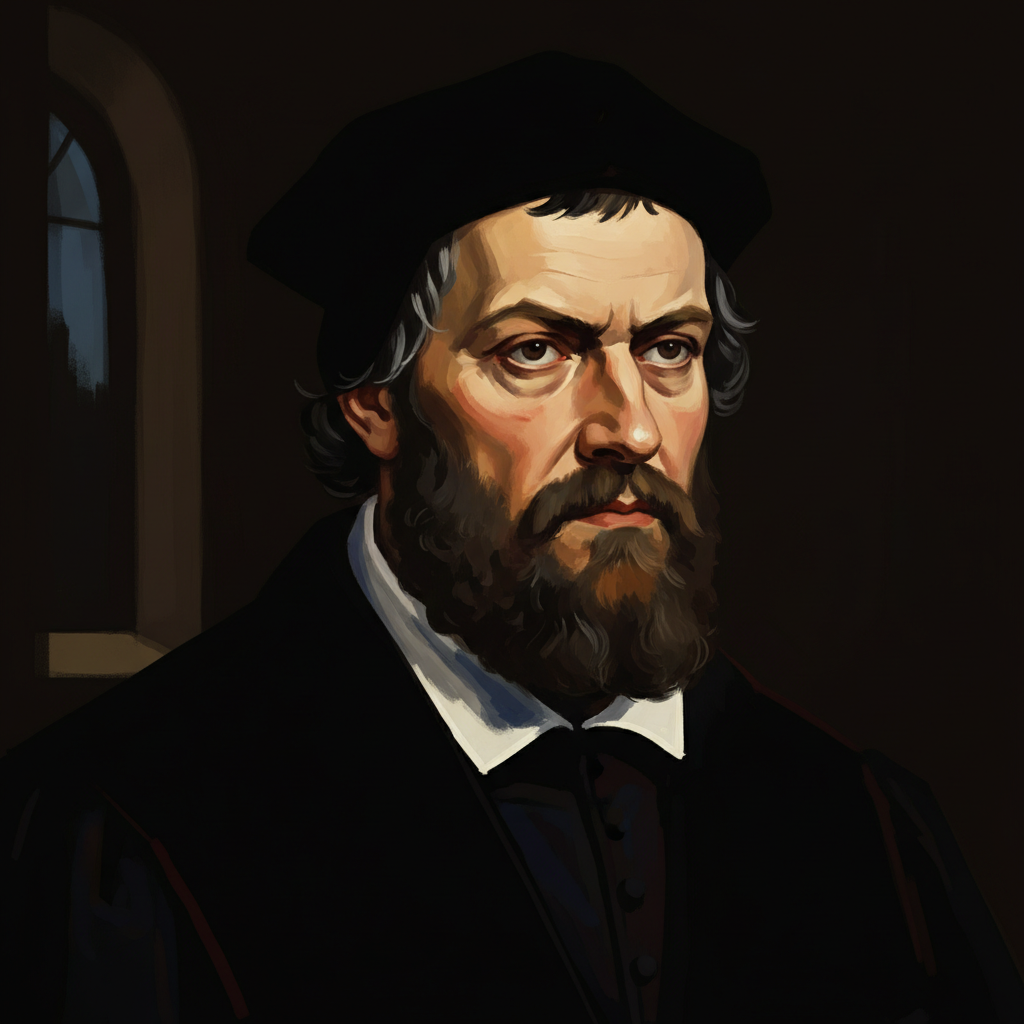
German theologian whose 95 Theses (1517) launched the Protestant Reformation and broke the Catholic Church's monopoly on Western Christianity. Closely associated with Philipp Melanchthon (Lutheran systematizer) and John Calvin (later Reformer who built on Luther's break). For an intellectual contrast, see Pope Leo X, Renaissance pope (1513-1521) — Leo X's indulgence sales triggered Luther's break and Leo excommunicated him in 1521 — Luther's entire Reformation is structured as a direct answer to the indulgence-funded Vatican Leo represented.
Found in 1 providers: grok
1 source checked
Luther is expressing complete moral incompatibility between genuine Christian faith and the practice of usury—lending money at interest. He uses hyperbolic, even grotesque language to say the two identities cannot coexist. A person who exploits others through high-interest loans cannot legitimately claim to follow Christ. The shocking cannibal image communicates absolute certainty: such a combination is so impossible that he would perform an unthinkable act if proven wrong.
Luther was a German monk, theologian, and biblical scholar who prized scriptural authority above medieval economic compromises. He repeatedly preached against usury in sermons and treatises, viewing greed as a grave sin that contradicted Christ's command to lend freely. His blunt, earthy rhetoric—often vulgar by modern standards—was a signature trait, used to shock listeners into moral clarity during his reform preaching.
In early sixteenth-century Europe, banking houses like the Fuggers were amassing enormous wealth lending to princes and the papacy itself. The Catholic Church's traditional ban on usury had eroded through loopholes, and indulgence sales—partly financed by such loans—sparked Luther's 1517 protest. Debates over money, interest, and salvation defined the Reformation's economic dimension alongside its theological one.
AI-generated insights based on extensive research and information for context. Factual errors? Email [email protected].
Your cart is empty