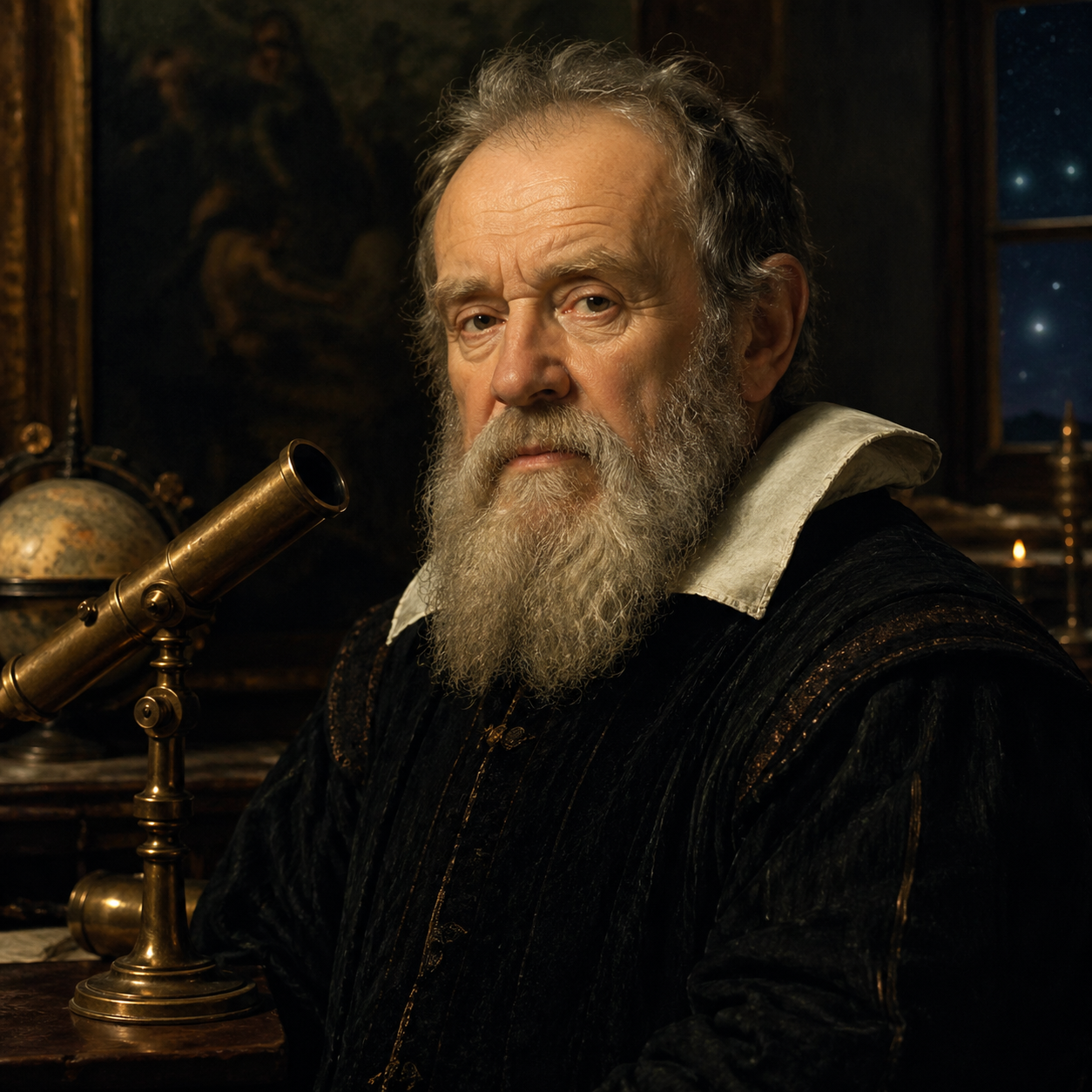
Galileo Galilei — "Ignorance is the parent of fear."
Ignorance is the parent of fear.
Ignorance is the parent of fear.
Click any product to generate a realistic preview. Up to 3 at a time.
* Initial load can take up to 90 seconds — revising the preview in another color is nearly instant.
"Eppur si muove! (And yet it moves!)"
"With the telescope, I have discovered many things that contradict the ideas of ancient philosophers."
"I hold it to be an error to believe that the truths of faith and the truths of science are contradictory."
"It is surely harmful to souls to make it a heresy to believe what has been proved."
"To apply oneself to a search for the truth, without any intent to serve some predetermined end, is the true path to discovery."
Often attributed, but a common philosophical sentiment, not uniquely Galileo's.
Date: Uncertain
WisdomFound in 1 providers: grok
1 source checked
Fear grows in the dark of not knowing. When we lack understanding of something—disease, death, the unknown cosmos—our minds fill the void with dread. Knowledge acts as a light that drives out that fear. The more clearly we understand how the world works, the less power the unknown holds over us. Understanding, not reassurance, is the true remedy for fear.
Galileo spent his career replacing superstition with observation. When he confirmed the heliocentric model through his telescope, he directly challenged the Church's authority over cosmic knowledge. In 1633, the Inquisition tried him for heresy—an institution whose power rested partly on keeping laypeople ignorant of natural truths. His willingness to publish findings despite danger embodied the belief that expanding knowledge, not deferring to authority, liberates humanity from fear.
In early modern Europe, the Church and Aristotelian tradition controlled acceptable knowledge. Astronomical events like comets were interpreted as divine omens, disease as God's punishment, and Earth's movement as heresy. Fear of the unknown—and of challenging official doctrine—kept most people silent. Galileo's era was a turning point where empirical science began displacing theological fear-based explanations, though at enormous personal cost to those who dared question established truth.
AI-generated insights based on extensive research and information for context. Factual errors? Email [email protected].
Your cart is empty