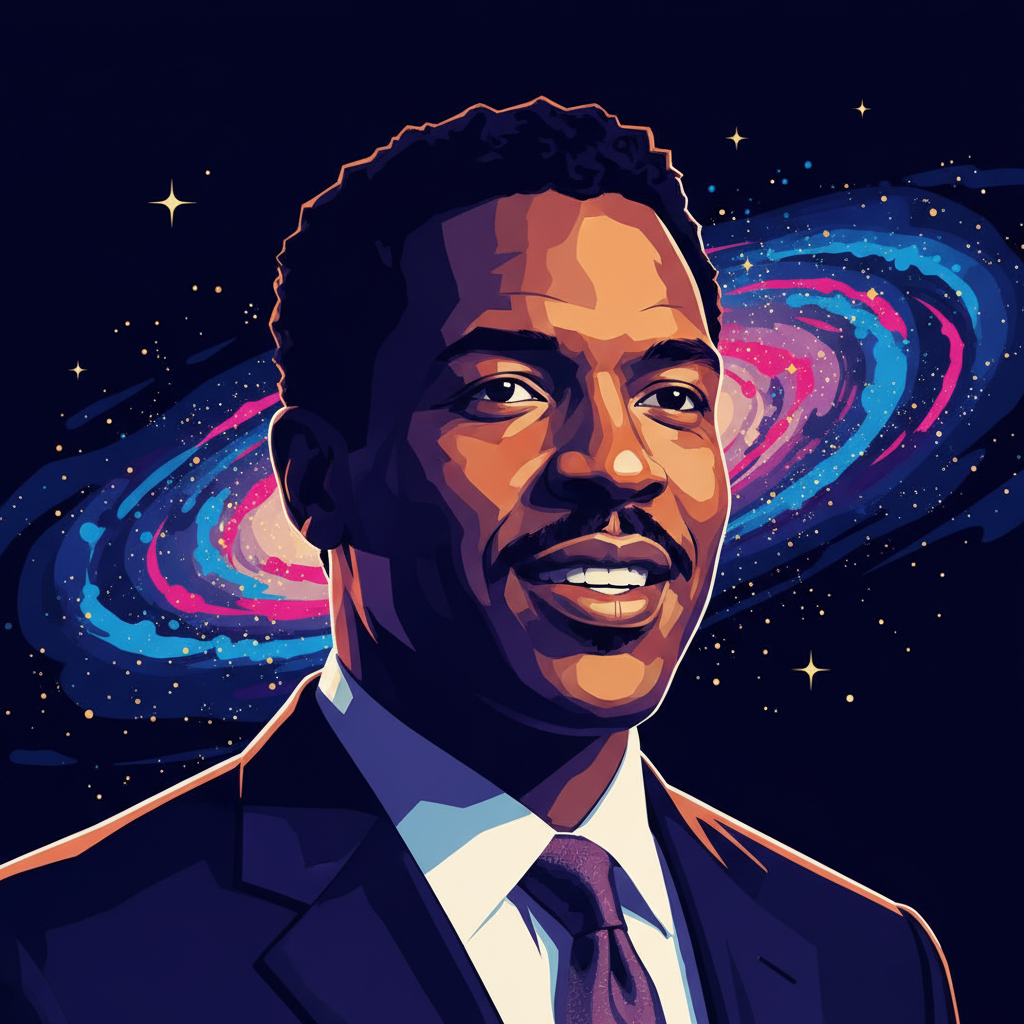
Neil deGrasse Tyson — "I'm not a vegetarian, but I do believe that we should be more mindful of where o…"
I'm not a vegetarian, but I do believe that we should be more mindful of where our food comes from, and how it's produced.
I'm not a vegetarian, but I do believe that we should be more mindful of where our food comes from, and how it's produced.
Click any product to generate a realistic preview. Up to 3 at a time.
* Initial load can take up to 90 seconds — revising the preview in another color is nearly instant.
"I'm not a fan of people who say, 'I believe in science.' Science is not a belief system. Science is a method."
"If you're religious, and you have some sort of revelation that makes you think something is true, that's not science. That's belief."
"I don't want to live in a world where people don't understand science. That's a world of darkness."
"The universe is a place of wonder. And we are all part of that wonder."
"If aliens ever visit us, I think the outcome would be much as when Columbus landed in America, which didn't turn out very well for the Native Americans."
American astrophysicist, Hayden Planetarium director, and Cosmos: A Spacetime Odyssey host who carries the Carl Sagan public-science mantle. Closely associated with Bill Nye (fellow science communicator) and Brian Greene (theoretical physicist and string-theory popularizer). For an intellectual contrast, see Ken Ham, founder of Answers in Genesis and the Creation Museum — Ham's career has been organized around defending biblical 6-day creationism — exactly the science-education position Tyson's mainstream-science communication is structured to refute.
Found in 1 providers: grok
1 source checked
We don't need to eliminate meat from our diets, but we owe it to ourselves to understand the systems that produce our food — the environmental costs, animal welfare conditions, and industrial practices behind what ends up on our plates. Awareness and intentionality matter more than rigid dietary rules.
Tyson consistently champions evidence-based thinking over ideological purity. As a science communicator who has discussed climate change, biodiversity loss, and human impact on Earth systems, this reflects his empirical approach: don't adopt a label, but follow the data about industrial agriculture's ecological footprint and make informed choices accordingly.
Contemporary food discourse is shaped by factory farming exposés, climate science linking livestock to greenhouse emissions, and movements like Meatless Monday. Documentaries like Food Inc. and rising interest in sustainability have pushed food sourcing into mainstream conversation, making mindful consumption a culturally resonant topic for science-literate audiences.
AI-generated insights based on extensive research and information for context. Factual errors? Email [email protected].
Your cart is empty