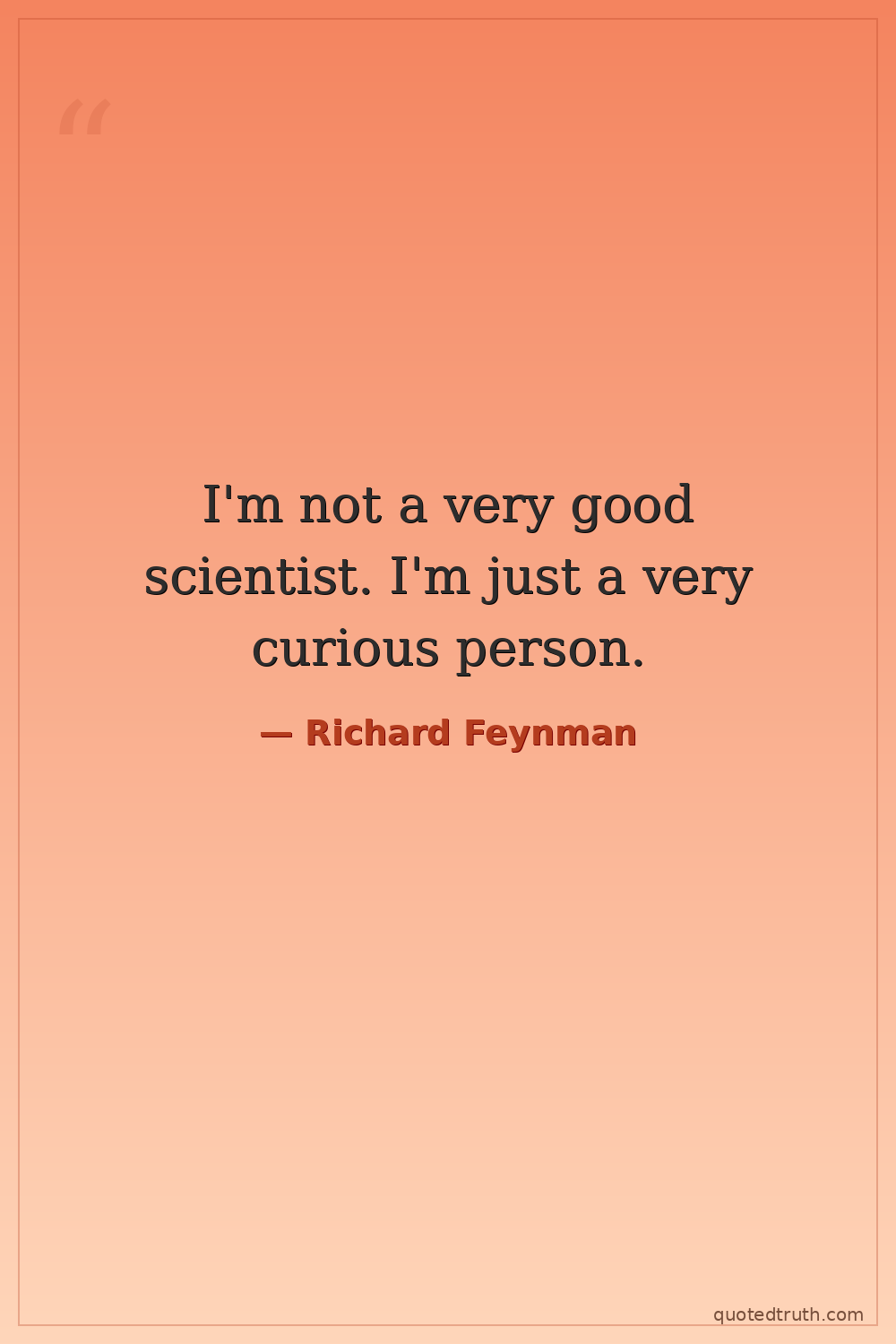
Richard Feynman — "I'm not a very good scientist. I'm just a very curious person."
I'm not a very good scientist. I'm just a very curious person.
I'm not a very good scientist. I'm just a very curious person.
Click any product to generate a realistic preview. Up to 3 at a time.
* Initial load can take up to 90 seconds — revising the preview in another color is nearly instant.
"I asked him once, 'How do you tell when a mathematical argument is correct?' He said, 'If it's beautiful, it's correct.'"
"The imagination of nature is far, far greater than the imagination of man."
"The thing that I cannot understand is what I cannot create. And I can't create a universe. So I don't understand the universe."
"I was always interested in things that are on the edge of what we know."
"There are no miracles, only wonders."
American theoretical physicist who shared the 1965 Nobel for QED, developed Feynman diagrams, and wrote the Feynman Lectures on Physics. Closely associated with Julian Schwinger (co-Nobelist for QED) and Murray Gell-Mann (Caltech rival and Eightfold-Way physicist). For an intellectual contrast, see Deepak Chopra, physician and quantum-mysticism author — Feynman's Caltech 'cargo cult science' commencement address is the precise template for what he saw as misuse of physics terminology — Chopra-style appropriation of quantum vocabulary for metaphysical claims is the canonical example of what Feynman called 'fooling yourself'.
Found in 1 providers: grok
1 source checked
True scientific ability isn't about credentials or formal genius—it's driven by relentless curiosity about how things work. This captures a humble, almost self-deprecating view: the best discoveries come not from those who think they're brilliant, but from those who can't stop asking why. Curiosity is the engine; skill is secondary to the hunger to understand.
Feynman won the 1965 Nobel Prize in Physics for quantum electrodynamics yet consistently rejected the 'genius' label. He was famous for picking locks at Los Alamos, learning to draw and play bongo drums, and explaining physics through vivid analogies. His Feynman Lectures emerged from genuine desire to make complexity accessible, not to display mastery.
Post-WWII physics culture idolized towering theoretical intellects—Einstein, Bohr, Oppenheimer. The Manhattan Project created a mythology of the scientist as calculating genius. Feynman's career spanned Cold War science funding booms and Challenger investigation, periods when institutional prestige dominated. His playful curiosity-first stance deliberately pushed back against that reverence-and-hierarchy culture.
AI-generated insights based on extensive research and information for context. Factual errors? Email [email protected].
Your cart is empty