Alexander Fleming — "It is a remarkable fact that this substance, which is so potent against bacteria…"
It is a remarkable fact that this substance, which is so potent against bacteria, is almost harmless to animal tissues.
It is a remarkable fact that this substance, which is so potent against bacteria, is almost harmless to animal tissues.
Click any product to generate a realistic preview. Up to 3 at a time.
* Initial load can take up to 90 seconds — revising the preview in another color is nearly instant.
"It is not often that one finds a substance that is both highly bactericidal and non-toxic to animal tissues."
"It is the common lot of discoverers to be misunderstood."
"My only merit is that I did not discard the cultures at an early stage."
"It is a happy accident that the mold grew on my plate, but it was not an accident that I recognized it."
"I hope that my work will inspire others to pursue scientific discovery."
Found in 1 providers: grok
1 source checked
A substance that kills bacteria but leaves animal cells unharmed seems almost paradoxical — living things share so much biochemistry. Fleming is marveling at penicillin's selective action: it destroys bacterial cell walls without touching equivalent structures in human tissue. This selectivity is what separates a medicine from a poison. He recognized that nature had produced something with a precision that human chemistry had not yet achieved on its own.
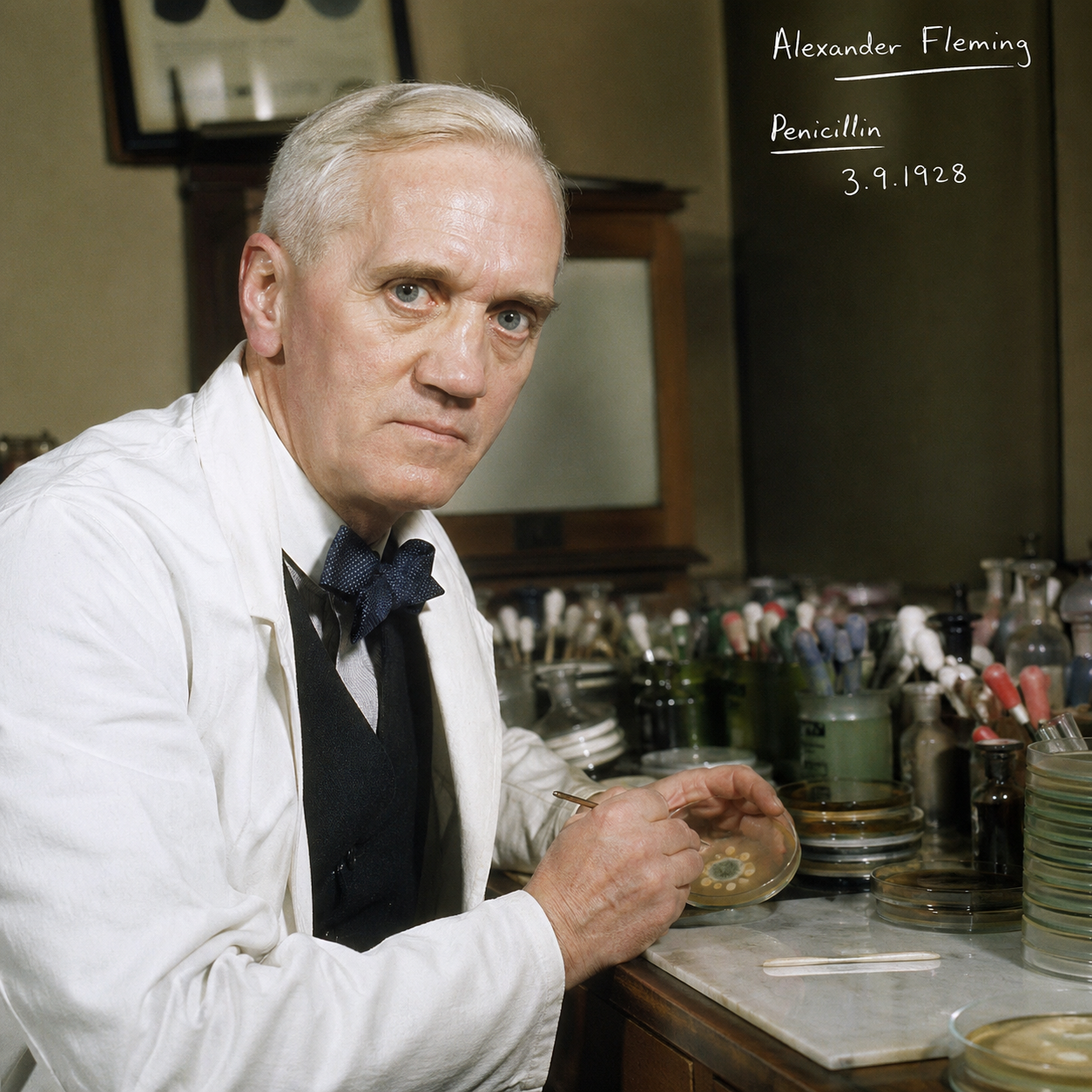
Fleming discovered penicillin in 1928 when a Penicillium mold contaminated a bacterial plate and created a bacteria-free zone around itself. His earlier discovery of lysozyme — a natural antimicrobial in tears and saliva — had primed him to seek substances that fought infection without harming the host. This quote, from his 1929 paper, captures the core insight making penicillin medically viable: not merely that it killed bacteria, but that it spared the patient.
In 1929, bacterial infections killed millions annually. Pneumonia, blood poisoning, and infected wounds were leading causes of death. Antiseptics like carbolic acid killed bacteria but also destroyed tissue. Paul Ehrlich's 'magic bullet' concept — a compound targeting pathogens without harming the host — remained largely theoretical. Fleming's observation that penicillin achieved exactly this selectivity pointed toward a new class of medicine that would, once mass-produced in the 1940s, save tens of millions of lives.
AI-generated insights based on extensive research and information for context. Factual errors? Email [email protected].
Your cart is empty