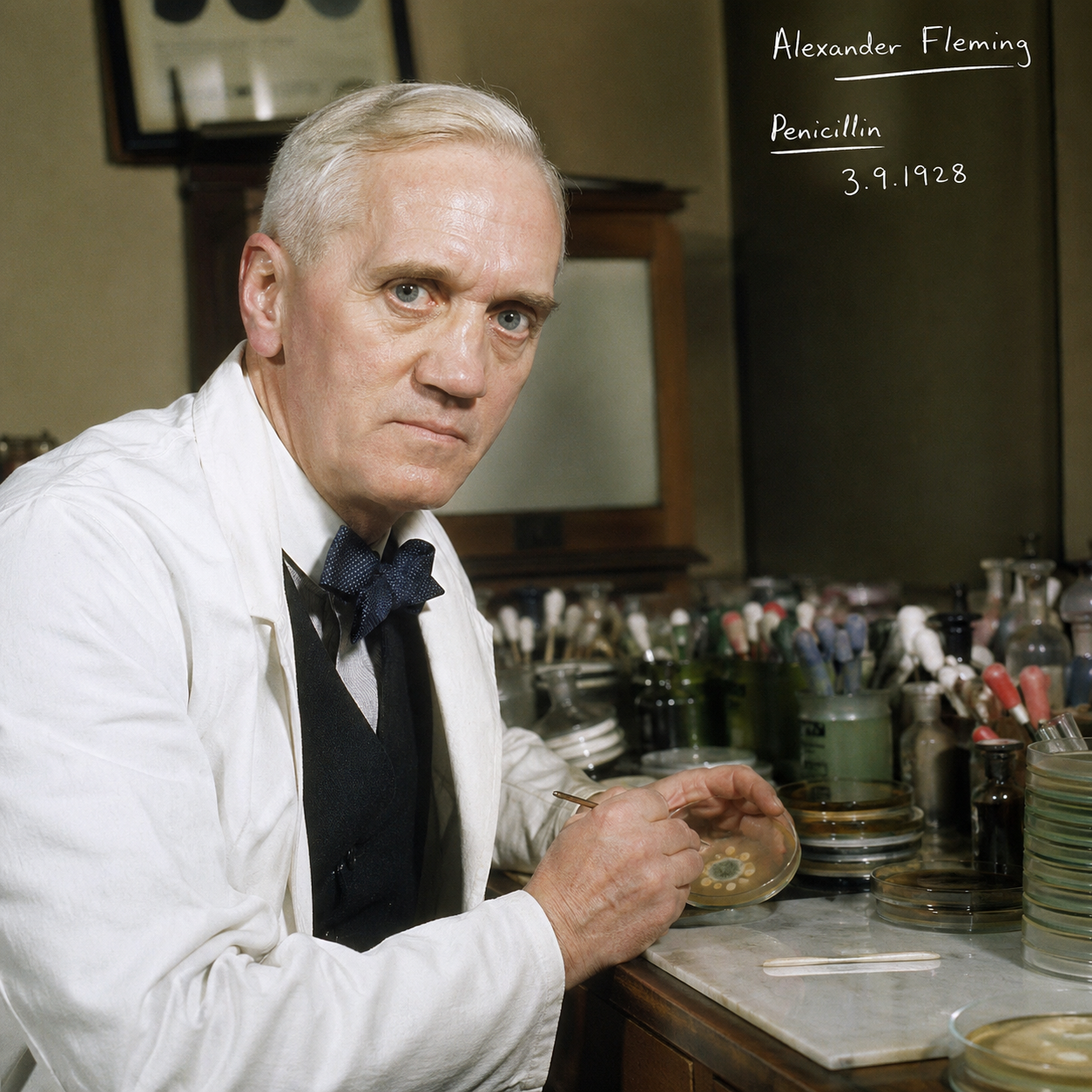
Alexander Fleming — "I did not invent penicillin. Nature did that. I only discovered it by accident."
I did not invent penicillin. Nature did that. I only discovered it by accident.
I did not invent penicillin. Nature did that. I only discovered it by accident.
Click any product to generate a realistic preview. Up to 3 at a time.
* Initial load can take up to 90 seconds — revising the preview in another color is nearly instant.
"It is a wonderful thing to be able to save lives with a simple substance."
"It is not enough to discover a thing; one must also know how to use it."
"The story of penicillin has been told so often that it is almost a cliché."
"The public will probably never understand the difficulties that beset the path of the original investigator."
"A good many people think that I deserve some credit for the discovery of penicillin. They are wrong. It was discovered by nature."
Found in 2 providers: grok,deepseek
2 sources checked
True discovery often comes from observing what already exists, not from deliberate creation. Credit belongs to natural processes, not the observer who stumbles upon them. Genuine scientific humility means acknowledging that researchers are interpreters of nature's work, not its authors. Accidents and open eyes matter more than planned experiments in pushing knowledge forward.
Fleming famously discovered penicillin in 1928 when mold contaminated a petri dish and killed surrounding bacteria. Rather than discarding the ruined culture, he investigated. His entire career embodied opportunistic observation over rigid protocol. This quote reflects his well-documented modesty; he repeatedly deflected personal glory, crediting chance and nature rather than claiming genius.
Fleming worked in the early-to-mid 20th century, when germ theory was established but antibiotics were nonexistent. Bacterial infections from wounds killed millions in WWI. The interwar scientific culture glorified deliberate rational method, making Fleming's embrace of accidental discovery quietly radical. Penicillin's mass production during WWII saved hundreds of thousands, giving this humble admission enormous historical weight.
AI-generated insights based on extensive research and information for context. Factual errors? Email [email protected].
Your cart is empty