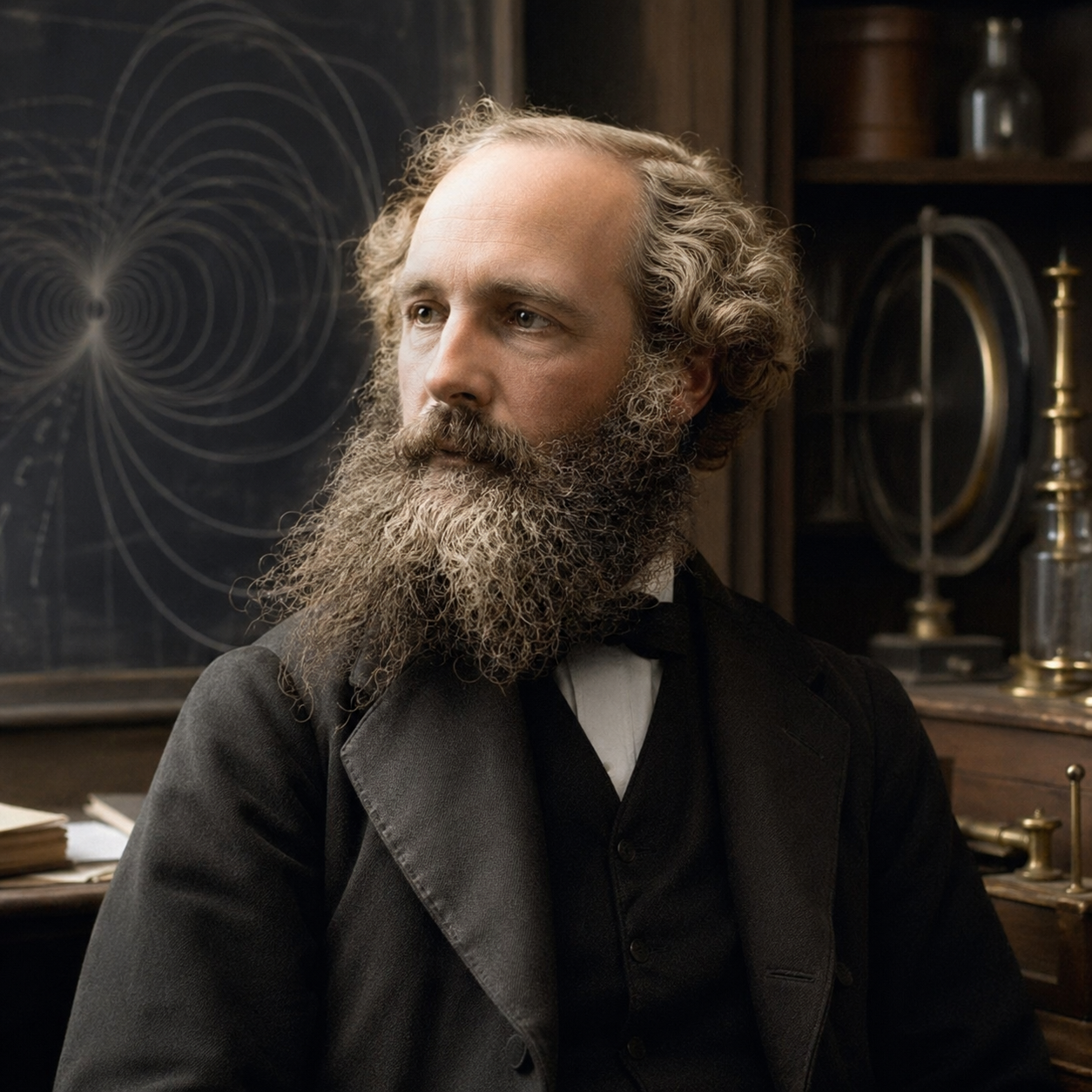
James Clerk Maxwell — "It is an unscientific habit to give names to things before we know what they are…"
It is an unscientific habit to give names to things before we know what they are.
It is an unscientific habit to give names to things before we know what they are.
Click any product to generate a realistic preview. Up to 3 at a time.
* Initial load can take up to 90 seconds — revising the preview in another color is nearly instant.
"The peculiar function of the scientific man is to make discoveries, not to talk about them."
"I have looked into most philosophical systems and I have seen that none will work without God."
"The only difference between a madman and me is that I am not mad."
"The human mind is seldom satisfied, and is certainly never exercising its highest functions, when it is doing the work of a calculating machine."
"The opinion seems to have got abroad, that in a few years all the great physical constants will have been approximately estimated, and that the only occupation which will then be left to men of scienc…"
Found in 1 providers: grok
1 source checked
Labeling something prematurely locks in assumptions before you actually understand it. Once a name sticks, people treat it as settled and stop investigating, confusing a tidy word for real knowledge. Maxwell is warning that naming should follow careful observation and measurement, not precede it. Terminology shapes thought, so sloppy definitions breed sloppy science. First figure out what a phenomenon actually is and does, then choose language that fits the evidence.
Maxwell built his career on replacing vague concepts with rigorous mathematical definitions. He recast Faraday's intuitive 'lines of force' into precise field equations, and in thermodynamics he insisted that terms like heat, entropy, and temperature carry exact physical meaning. As a Cambridge professor and founding director of the Cavendish Laboratory, he trained students to measure first and label second. The quote captures his lifelong demand that physics speak in definitions tight enough to calculate with.
Maxwell worked in mid-Victorian Britain (1850s-1870s), when physics was shedding speculative natural philosophy for quantitative experiment. The era swarmed with half-defined terms: ether, caloric, animal magnetism, vital force. Spiritualism and pseudoscience rode alongside real discovery, and public lectures blurred the line. Meanwhile electromagnetism, thermodynamics, and kinetic theory were being born, each demanding new vocabulary. Maxwell spoke into that noise, insisting the young professional science discipline itself before glamorous names outran the evidence behind them.
AI-generated insights based on extensive research and information for context. Factual errors? Email [email protected].
Your cart is empty