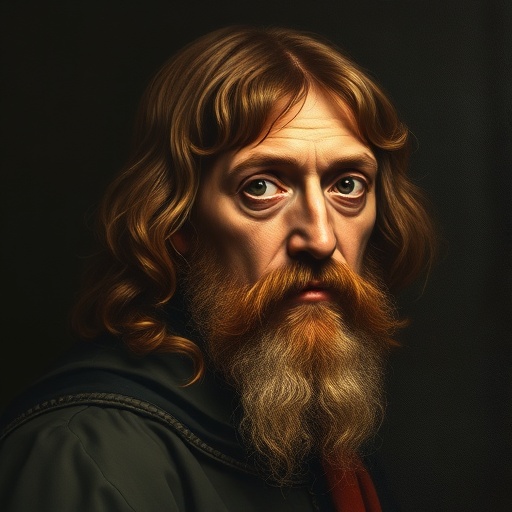
Nicolaus Copernicus — "It is clear that the earth also moves in a similar manner, and describes an annu…"
It is clear that the earth also moves in a similar manner, and describes an annual course.
It is clear that the earth also moves in a similar manner, and describes an annual course.
Click any product to generate a realistic preview. Up to 3 at a time.
* Initial load can take up to 90 seconds — revising the preview in another color is nearly instant.
"To know that we know what we know, and to know that we do not know what we do not know, that is true knowledge."
"Therefore, we should not be surprised if the earth moves, for it is a planet, and all planets move."
"Indeed, I am aware that a philosopher's thoughts are far removed from the judgment of the multitude, for his aim is to seek the truth in all things, to the extent permitted to human reason by God."
"I am not ignorant that there are some who, having heard that in my treatises on the ordering of the spheres of the universe, I attribute certain motions to the terrestrial globe, will immediately shou…"
"Nations are not ruined by one act of violence, but gradually and in an almost imperceptible manner by the depreciation of their circulating currency, through its excessive quantity."
Found in 1 providers: grok
1 source checked
The quote asserts that Earth is not fixed at the center of the universe but moves through space just like the planets. Specifically, it traces an annual orbit — completing one full loop around the Sun each year. This directly overturns the ancient assumption that Earth stands still while celestial bodies revolve around it, reframing our planet as one moving body among many.
Copernicus spent roughly 30 years developing his heliocentric model before publishing De revolutionibus orbium coelestium in 1543, the year he died. As a Catholic canon in Poland, he risked his reputation by contradicting Church-sanctioned Ptolemaic cosmology. This quote encapsulates his central proof: Earth behaves identically to other planets, orbiting the Sun annually, which required both intellectual courage and rigorous mathematical precision to assert.
In the early 16th century, Ptolemy's geocentric model — Earth stationary at the universe's center — had governed astronomy for 1,400 years, reinforced by Church doctrine and Aristotelian philosophy. The Renaissance was challenging ancient authorities, and the printing press accelerated intellectual exchange. Copernicus's claim that Earth moved annually around the Sun shattered this foundation, igniting the Scientific Revolution that would transform the following two centuries.
AI-generated insights based on extensive research and information for context. Factual errors? Email [email protected].
Your cart is empty