Nicolaus Copernicus — "To know that we know what we know, and to know that we do not know what we do no…"
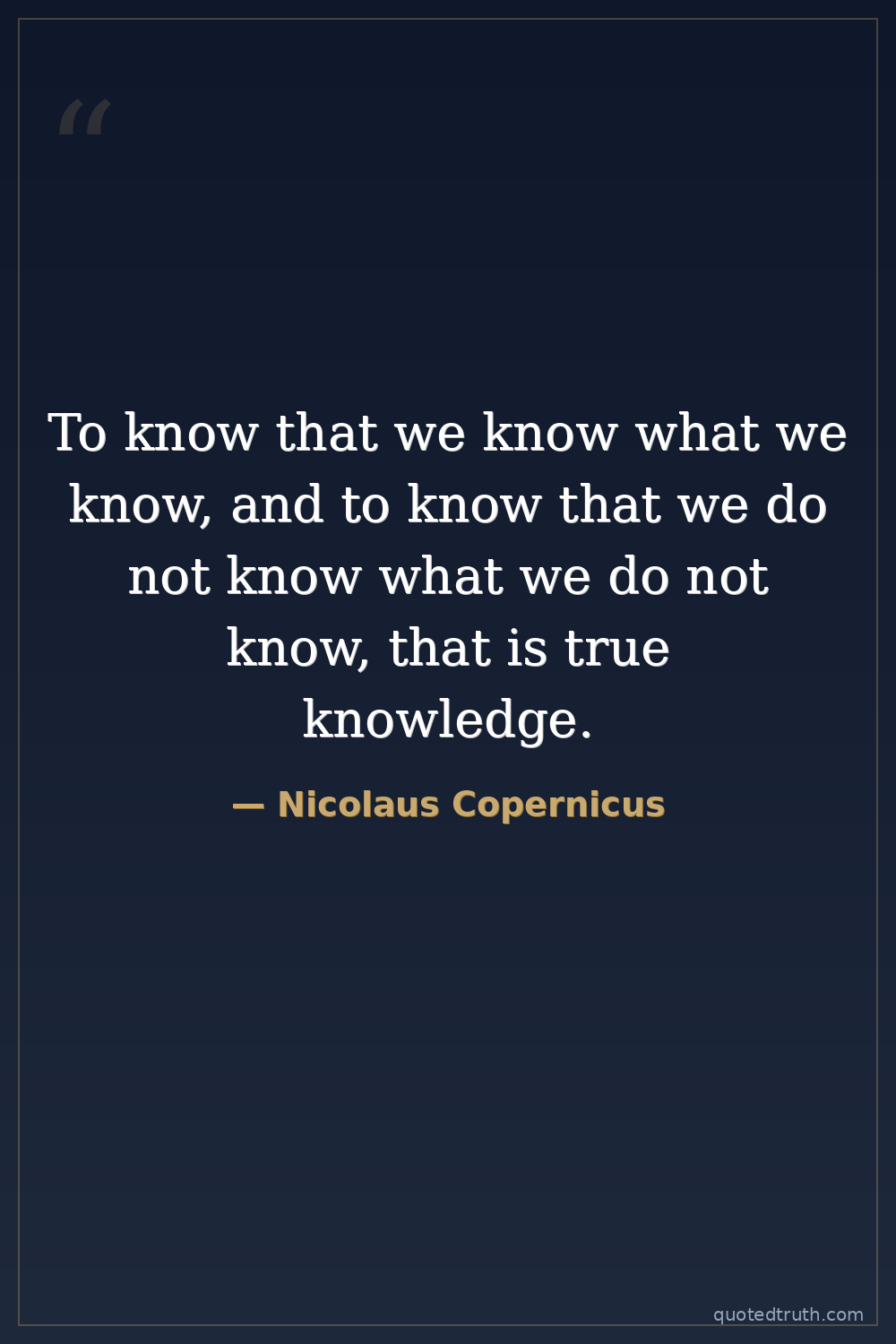
To know that we know what we know, and to know that we do not know what we do not know, that is true knowledge.
To know that we know what we know, and to know that we do not know what we do not know, that is true knowledge.
Click any product to generate a realistic preview. Up to 3 at a time.
* Initial load can take up to 90 seconds — revising the preview in another color is nearly instant.
"The universe is a harmonious system, and all its parts are in perfect accord."
"Therefore, we should not be surprised if the earth moves, for it is a planet, and all planets move."
"To attribute the motion of the earth to the sun is as absurd as to attribute the motion of the sun to the earth."
"The world is spherical; whether it is finite or infinite is an open question."
"For the universe, wrought for us by the best and most orderly Workman of all, is a wonderful work."
Found in 3 providers: gemini,grok,deepseek
3 sources checked
True wisdom requires intellectual honesty about the limits of your own understanding. Recognizing the boundaries of your knowledge — confidently owning what you genuinely understand while honestly admitting what remains unknown — is itself a sophisticated form of intelligence, not weakness. Most people confuse familiarity with real comprehension, but genuine knowledge demands clear-eyed self-assessment about both certainty and ignorance.
Copernicus spent decades carefully distinguishing what mathematics and observation could actually prove about celestial motion versus inherited Ptolemaic assumptions. His heliocentric model required the courage to say existing astronomical knowledge was wrong while also admitting his own model had unresolved problems. He held his manuscript for years, embodying this principle — publishing only when confident he knew what he knew.
The Renaissance and early Reformation period was dismantling medieval scholastic authority, where Church doctrine defined the boundaries of acceptable knowledge. Challenging Aristotelian cosmology meant confronting institutional certainty with empirical humility. Copernicus worked during an era when admitting uncertainty was intellectually dangerous, yet the Scientific Revolution demanded precisely this epistemic honesty to replace dogma with systematic, evidence-based inquiry.
AI-generated insights based on extensive research and information for context. Factual errors? Email [email protected].
Your cart is empty