Alexander Fleming — "It is not an exaggeration to say that the discovery of penicillin has saved mill…"
It is not an exaggeration to say that the discovery of penicillin has saved millions of lives.
It is not an exaggeration to say that the discovery of penicillin has saved millions of lives.
Click any product to generate a realistic preview. Up to 3 at a time.
* Initial load can take up to 90 seconds — revising the preview in another color is nearly instant.
"It is the lone worker who makes the first advance in a subject; the details may be worked out by a team, but the prime idea is due to enterprise, thought, and perception of an individual."
"It is remarkable how easily the public can be misled by sensational statements."
"Penicillin cures, but wine makes people happy."
"I was just a dirty old man who left his dishes unwashed."
"The world is full of interesting things. You just have to look for them."
Found in 1 providers: grok
1 source checked
This claim is entirely accurate rather than inflated praise: a single scientific discovery fundamentally changed medicine's ability to treat bacterial infections that previously killed routinely. Before penicillin, pneumonia, sepsis, infected wounds, and sexually transmitted diseases were often death sentences. The antibiotic revolution that followed made previously fatal conditions reliably survivable, transforming both wartime medicine and everyday healthcare for billions of people.
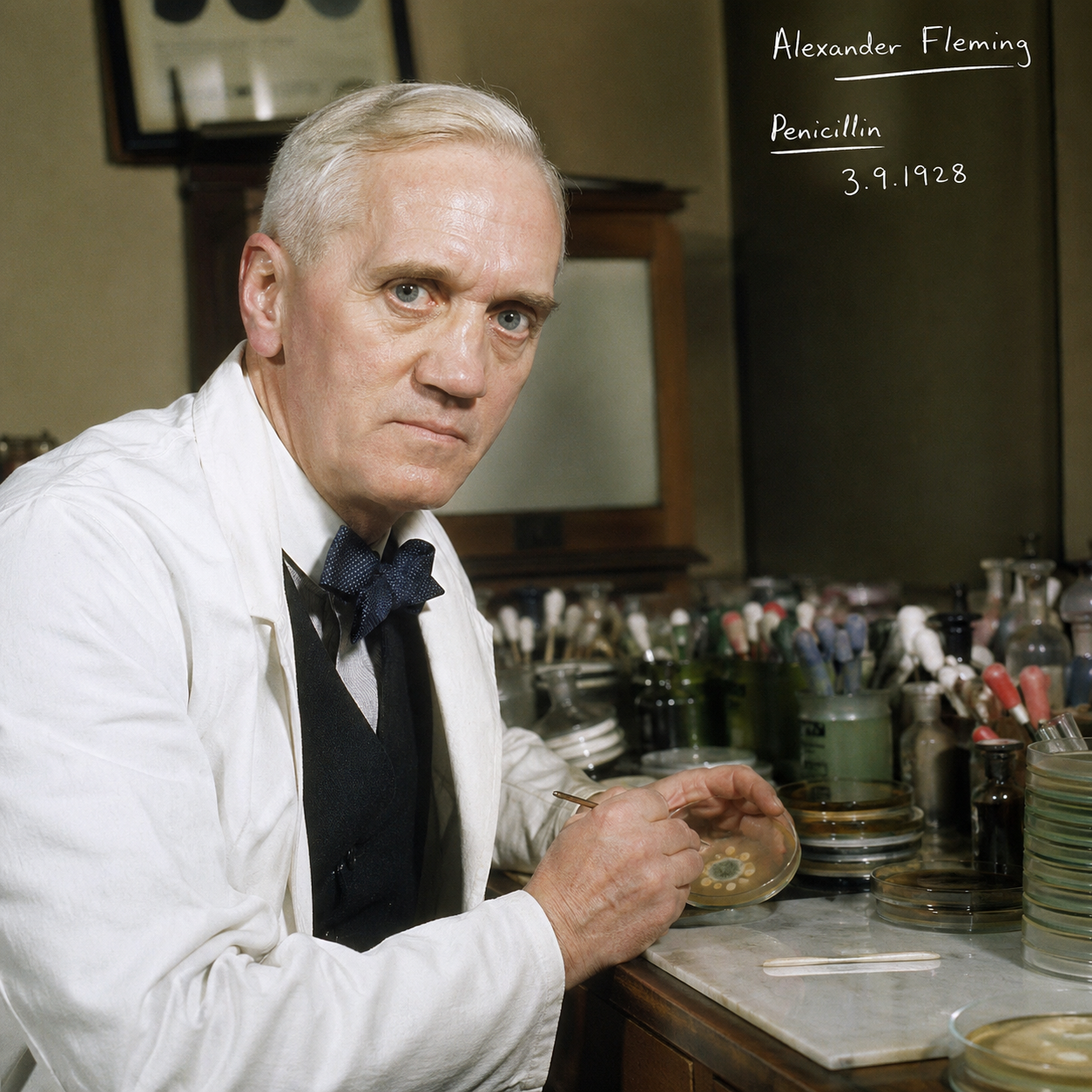
Fleming discovered penicillin in 1928 almost by accident, observing mold contaminating a petri dish killing surrounding bacteria. He was a meticulous Scottish bacteriologist shaped by witnessing soldiers die from infected wounds in World War I. His lifelong focus on antiseptics and bacterial killers meant he recognized penicillin's significance immediately, though it took Florey and Chain to develop it clinically. He received the 1945 Nobel Prize in Medicine.
Fleming worked through an era when bacterial infections were civilization's greatest killer. Pre-antibiotic medicine had no reliable treatment for sepsis, pneumonia, or wound infections. World War II created urgent demand for infection control as battle casualties died from contamination rather than injuries. Penicillin's mass production from 1943 onward dramatically reduced military and civilian death rates, marking the pivotal transition into the modern antibiotic era.
AI-generated insights based on extensive research and information for context. Factual errors? Email [email protected].
Your cart is empty