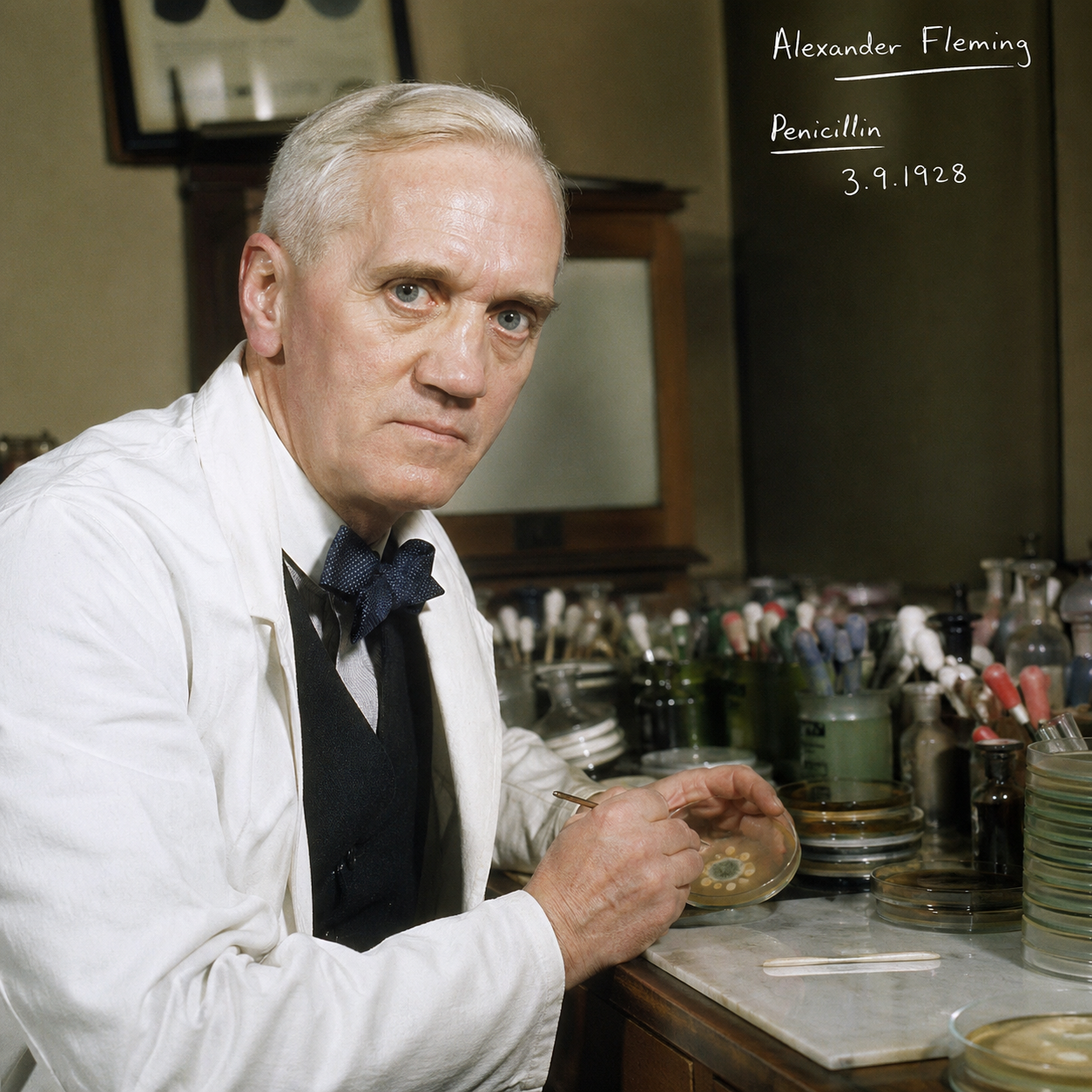
Alexander Fleming — "The medical profession has a great responsibility in seeing that penicillin is u…"
The medical profession has a great responsibility in seeing that penicillin is used wisely.
The medical profession has a great responsibility in seeing that penicillin is used wisely.
Click any product to generate a realistic preview. Up to 3 at a time.
* Initial load can take up to 90 seconds — revising the preview in another color is nearly instant.
"Penicillin cures, but wine makes people happy."
"I found penicillin and have given it free for the benefit of humanity. Why should it become a profit-making monopoly of manufacturers in another country?"
"Penicillin sat on my bench for ten years while I was called a quack."
"I did not invent penicillin. Nature did that. I only discovered it by accident."
"I never thought of myself as a great man, just a man who made a great discovery."
Found in 1 providers: grok
1 source checked
Doctors and healthcare providers carry a serious ethical duty to prescribe and use penicillin with careful judgment rather than freely or carelessly. A powerful medical tool can cause harm if overused or misapplied. The responsibility for outcomes does not rest with the drug's discoverer alone but with every practitioner who wields it—demanding disciplined, evidence-based decision-making over convenience or commercial pressure.
Fleming discovered penicillin by accident in 1928, then spent decades watching it transform medicine. In his 1945 Nobel Prize acceptance speech he explicitly warned that under-dosing would breed resistant bacteria. As the drug's originator he felt personal accountability for its fate, and spent his later career advocating disciplined prescribing. This quote reflects his recurring anxiety that the miracle he stumbled upon could be squandered or weaponized by careless clinical habits.
Fleming made this warning in the mid-1940s as penicillin shifted from scarce wartime medicine to mass civilian production. Pharmaceutical companies were scaling output rapidly, and doctors prescribed it for nearly every infection in a climate of near-euphoric optimism about antibiotics ending infectious disease. Fleming's caution was distinctly against the grain—a prescient concern about resistance that the broader medical establishment would not take seriously for another generation.
AI-generated insights based on extensive research and information for context. Factual errors? Email [email protected].
Your cart is empty