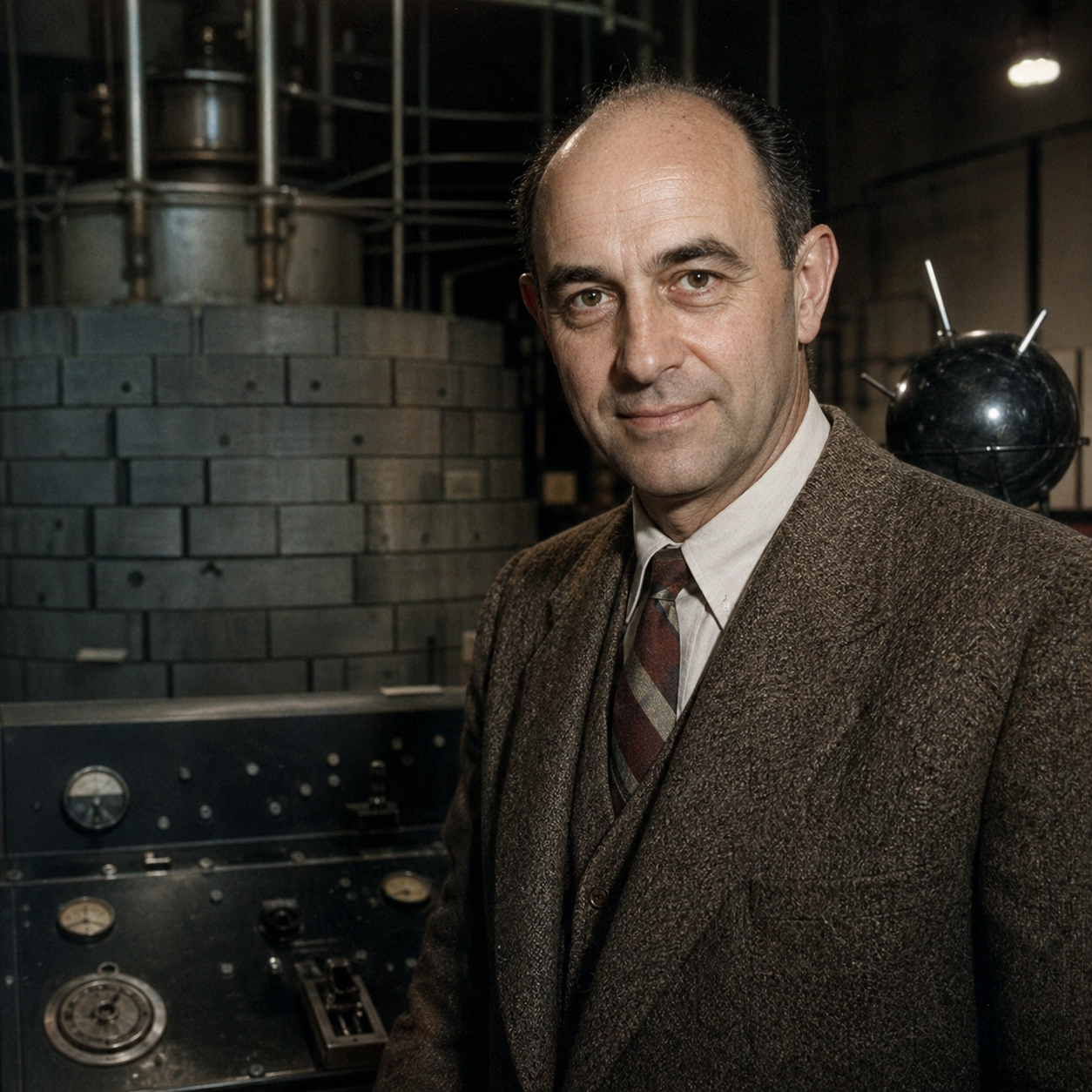
Enrico Fermi — "It is not good to be the only intelligent man in the world."
It is not good to be the only intelligent man in the world.
It is not good to be the only intelligent man in the world.
Click any product to generate a realistic preview. Up to 3 at a time.
* Initial load can take up to 90 seconds — revising the preview in another color is nearly instant.
"The mind is not a vessel to be filled, but a fire to be kindled."
"The only way to do great work is to love what you do."
"I have never been interested in making money. I have always been interested in doing physics."
"I consider myself a lucky man who did not have to choose between going to war and doing something else. I just did what I was doing."
"We are like children who have found a new toy. We do not know what to do with it, but we are playing with it."
Found in 1 providers: grok
1 source checked
Isolation from intellectual peers is a disadvantage, not a mark of superiority. When no one around you can challenge your ideas, spot your errors, or build on your thinking, progress stalls. Intelligence is most powerful in dialogue — through disagreement, collaboration, and mutual verification. Being the smartest person in the room means losing the friction and partnership that sharpen ideas and prevent catastrophic mistakes.
Fermi thrived in intensely collaborative environments — the University of Chicago, Los Alamos — surrounded by peers like Oppenheimer, Bohr, and Teller who could match his thinking. He invented the Fermi estimate as a social intellectual tool, reasoning aloud with colleagues. His famous Fermi Paradox question — why we detect no other intelligent life — reveals a genuine longing for intellectual peers beyond humanity itself.
Fermi worked during the 1930s–1950s, when physics underwent revolutionary transformation. The Manhattan Project concentrated the world's top scientific minds in a single collaborative effort. Post-war, the Cold War created urgent competition between American and Soviet scientific communities, proving that no single genius could advance civilization alone — breakthroughs required teams, institutions, and the relentless pressure of intellectual equals.
AI-generated insights based on extensive research and information for context. Factual errors? Email [email protected].
Your cart is empty