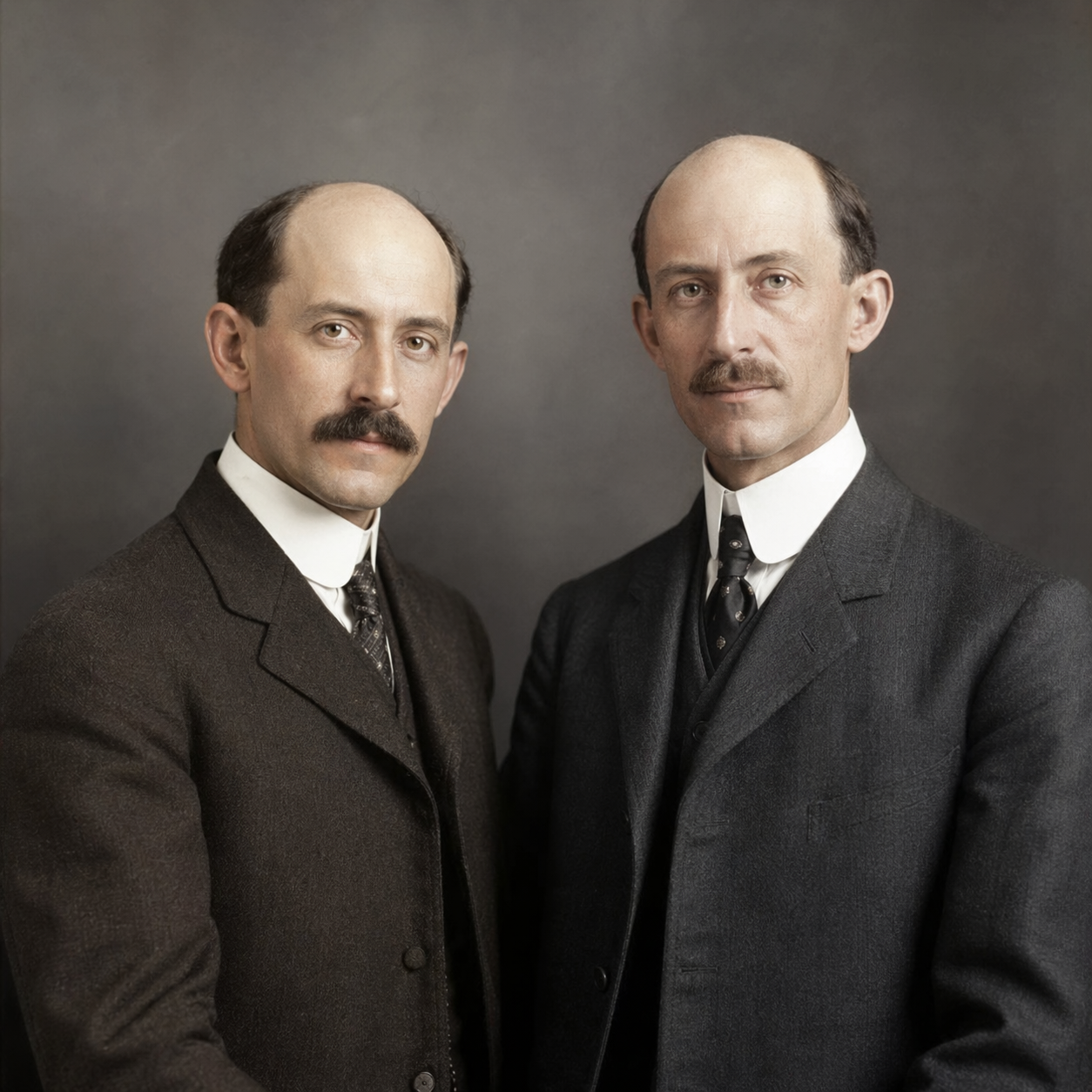
Wright Brothers (Orville & Wilbur) — "It is not in the nature of man to be content with things as they are."
It is not in the nature of man to be content with things as they are.
It is not in the nature of man to be content with things as they are.
Click any product to generate a realistic preview. Up to 3 at a time.
* Initial load can take up to 90 seconds — revising the preview in another color is nearly instant.
"The only difference between us and others is that we have made a more thorough study of the problem."
"The machine has been working very nicely and we have been making several flights each day."
"The only way to learn to fly is to fly."
"The best dividends on the labor invested have invariably come from seeking more knowledge rather than more power."
"The greatest value of our work is that it will be an inspiration to others."
American aviation pioneers who achieved the first sustained powered controlled airplane flight at Kitty Hawk, NC, on December 17, 1903. Closely associated with Octave Chanute (their gliding mentor and aeronautical correspondent). For an intellectual contrast, see Samuel Pierpont Langley, Smithsonian Institution Secretary and government-funded aviation researcher — Langley's Aerodrome crashed twice into the Potomac in October-December 1903 with $50,000 of War Department funding; the Wright Brothers' bicycle-shop empiricism beat Langley's institutional Big Science by 9 days. The most-cited example in engineering history of empirical-tinkerer beating institution-funded credentialism.
Found in 1 providers: grok
1 source checked
Humans are wired to push past the present and seek improvement. We naturally feel restless about limitations, accepted norms, or 'good enough' solutions. That dissatisfaction is not a flaw but a driver: it pulls people toward invention, exploration, and reform. Whether the discontent shows up as curiosity, ambition, or frustration, it keeps us reaching for what does not yet exist instead of settling for the world we inherited.
The Wrights embodied this restlessness. Two bicycle mechanics from Dayton refused to accept that human flight was impossible, even after credentialed scientists like Samuel Langley failed publicly. They built their own wind tunnel, recalculated lift tables they found wrong, and iterated through gliders at Kitty Hawk before achieving powered flight in 1903. Neither held a college degree, yet their dissatisfaction with existing aeronautical data and transportation limits drove them to solve a problem humanity had chased for centuries.
Their era straddled the late 1800s and early 1900s, a moment when steam, electricity, the telephone, and the automobile were rewriting daily life. Industrial-age optimism convinced ordinary tinkerers they could crack problems once reserved for academies. Yet powered flight was widely mocked as fantasy after high-profile failures. The Wrights worked in this tension between a culture that celebrated invention and an establishment that insisted some frontiers, especially the air, would stay closed.
AI-generated insights based on extensive research and information for context. Factual errors? Email [email protected].
Your cart is empty