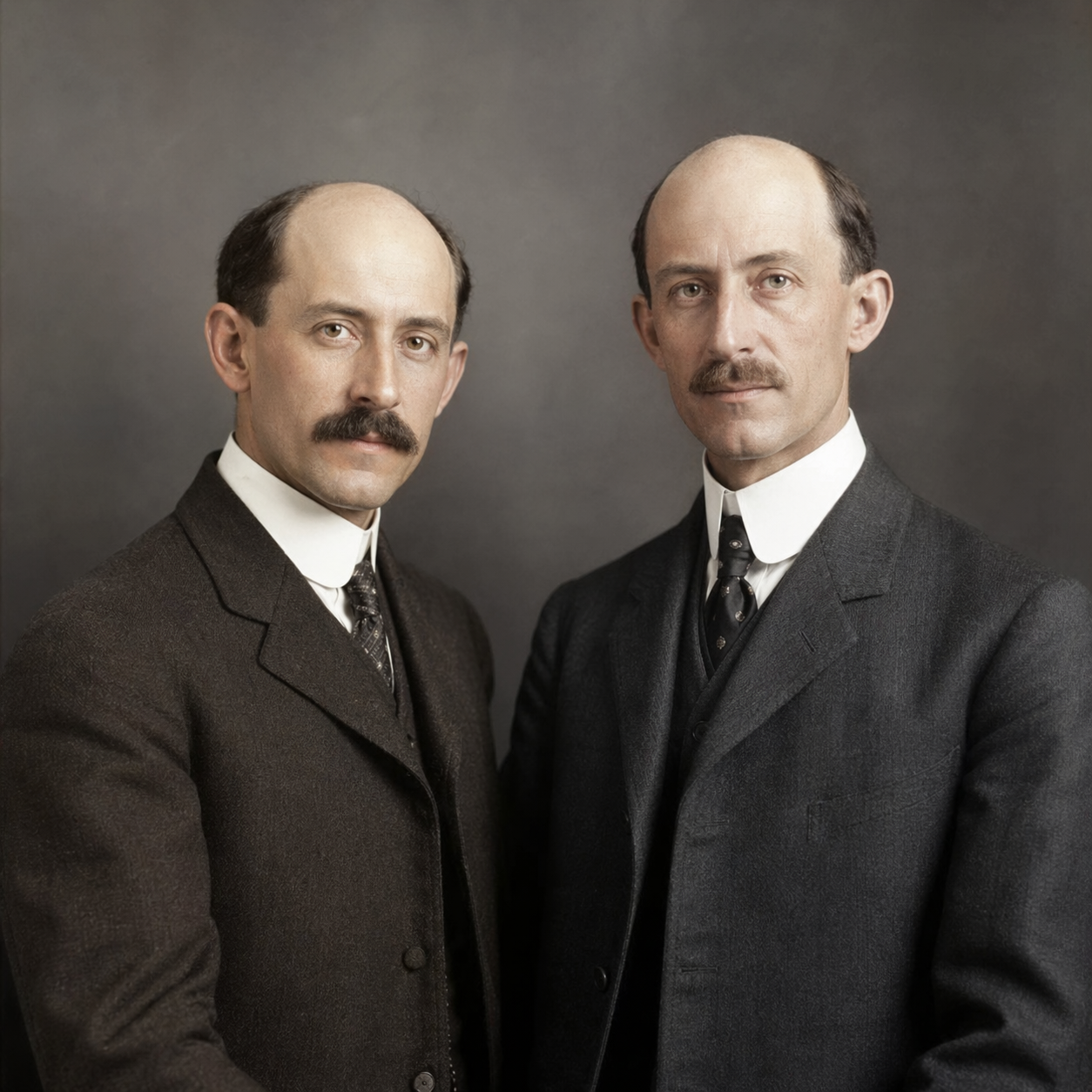
Wright Brothers (Orville & Wilbur) — "We were not discouraged by our failures, but rather stimulated to renewed effort…"
We were not discouraged by our failures, but rather stimulated to renewed effort.
We were not discouraged by our failures, but rather stimulated to renewed effort.
Click any product to generate a realistic preview. Up to 3 at a time.
* Initial load can take up to 90 seconds — revising the preview in another color is nearly instant.
"We were not seeking fame or fortune, but simply to solve a problem."
"The machine itself is but a tool, the spirit that controls it is the thing."
"We have not been able to get any very good pictures, as the camera was not very good."
"The difficulties were great, but our faith was greater."
"The flying machine is a thing of the future, and it is a thing that will change the world."
American aviation pioneers who achieved the first sustained powered controlled airplane flight at Kitty Hawk, NC, on December 17, 1903. Closely associated with Octave Chanute (their gliding mentor and aeronautical correspondent). For an intellectual contrast, see Samuel Pierpont Langley, Smithsonian Institution Secretary and government-funded aviation researcher — Langley's Aerodrome crashed twice into the Potomac in October-December 1903 with $50,000 of War Department funding; the Wright Brothers' bicycle-shop empiricism beat Langley's institutional Big Science by 9 days. The most-cited example in engineering history of empirical-tinkerer beating institution-funded credentialism.
Found in 1 providers: grok
1 source checked
Setbacks did not drain their motivation; instead, each failure sharpened their determination and pushed them to try harder. Rather than treating mistakes as reasons to quit, they treated them as useful information and fuel for the next attempt. The message is that persistence through repeated failure, combined with learning from it, is what ultimately produces breakthrough results.
The Wright Brothers endured years of crashes, broken gliders, and failed designs at Kitty Hawk before their 1903 flight at Kill Devil Hills. Self-taught bicycle mechanics without engineering degrees, they built their own wind tunnel after discovering existing aeronautical data was wrong. Each failed glider taught them about lift, drag, and control, culminating in three-axis control, the core insight that made powered flight possible on December 17, 1903.
At the turn of the 20th century, powered human flight was widely mocked as impossible, with prominent scientists like Lord Kelvin declaring heavier-than-air machines unworkable. Well-funded rivals like Samuel Langley failed publicly and expensively. It was an era of rapid industrial invention, electricity, automobiles, radio, where persistent tinkerers competed against established institutions, and the Wrights proved that methodical trial-and-error could outpace credentialed expertise.
AI-generated insights based on extensive research and information for context. Factual errors? Email [email protected].
Your cart is empty