Galileo Galilei — "It is not in the power of any created being to make things true or false, but on…"
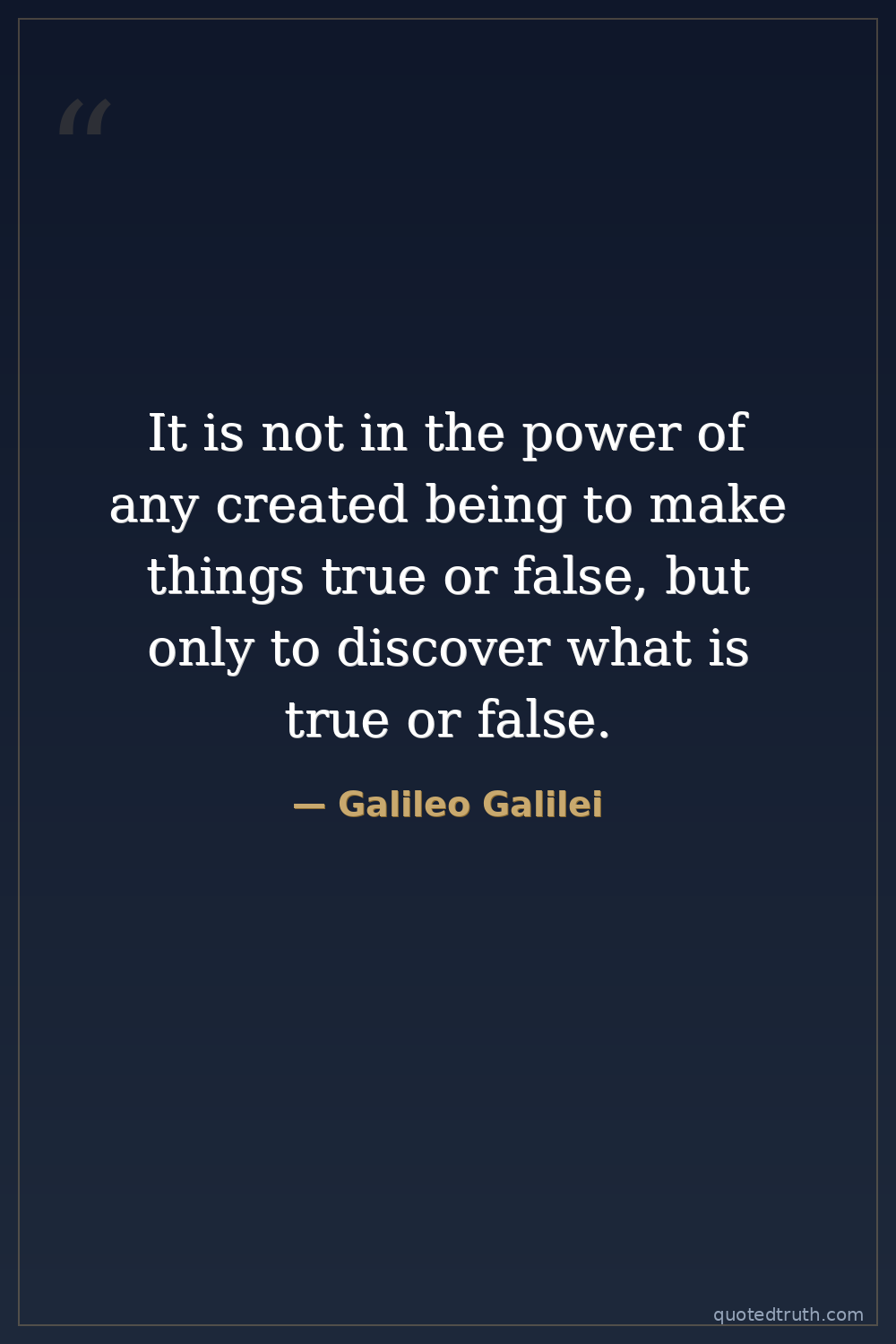
It is not in the power of any created being to make things true or false, but only to discover what is true or false.
It is not in the power of any created being to make things true or false, but only to discover what is true or false.
Click any product to generate a realistic preview. Up to 3 at a time.
* Initial load can take up to 90 seconds — revising the preview in another color is nearly instant.
"Facts which at first seem improbable will, even on scant explanation, drop the cloak which has hidden them and stand forth in naked and simple beauty."
"Philosophy is written in this grand book, the universe, which stands continually open to our gaze. But the book cannot be understood unless one first learns to comprehend the language and interpret th…"
"Measure what is measurable, and make measurable what is not so."
"Where the senses fail us, reason must step in."
"I hold it to be an error to believe that the truths of faith and the truths of science are contradictory."
Found in 1 providers: grok
1 source checked
Truth exists independently of human will or desire. No person, institution, or authority can decree what is factually real—they can only uncover what reality already is. Discovery, not declaration, is the only legitimate path to knowledge. Truth is not negotiable, not a matter of consensus or power, but an objective condition waiting to be found through honest inquiry and observation.
Galileo's entire career embodied this conviction. When the Church insisted Earth was central to the cosmos, he didn't argue about authority—he pointed his telescope at Jupiter's moons and recorded what was there. His trial by the Inquisition proved his point: even forced recantation couldn't make heliocentrism false. He understood that nature answers only to itself, not to ecclesiastical decree or Aristotelian tradition.
In early modern Europe, religious institutions held authority over cosmological truth. The Catholic Church's geocentric worldview was doctrine, not hypothesis. Galileo lived through the Scientific Revolution's birth—Copernicus, Kepler, and he himself were dismantling ancient certainties. The Inquisition actively prosecuted heretical natural philosophy. His statement was radical: it placed empirical reality above institutional authority at a time when that distinction could mean imprisonment or death.
AI-generated insights based on extensive research and information for context. Factual errors? Email [email protected].
Your cart is empty