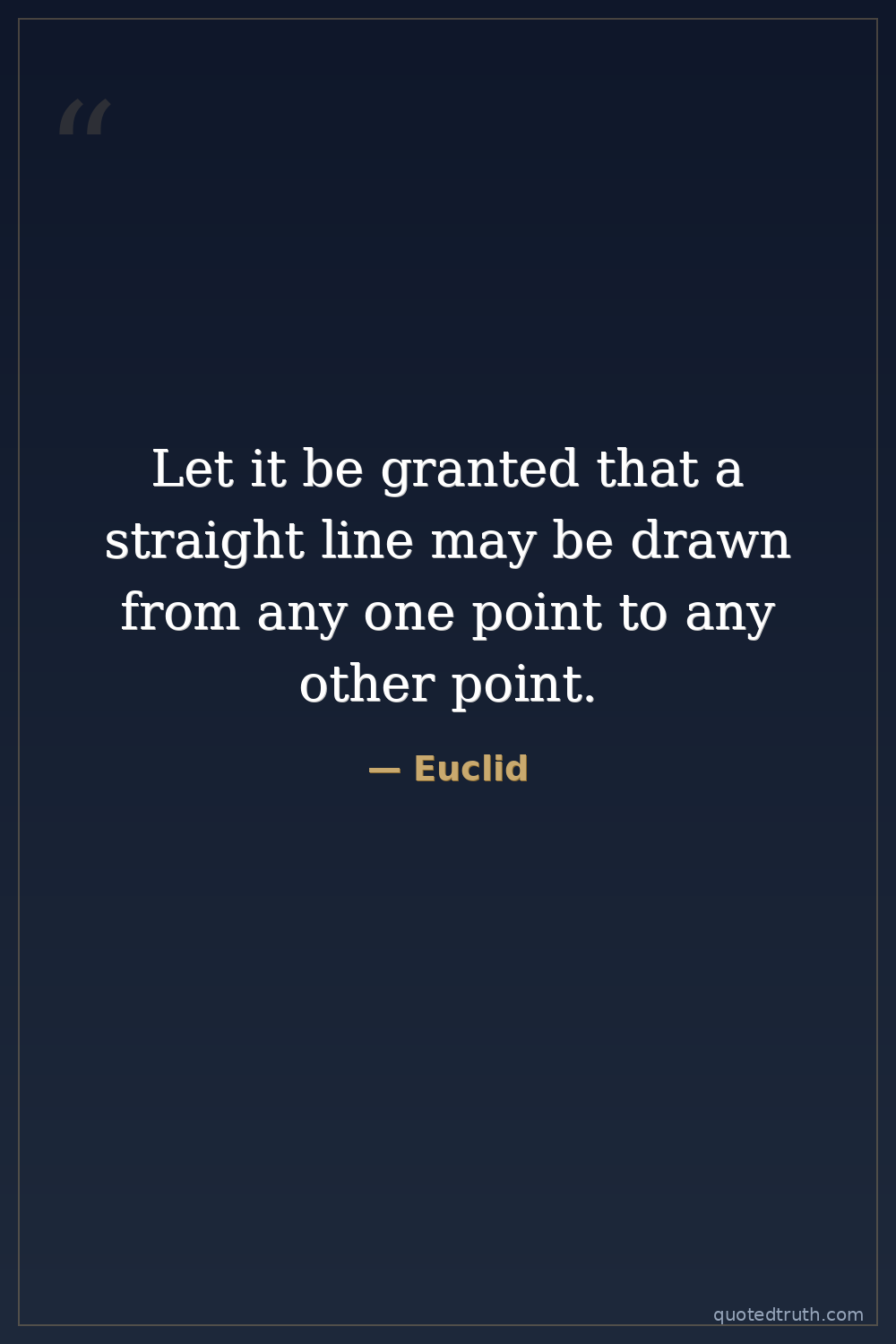
Euclid — "Let it be granted that a straight line may be drawn from any one point to any ot…"
Let it be granted that a straight line may be drawn from any one point to any other point.
Let it be granted that a straight line may be drawn from any one point to any other point.
Click any product to generate a realistic preview. Up to 3 at a time.
* Initial load can take up to 90 seconds — revising the preview in another color is nearly instant.
"To construct an equilateral triangle on a given finite straight line."
"If a straight line be drawn from the ends of a straight line, it will be a triangle."
"The prime numbers are more than any assigned multitude of prime numbers."
"There are infinitely many prime numbers."
"Of trilateral figures, an equilateral triangle is that which has its three sides equal, an isosceles triangle that which has two of its sides alone equal, and a scalene triangle that which has its thr…"
Found in 2 providers: grok,gemini
2 sources checked
Two points always define a straight line between them — accept this as given. Euclid isn't proving this; he's declaring it a foundational rule, a postulate. Modern geometry, engineering, and physics still operate on this assumption. It means space is uniform: no matter where two points exist, a direct path connects them. This simple grant launches the entire logical edifice of geometry from one unquestionable starting rule.
Euclid's entire achievement in Elements rests on five postulates — minimal assumptions he asked readers to grant without proof. This first postulate reflects his axiomatic philosophy: build irrefutable logical chains from the fewest possible starting truths. As a teacher at Alexandria's Mouseion, he believed mathematics required rigorous foundations, not intuition. His character was methodical and precise — this postulate captures that perfectly, asking one obvious concession before constructing 465 theorems atop it.
Around 300 BCE in Alexandria, Egypt, Greek thinkers were systematizing all knowledge under Ptolemy I's patronage. Plato's influence had established that truth comes through reason, not observation alone. Before Euclid, geometric facts were scattered and assumed informally. His era demanded formal demonstration — but demonstration requires starting somewhere. This postulate answered that challenge: declare obvious first principles, then derive everything else through pure logic, a revolutionary move in an age building civilization on reason.
AI-generated insights based on extensive research and information for context. Factual errors? Email [email protected].
Your cart is empty