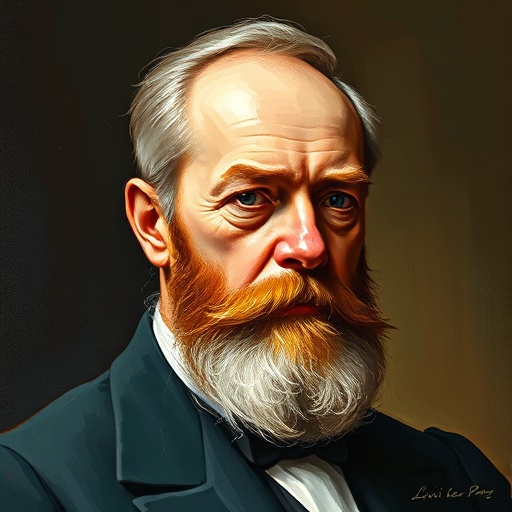
Louis Pasteur — "Let me tell you the secret that has led me to my goal: my strength lies solely i…"
Let me tell you the secret that has led me to my goal: my strength lies solely in my tenacity.
Let me tell you the secret that has led me to my goal: my strength lies solely in my tenacity.
Click any product to generate a realistic preview. Up to 3 at a time.
* Initial load can take up to 90 seconds — revising the preview in another color is nearly instant.
"The cultivation of the soil is the noblest occupation of man."
"The more I learn, the more I realize how much I don't know."
"There are no such things as applied sciences, only applications of science."
"The Greeks understood the mysterious power of the hidden side of things. They bequeathed to us one of the most beautiful words in our language—the word 'enthusiasm'—en theos—a god within."
"Science knows no country, because knowledge belongs to humanity, and is the torch which illuminates the world."
Found in 2 providers: grok,deepseek
2 sources checked
Pasteur credits his achievements not to genius or luck but to sheer persistence. He is saying that the single trait responsible for reaching his goals is refusing to quit. Talent matters less than the willingness to keep working through setbacks, failed experiments, and criticism. The secret, in modern terms, is grit: showing up repeatedly, grinding through obstacles, and continuing long after others would have stopped or given up entirely.
Pasteur spent decades battling entrenched scientific opinion to prove germ theory, pasteurization, and vaccination. He endured a stroke at 46 yet kept working, personally testing the rabies vaccine on Joseph Meister in 1885. Ridiculed early on for challenging spontaneous generation, he repeated experiments exhaustively until results were undeniable. His swan-neck flask work and anthrax trials required relentless iteration. Tenacity, not flashes of insight, defined a career that reshaped medicine, microbiology, and public health across the 19th century.
Pasteur worked in 19th-century France during a scientific revolution where established authorities still defended spontaneous generation and miasma theory. Surgery killed patients through unseen infection, rabies meant certain death, and children died routinely of preventable disease. The Franco-Prussian War, industrialization of brewing and silk, and public health crises created urgent demand for microbiological answers. Rigorous experimentation was replacing speculation, and Pasteur's refusal to yield embodied a new scientific era built on repeatable proof rather than inherited dogma.
AI-generated insights based on extensive research and information for context. Factual errors? Email [email protected].
Your cart is empty