Alan Turing — "Machines take me by surprise with great frequency."
Machines take me by surprise with great frequency.
Machines take me by surprise with great frequency.
Click any product to generate a realistic preview. Up to 3 at a time.
* Initial load can take up to 90 seconds — revising the preview in another color is nearly instant.
"The digital computer is a universal machine, capable of performing any computable task."
"The human mind is a very powerful computer."
"The human mind is a very complicated machine."
"We are trying to create a machine that can solve problems."
"Up to a point, it is better to just let the snags [bugs] be there than to spend such time in design that there are none."
Found in 2 providers: gemini,grok
2 sources checked
Even those who design and build machines cannot fully predict what those machines will do. The quote acknowledges that computational systems generate outputs and behaviors their creators didn't anticipate. Rather than treating this as a flaw, it suggests machines carry a complexity that outruns human expectation—a subtle argument that unpredictability, often considered proof of thought, isn't exclusive to humans.
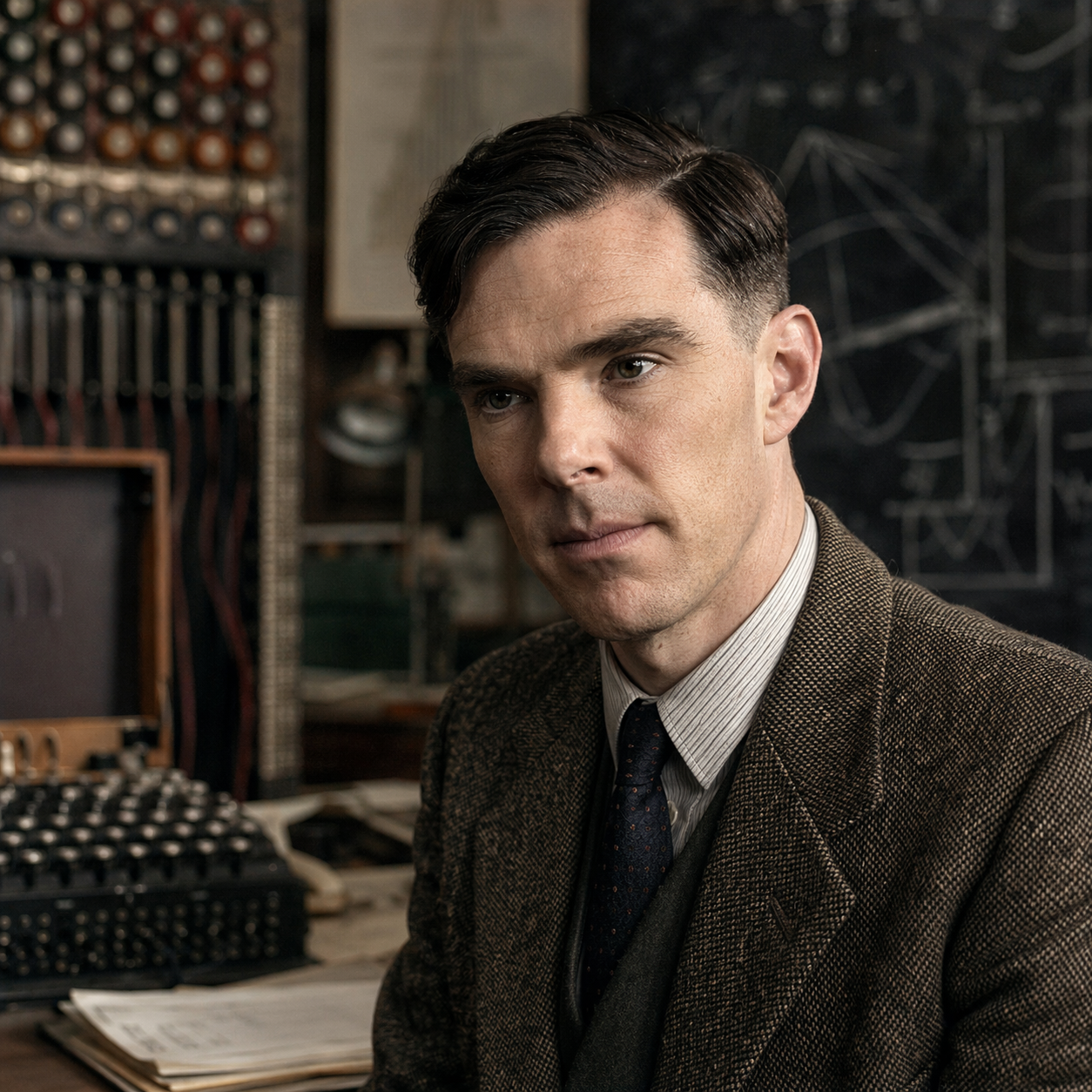
This quote appears in Turing's landmark 1950 paper 'Computing Machinery and Intelligence,' where he introduced the Turing Test. He used it to counter the objection that machines can't surprise us, arguing it exposes a false assumption about human mental processes. His wartime codebreaking at Bletchley Park, where the Bombe machine surfaced unexpected Enigma solutions daily, gave him direct experience of machines defying prediction.
In 1950, computers were room-sized machines accessible only to governments and universities, and machine intelligence was deeply controversial. The Cold War was intensifying, WWII codebreaking remained classified, and scientists debated whether logic machines could ever truly think. Engineers widely assumed machines were purely deterministic—incapable of genuine surprise. Turing's observation challenged that consensus at the exact moment modern computing was being born.
AI-generated insights based on extensive research and information for context. Factual errors? Email [email protected].
Your cart is empty