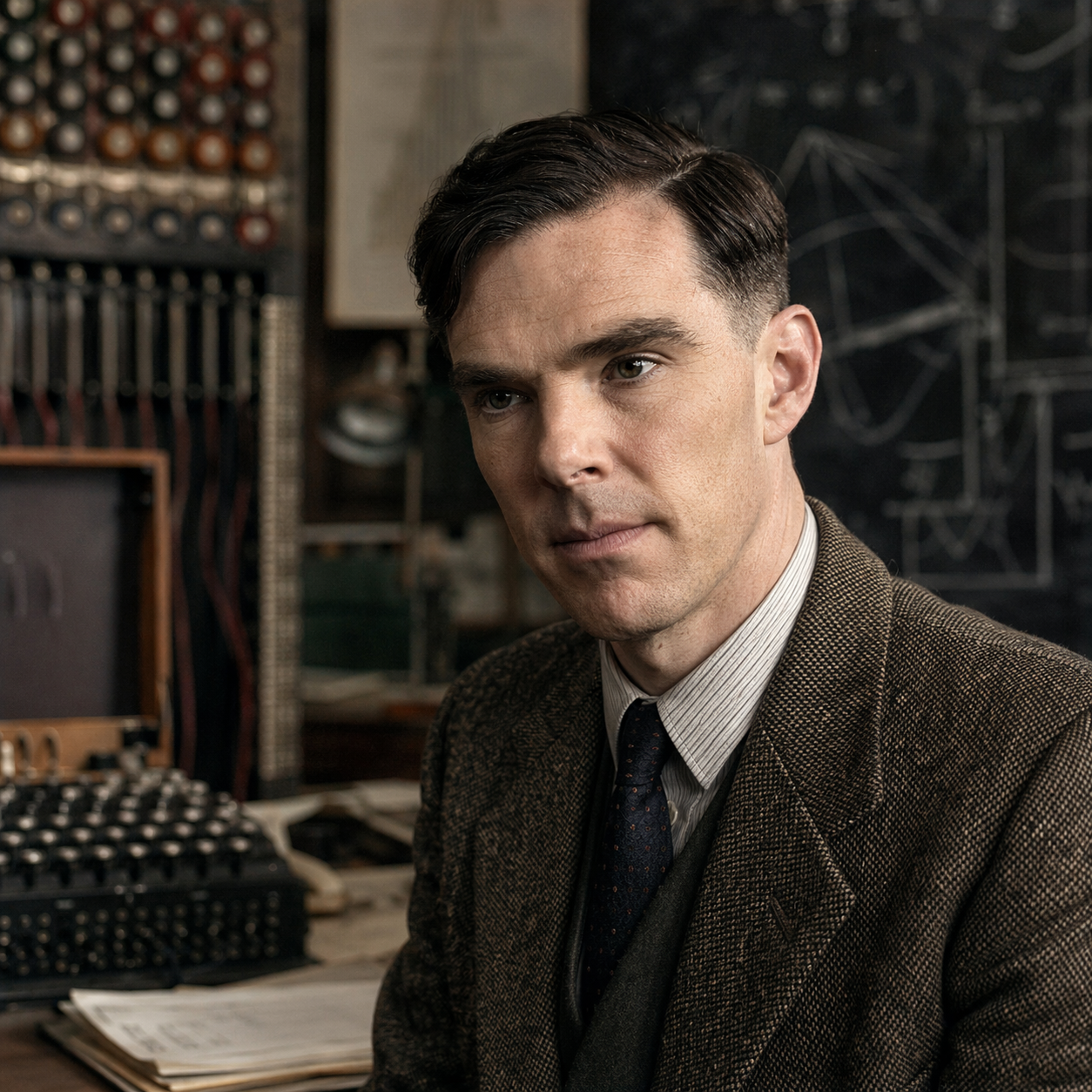
Alan Turing — "The universe is full of mysteries, and it is our task to unravel them."
The universe is full of mysteries, and it is our task to unravel them.
The universe is full of mysteries, and it is our task to unravel them.
Click any product to generate a realistic preview. Up to 3 at a time.
* Initial load can take up to 90 seconds — revising the preview in another color is nearly instant.
"I've now got myself into the kind of trouble that I have always considered to be quite a possibility for me, though I have usually rated it at about 10:1 against."
"No, I am not interested in developing a powerful brain. All I am after is just a mediocre brain, something like the Brain of the Man in the Street."
"If a machine can think, it might think more intelligently than we do, and then where should we be?"
"The human mind is a self-organizing system."
"I have had a number of conversations with people who are convinced that machines cannot think. I have not been convinced by their arguments."
Found in 1 providers: grok
1 source checked
Reality is packed with things we don't yet understand — from subatomic physics to the nature of consciousness. Rather than accepting mystery as permanent, we're obligated to pursue answers through reason, experiment, and logic. Curiosity isn't a pastime; it's a responsibility. Every solved problem reveals new unknowns, making inquiry endless. Understanding the universe is not just possible — it's what thinking beings are meant to do.
Turing spent his career attacking problems others deemed unsolvable. He cracked the mathematical underpinnings of computation with the Turing machine concept, broke Enigma ciphers that changed World War II, and asked whether machines could think — a question still driving AI research today. His 1950 paper didn't theorize cautiously; it proposed a test. Turing treated mystery as an invitation, not a wall, a disposition that defined every major contribution he made.
Turing worked during a period of dramatic scientific acceleration: World War II weaponized mathematics and code, the Manhattan Project harnessed physics, and the first electronic computers emerged in the late 1940s. Science was simultaneously humanity's greatest tool and greatest threat. In this climate — where governments classified knowledge and prosecuted unconventional thinkers — asserting that unraveling mysteries was a universal human task was both an intellectual commitment and a quiet act of defiance.
AI-generated insights based on extensive research and information for context. Factual errors? Email [email protected].
Your cart is empty