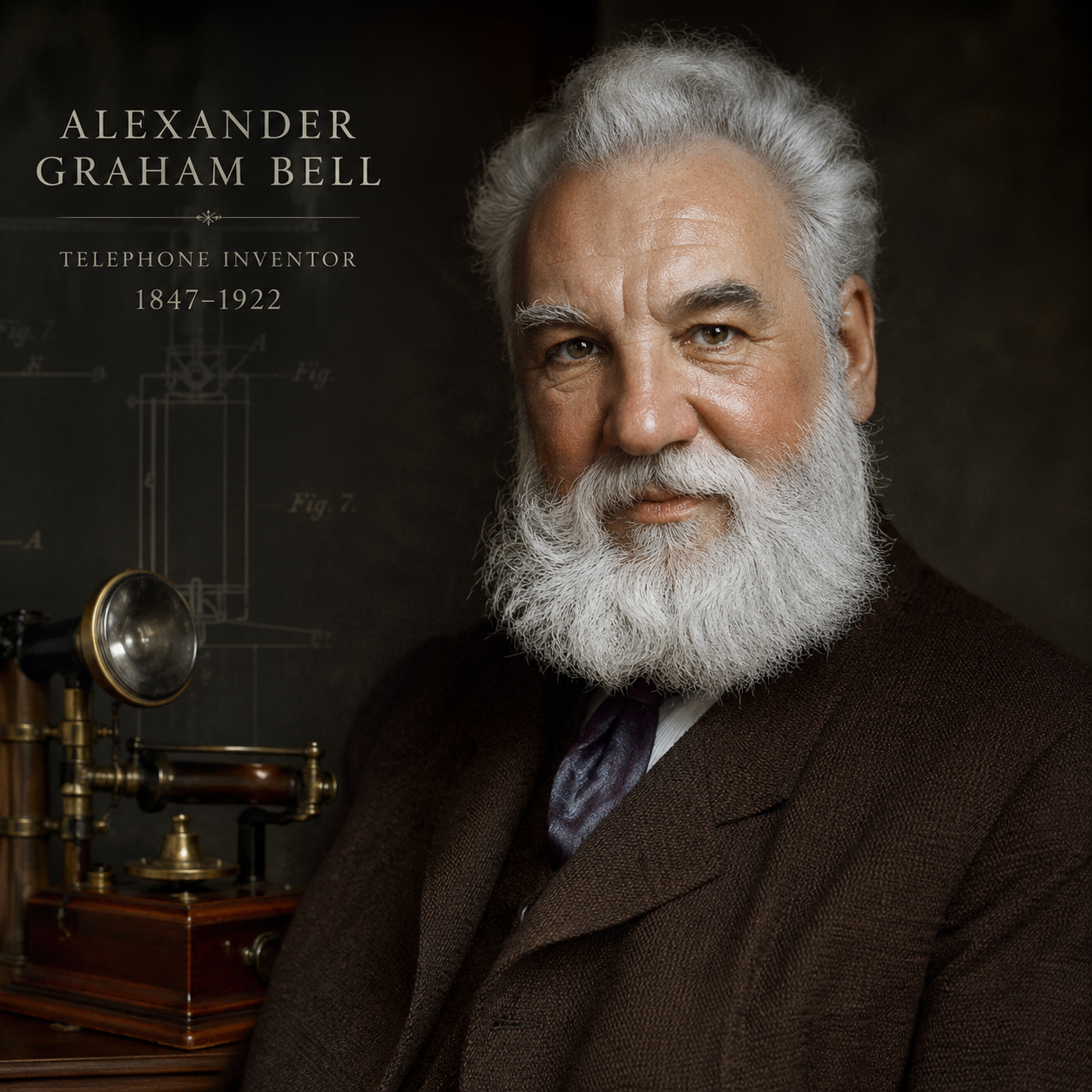
Alexander Graham Bell — "Man is a tool-using animal. Without tools he is nothing, with tools he is all."
Man is a tool-using animal. Without tools he is nothing, with tools he is all.
Man is a tool-using animal. Without tools he is nothing, with tools he is all.
Click any product to generate a realistic preview. Up to 3 at a time.
* Initial load can take up to 90 seconds — revising the preview in another color is nearly instant.
"Perseverance is the chief; but perseverance must have some practical end, or it does not avail the man possessing it. A person without a practical end in view becomes a crank or an idiot. Such persons…"
"Man is an animal who is constantly striving to rise to a higher altitude."
"The only way to do great work is to love what you do. If you haven't found it yet, keep looking. Don't settle."
"There are two critical points in every aerial flight - its beginning and its end."
"The telephone will be so important that every town will have one."
Often attributed to him, but this phrasing is very similar to Thomas Carlyle's 'Man is a Tool-using Animal' from 'Sartor Resartus'. Bell might have quoted or paraphrased it.
Date: unknown
GeneralFound in 1 providers: grok
1 source checked
Humans are fundamentally defined by their capacity to create and use tools. Without them, we are vulnerable, limited creatures. With them, we reshape nature, build civilizations, and transcend our biological constraints. Tool-use isn't incidental to humanity — it is humanity's core attribute, the thing that separates us from other animals and makes science, communication, and lasting progress possible.
Bell spent his life extending human capability through invention. His telephone demolished the barrier of distance, letting voices travel instantly across miles — the ultimate communicative tool. Motivated by his deaf mother and wife, he devoted years to hearing devices and education for the deaf. His later work on the photophone and early aircraft confirmed a lifelong conviction: technology is how humans transcend their natural limits.
Bell's era — the Second Industrial Revolution (1870s–1910s) — was defined by explosive invention: electric lights, railroads, automobiles, telegraphs, and telephones. Machines were visibly reshaping labor, cities, and daily life within a single generation. Scientific progress was treated as moral progress. The question of what tools could achieve was not abstract; it was unfolding in real time, making this sentiment both timely and urgently felt.
AI-generated insights based on extensive research and information for context. Factual errors? Email [email protected].
Your cart is empty