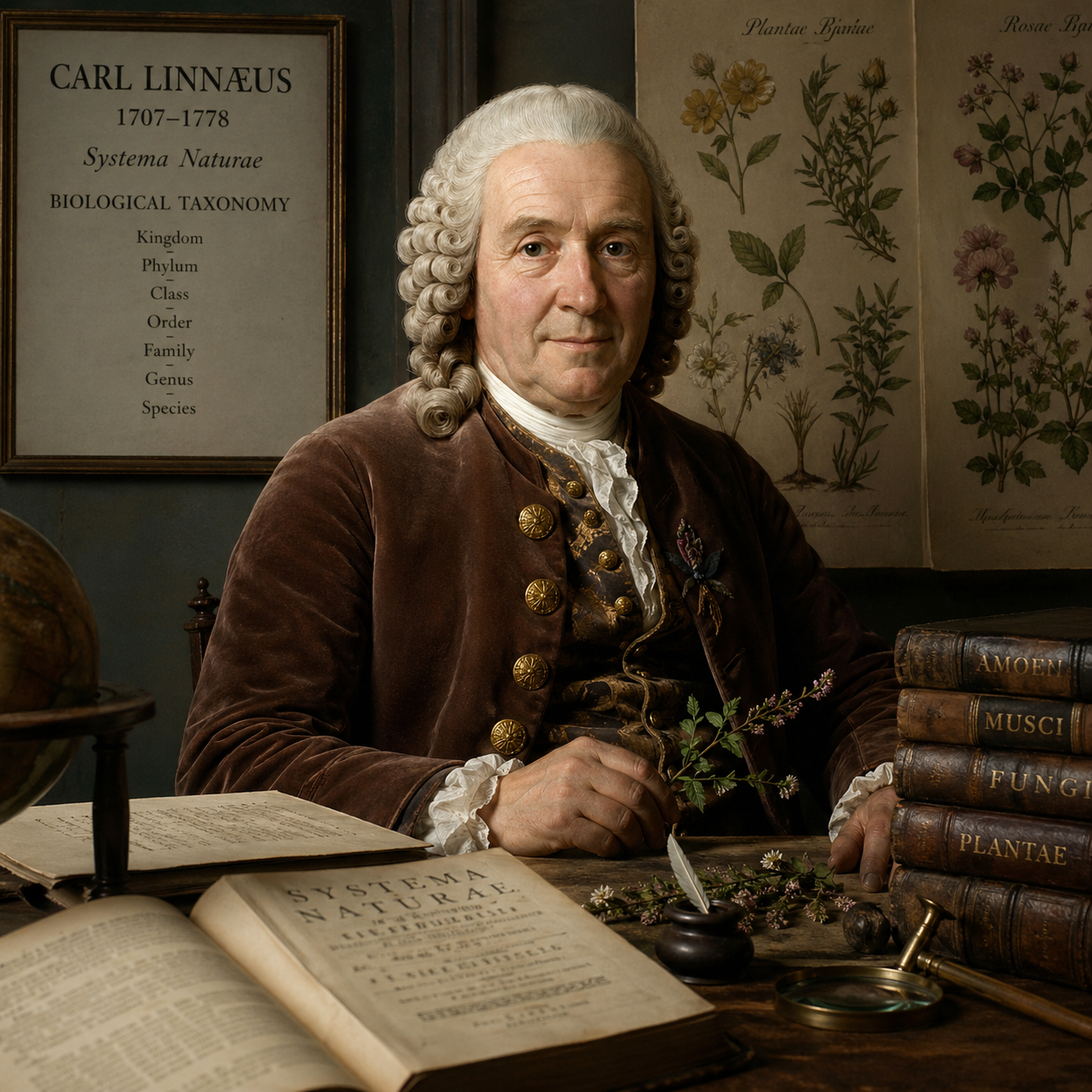
Carl Linnaeus — "Man is the masterpiece of creation."
Man is the masterpiece of creation.
Man is the masterpiece of creation.
Click any product to generate a realistic preview. Up to 3 at a time.
* Initial load can take up to 90 seconds — revising the preview in another color is nearly instant.
"The only way to know nature is to love it."
"A professor can never better distinguish himself in his work than by encouraging a clever pupil, for the true discoverers are among them, as comets amongst the stars."
"I am not ashamed to confess that I have learned much from women."
"The most beautiful thing in the world is a flower, but it is not so beautiful as a woman."
"I have classified all plants and animals."
Swedish botanist and the father of modern taxonomy whose Systema Naturae (1735) introduced binomial nomenclature for naming all species. Closely associated with Joseph Banks (British naturalist who carried Linnaean classification on Cook's voyages). For an intellectual contrast, see Comte de Buffon, French naturalist and Histoire Naturelle author (1749-1788) — Buffon explicitly attacked Linnaean fixed-categories taxonomy as artificial and rejected the binomial system; his gradualist, environment-shaped natural history was the explicit alternative. Anticipates the fixed-species-vs-evolution debate Darwin would later resolve.
A anthropocentric view, typical of his era and consistent with his religious beliefs.
Date: c. 1750s
ShockingFound in 1 providers: grok
1 source checked
Humans represent the pinnacle of all living things — the most complex, refined, and extraordinary product of nature's processes. This asserts a hierarchy where mankind stands apart from and above all other organisms, possessing unique capacities for reason, language, and self-awareness that distinguish the species from every other creature sharing the earth.
Linnaeus spent his life cataloguing all living things in his Systema Naturae, positioning Homo sapiens within his taxonomy. Yet he simultaneously elevated humans above that system. He coined 'Homo sapiens' — 'wise man' — deliberately. His classification reflected sincere belief that humans, while animals anatomically, occupied a uniquely dignified station among creation as rational observers capable of naming and ordering nature itself.
The early modern period wrestled with humanity's place following Copernicus displacing Earth from cosmic center. Natural theology dominated — scholars like Linnaeus saw classification as revealing God's rational design. Enlightenment thinkers simultaneously celebrated human reason as supreme. Placing man as creation's masterpiece reconciled religious tradition with scientific inquiry, affirming human dignity precisely when astronomy and emerging biology were challenging anthropocentric worldviews.
AI-generated insights based on extensive research and information for context. Factual errors? Email [email protected].
Your cart is empty