Carl Linnaeus — "The most important thing in life is to be useful."
The most important thing in life is to be useful.
The most important thing in life is to be useful.
Click any product to generate a realistic preview. Up to 3 at a time.
* Initial load can take up to 90 seconds — revising the preview in another color is nearly instant.
"Blessed be the Lord for the beauty of summer and spring, for the air, the water, the verdure, and the song of birds."
"The Negro is a different species from the European."
"A world without names is a world without knowledge."
"Yet man does recognise himself [as an animal]. But I ask you and the whole world for a generic differentia between man and ape which conforms to the principles of natural history, I certainly know of …"
"I have been called a second Adam."
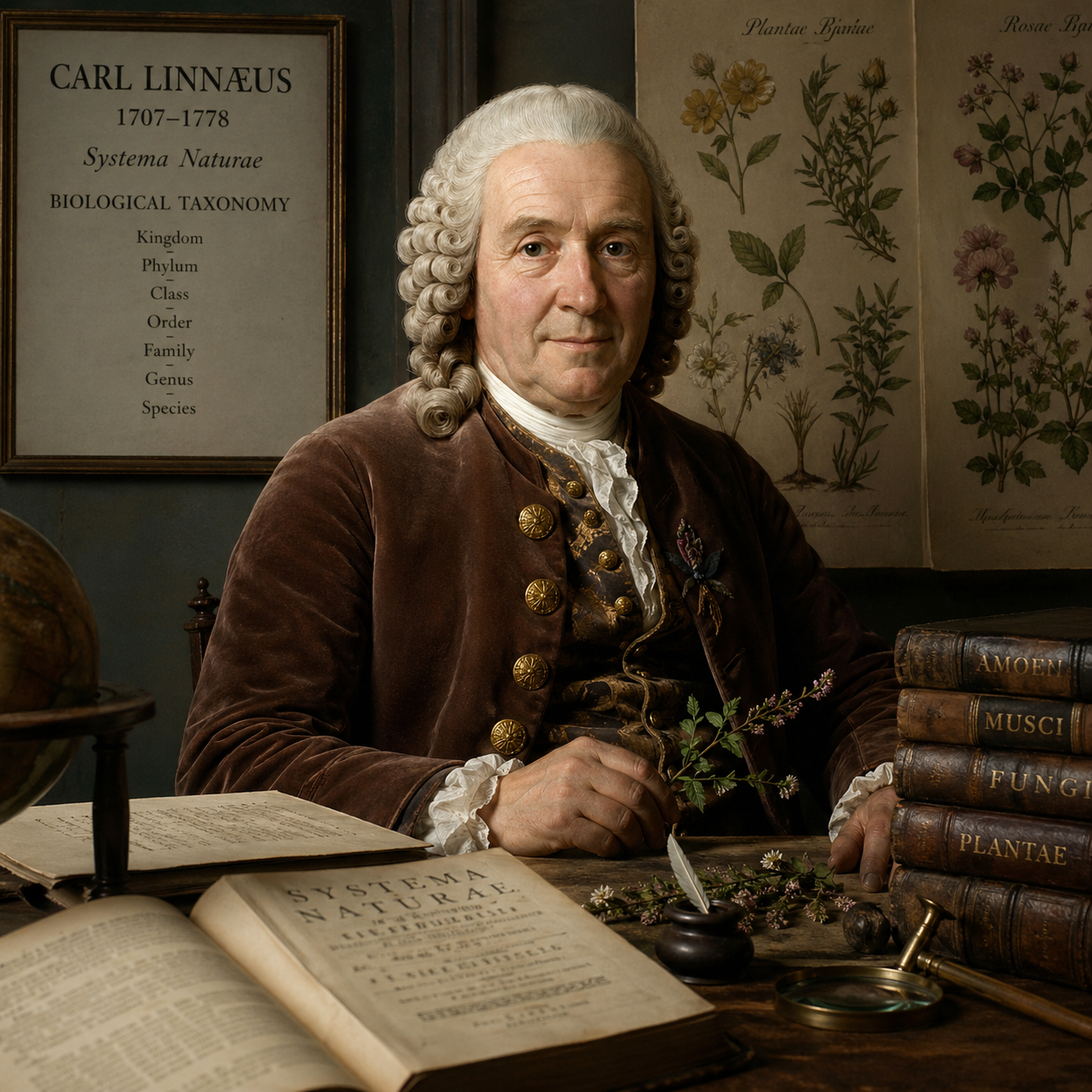
Swedish botanist and the father of modern taxonomy whose Systema Naturae (1735) introduced binomial nomenclature for naming all species. Closely associated with Joseph Banks (British naturalist who carried Linnaean classification on Cook's voyages). For an intellectual contrast, see Comte de Buffon, French naturalist and Histoire Naturelle author (1749-1788) — Buffon explicitly attacked Linnaean fixed-categories taxonomy as artificial and rejected the binomial system; his gradualist, environment-shaped natural history was the explicit alternative. Anticipates the fixed-species-vs-evolution debate Darwin would later resolve.
Found in 1 providers: gemini
1 source checked
Usefulness — contributing something of value to others or to collective knowledge — is life's highest purpose. The quote rejects passive existence in favor of active contribution. It measures a life not by wealth, status, or pleasure, but by how much one's presence and efforts tangibly benefit others, advance understanding, or solve real problems. A life that leaves nothing behind for others to use is, by this standard, wasted.
Linnaeus dedicated his career to creating binomial nomenclature — the two-part Latin naming system still organizing all known species today. He trained traveling disciples called apostles to collect specimens globally and wrote Systema Naturae to turn chaotic natural knowledge into universally usable categories. For Linnaeus, science was service: his classification framework was a practical gift to every future naturalist, physician, and farmer who needed reliable identification of plants and animals.
Linnaeus worked during the Enlightenment, when European thinkers prized reason and practical knowledge over inherited authority. Colonial expansion made systematic botany economically critical — identifying medicinal plants, edible species, and commercial crops required reliable classification. Sweden's Academy of Sciences was newly founded, and natural philosophy was becoming organized science. Scholars were explicitly expected to produce knowledge with tangible social, agricultural, and medical benefits, making usefulness a defining cultural virtue among eighteenth-century intellectuals.
AI-generated insights based on extensive research and information for context. Factual errors? Email [email protected].
Your cart is empty