Alexander Fleming — "The most important thing in science is not to get discouraged by failures."
The most important thing in science is not to get discouraged by failures.
The most important thing in science is not to get discouraged by failures.
Click any product to generate a realistic preview. Up to 3 at a time.
* Initial load can take up to 90 seconds — revising the preview in another color is nearly instant.
"The discovery of penicillin was a stroke of luck, but it was also the result of many years of hard work."
"I can only warn. It is up to others to heed the warning."
"My greatest satisfaction comes from knowing that my work has saved countless lives."
"The purification of penicillin was a major triumph of chemistry."
"We must be careful not to create a race of penicillin-resistant superbugs."
Found in 1 providers: grok
1 source checked
Persistence through failure is the most essential quality in scientific work. Setbacks, dead ends, and botched experiments are inevitable in discovery — but quitting when things go wrong is the real obstacle to progress. Success in science means treating failure as data rather than defeat, staying curious and committed even when results don't cooperate, because breakthroughs are rarely linear and most paths forward are discovered only after the wrong ones are exhausted.
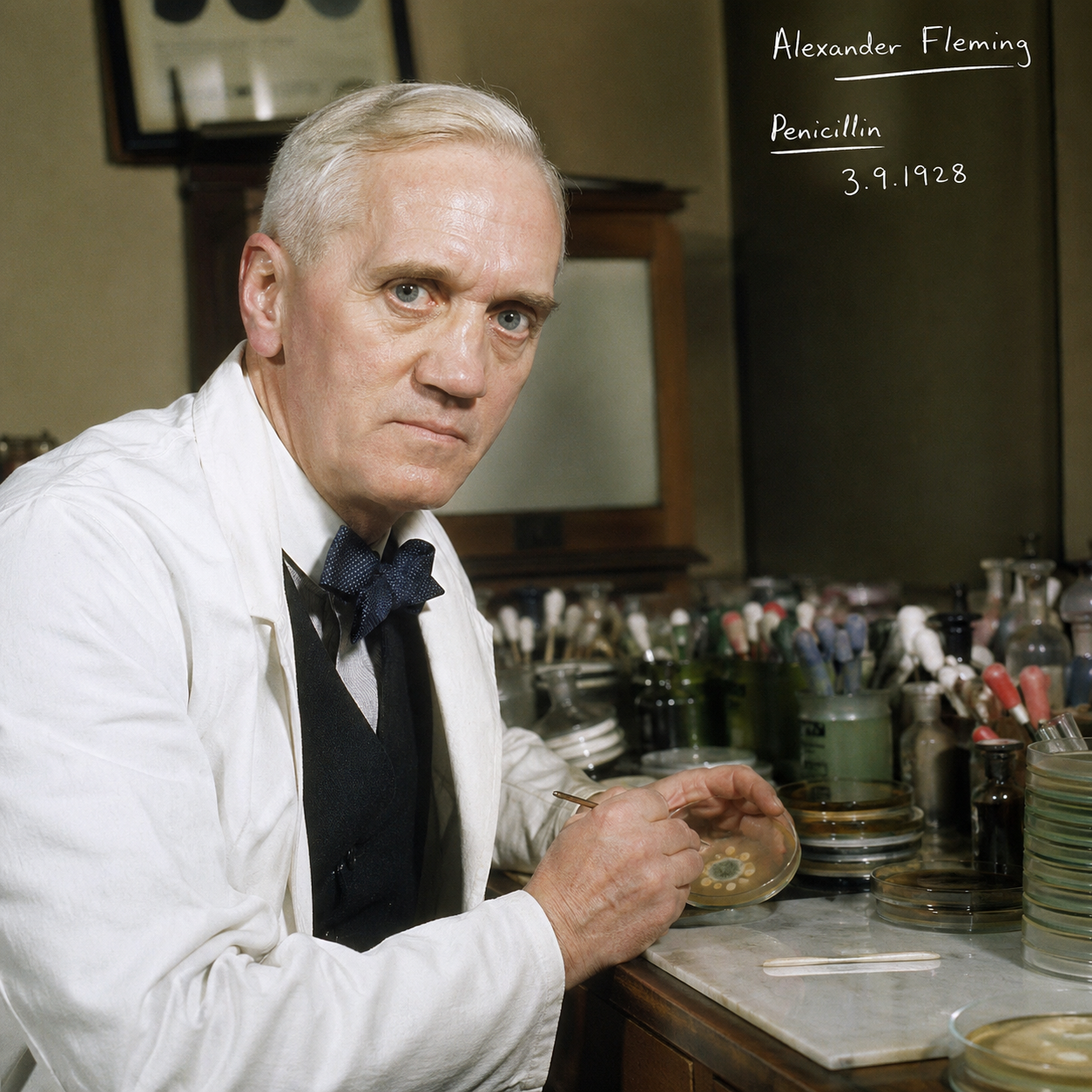
Fleming's greatest discovery came from what looked like a ruined experiment. In 1928, a mold-contaminated petri dish he nearly discarded revealed that Penicillium was killing surrounding bacteria. Before that, he spent years in World War I watching soldiers die from infected wounds, which drove his long, mostly fruitless search for antibacterial agents. Penicillin wasn't even developed into medicine until over a decade after his initial observation — his entire career was a lived argument for this principle.
Fleming worked in an era before antibiotics existed, when bacterial infections — pneumonia, sepsis, syphilis, wound infection — killed tens of millions. Laboratory science was under-resourced and germ theory was barely decades old. World War I had just shown that infectious disease killed more soldiers than combat itself. Scientific failure was the norm, not the exception, and institutional pressure to produce results quickly made the call to stay patient through repeated setbacks genuinely countercultural and essential.
AI-generated insights based on extensive research and information for context. Factual errors? Email [email protected].
Your cart is empty