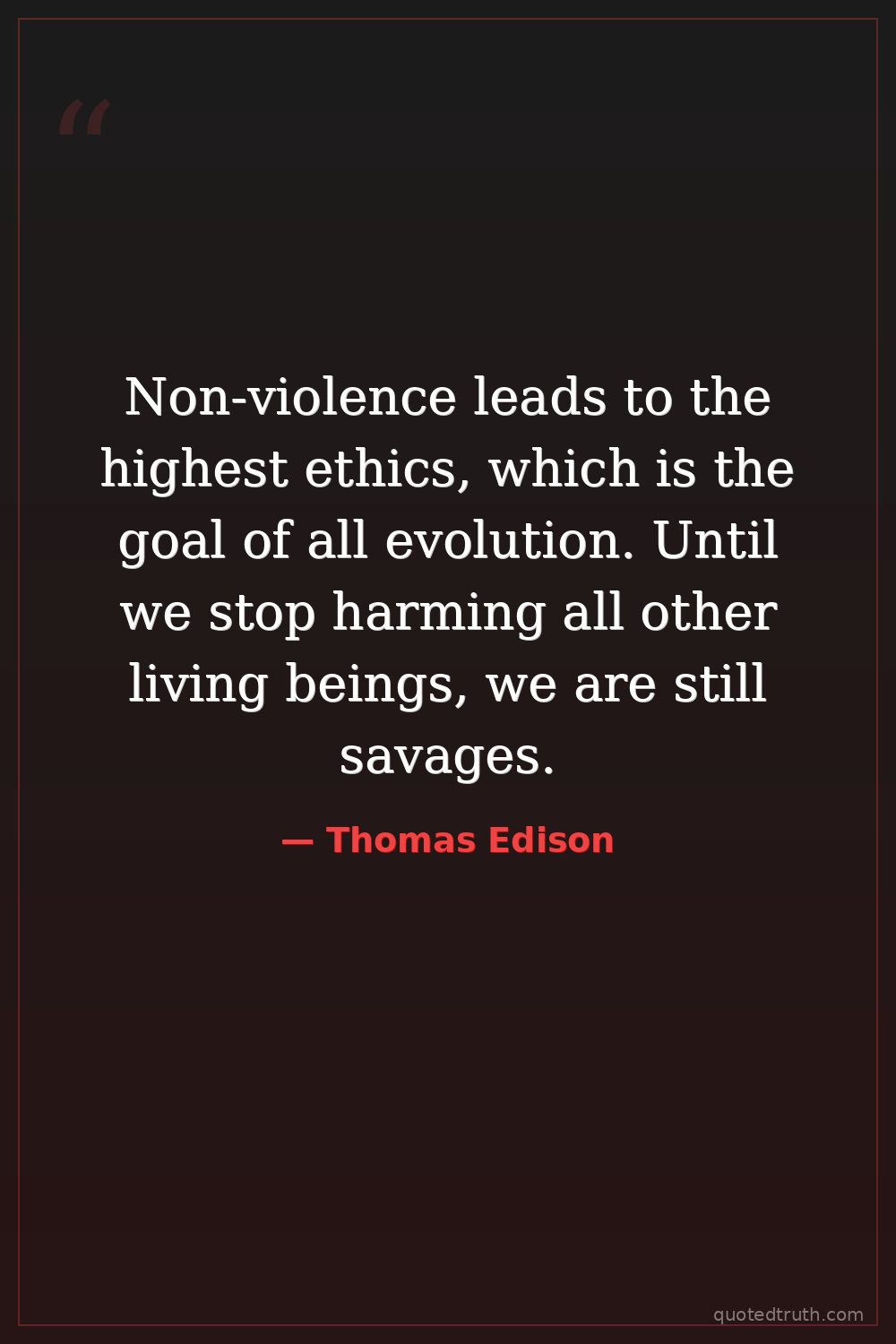
Thomas Edison — "Non-violence leads to the highest ethics, which is the goal of all evolution. Un…"
Non-violence leads to the highest ethics, which is the goal of all evolution. Until we stop harming all other living beings, we are still savages.
Non-violence leads to the highest ethics, which is the goal of all evolution. Until we stop harming all other living beings, we are still savages.
Click any product to generate a realistic preview. Up to 3 at a time.
* Initial load can take up to 90 seconds — revising the preview in another color is nearly instant.
"The doctor of the future will give no medicine but will interest his patients in the care of the human frame, in diet, and in the cause and prevention of disease."
"All bibles are man-made."
"There is no substitute for hard work."
"I have more respect for the man who is trying to get somewhere than for the man who has gotten somewhere and is resting on his laurels."
"There will be more women than men inventors in the future."
Found in 1 providers: deepseek
1 source checked
Refusing to harm others is the peak of moral development, and humanity's entire progress points toward that ideal. As long as we keep inflicting suffering on any living creature, including animals, we have not truly advanced beyond our brutal origins. Real civilization is measured not by technology or power, but by how gently we treat every form of life that shares the world with us.
Edison was a committed vegetarian late in life and openly opposed cruelty to animals, viewing compassion as a marker of an advanced mind. The same relentless observer who logged thousands of filament tests applied that rational scrutiny to ethics, concluding that inflicting pain was primitive. For a man who reshaped modern life through invention, defining progress as nonviolence rather than machinery reflects his belief that moral evolution mattered more than industrial output.
Edison lived through the Gilded Age and early twentieth century, when slaughterhouses industrialized, vivisection expanded, and factory production normalized mass animal use. Vegetarian societies, anti-vivisection leagues, and humane movements were forming in America and Britain, influenced by figures like Tolstoy and later Gandhi. Against a backdrop of world wars and mechanized killing, thinkers increasingly questioned whether technological power without ethical restraint signaled genuine civilization or merely sophisticated savagery.
AI-generated insights based on extensive research and information for context. Factual errors? Email [email protected].
Your cart is empty