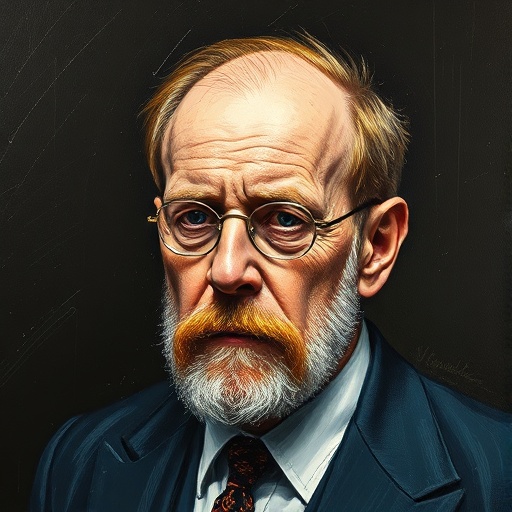
Werner Heisenberg — "One day, when we have learned to understand the elementary particles, we will ha…"
One day, when we have learned to understand the elementary particles, we will have understood the whole world.
One day, when we have learned to understand the elementary particles, we will have understood the whole world.
Click any product to generate a realistic preview. Up to 3 at a time.
* Initial load can take up to 90 seconds — revising the preview in another color is nearly instant.
"Physics does not consist only of atomic research, science does not consist only of physics, and life does not consist only of science. The aim of atomic research is to fit our empirical knowledge conc…"
"I would say that I was absolutely convinced of the possibility of our making a uranium engine. but I never thought that we would make a bomb. and at the bottom of my heart. I was really glad that it w…"
"I don't believe a word of the whole thing they must have spent the whole of their £500. million in separating isotopes. and then it's possible."
"Science is made by men, not by apparatus."
"One cannot be a physicist without feeling that a religious element is present in the world."
Found in 1 providers: grok
1 source checked
The quote expresses the reductionist hope that grasping the smallest building blocks of matter will unlock a complete understanding of reality. If we can fully describe how particles behave and interact, every larger phenomenon—chemistry, biology, stars, minds—becomes explainable as a consequence. It treats fundamental physics as the master key: learn the rules at the bottom, and everything built on top eventually falls into place.
Heisenberg devoted his life to probing the subatomic realm, formulating matrix mechanics in 1925 and the uncertainty principle in 1927, both cornerstones of quantum theory. He later pursued a unified field theory attempting to derive all particles from a single equation. The quote mirrors that lifelong conviction: that nature's deepest secrets sit at the particle level, and cracking them would complete physics itself—a goal he chased until his death in 1976.
Heisenberg worked through physics' most transformative century. The 1920s quantum revolution overturned Newtonian certainty; the 1930s–40s brought nuclear fission and the atomic bomb, which he controversially worked on for Germany. Postwar decades saw accelerators uncover quarks, neutrinos, and a growing particle zoo, fueling dreams of a Theory of Everything. His statement captures that era's optimism that humanity stood on the verge of reading nature's final code.
AI-generated insights based on extensive research and information for context. Factual errors? Email [email protected].
Your cart is empty