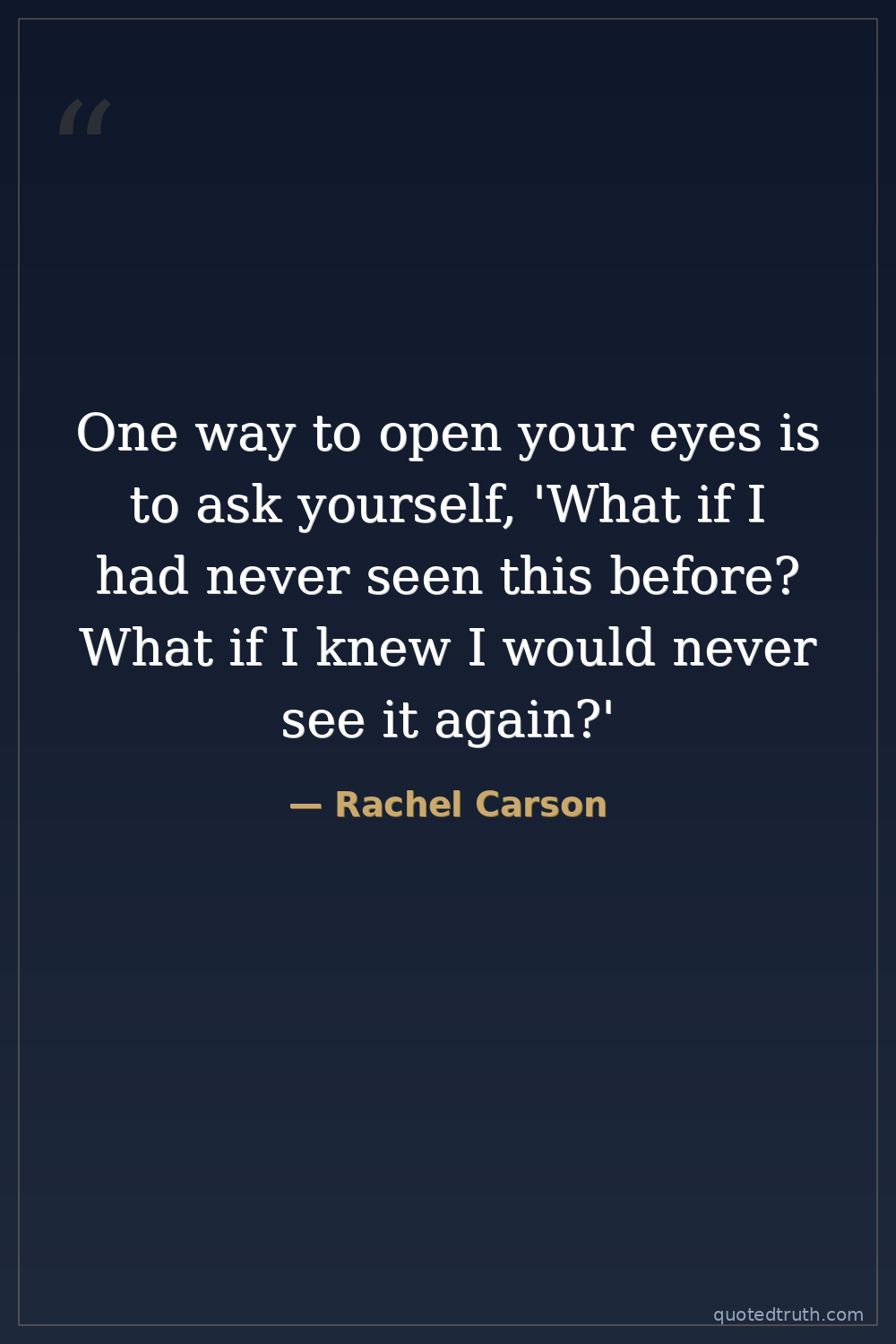
Rachel Carson — "One way to open your eyes is to ask yourself, 'What if I had never seen this bef…"
One way to open your eyes is to ask yourself, 'What if I had never seen this before? What if I knew I would never see it again?'
One way to open your eyes is to ask yourself, 'What if I had never seen this before? What if I knew I would never see it again?'
Click any product to generate a realistic preview. Up to 3 at a time.
* Initial load can take up to 90 seconds — revising the preview in another color is nearly instant.
"The fact that we are so ignorant of the long-term effects of these chemicals is terrifying."
"It is a truism that in this world of ours, just as in the world of the ancient Greeks, whom we have taught ourselves to admire, there is a certain fatalism."
"To stand at the edge of the sea, to sense the ebb and flow of the tides, to feel the breath of a coastal breeze—this is to know the pulse of life."
"In nature, nothing exists alone."
"The true meaning of conservation is to protect the earth's resources for future generations."
Found in 1 providers: grok
1 source checked
Familiarity breeds inattention — we stop truly seeing what surrounds us daily. This quote offers a mental reset: imagine encountering something for the very first time, or losing it permanently. Both framings force genuine attention and gratitude. It's a practical technique for breaking through the numbness of routine, rekindling wonder, and perceiving ordinary things — a tree, a bird, a coastline — with the sharpness they deserve.
Carson spent decades observing marine ecosystems with meticulous attention, believing wonder was conservation's foundation. Her posthumous book The Sense of Wonder argued that children and adults must cultivate awe to care about nature. Silent Spring emerged from her horror at watching irreplaceable species vanish under industrial pesticide use. This quote captures her core conviction: we cannot protect what we no longer truly see.
Carson wrote during postwar America's rapid industrialization — DDT and synthetic pesticides were celebrated as miracles of progress, suburban sprawl was erasing natural landscapes, and factory farming was transforming agriculture. Few questioned the cost. Silent Spring (1962) shocked readers into recognizing that familiar species — robins, eagles — were disappearing silently. In an era of unchecked development, Carson's call to truly look before something vanished carried urgent political weight.
AI-generated insights based on extensive research and information for context. Factual errors? Email [email protected].
Your cart is empty