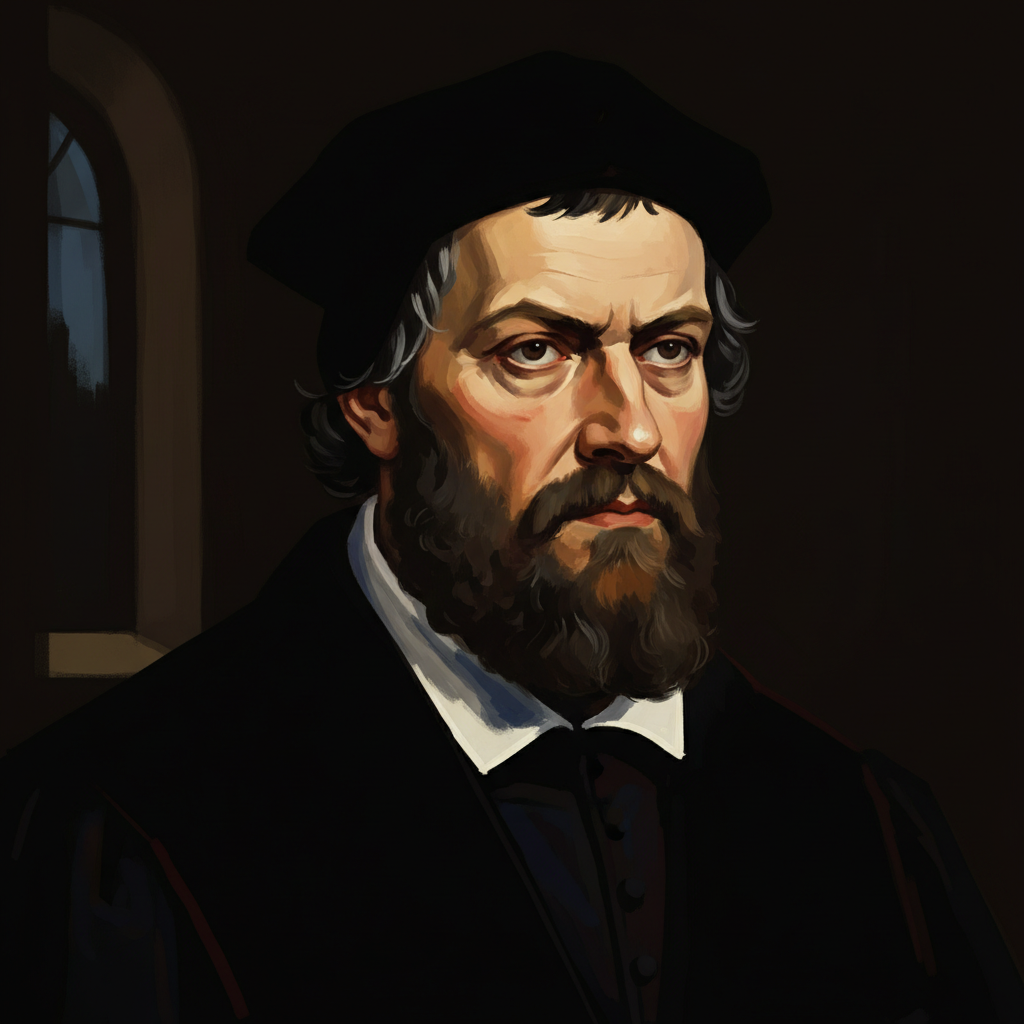
Martin Luther — "Printing is the ultimate gift of God and the greatest one. Through it, God inten…"
Printing is the ultimate gift of God and the greatest one. Through it, God intends to spread the true knowledge of religion through the whole world.
Printing is the ultimate gift of God and the greatest one. Through it, God intends to spread the true knowledge of religion through the whole world.
Click any product to generate a realistic preview. Up to 3 at a time.
* Initial load can take up to 90 seconds — revising the preview in another color is nearly instant.
"When I am assailed by temptation, I merely eat and drink more, and laugh and joke, and so kill the thoughts."
"What God wills is not right because he ought, or was bound, so to will; on the contrary, what takes place must be right, because he so wills it."
"Heretics are not to be disputed with, but to be condemned unheard, and whilst they perish by fire, the faithful ought to pursue the evil to its source, and bathe their heads in the blood of the Cathol…"
"If I could understand how a good Christian could be a usurer, I would eat him."
"If we do [tolerate their conduct], we become sharers in their lies, cursing and blasphemy. Thus we cannot extinguish the unquenchable fire of divine wrath, of which the prophets speak, nor can we conv…"
German theologian whose 95 Theses (1517) launched the Protestant Reformation and broke the Catholic Church's monopoly on Western Christianity. Closely associated with Philipp Melanchthon (Lutheran systematizer) and John Calvin (later Reformer who built on Luther's break). For an intellectual contrast, see Pope Leo X, Renaissance pope (1513-1521) — Leo X's indulgence sales triggered Luther's break and Leo excommunicated him in 1521 — Luther's entire Reformation is structured as a direct answer to the indulgence-funded Vatican Leo represented.
Found in 1 providers: grok
1 source checked
Luther calls the printing press the best blessing God has ever given humanity. He believes its unique ability to mass-produce books will carry authentic religious teaching to every corner of the earth. In modern terms, he sees new communication technology as a divinely gifted tool that can finally break the old monopoly on knowledge and put truth directly into ordinary people's hands everywhere.
Luther's entire career depended on the press. His 95 Theses (1517) and German Bible translation spread across Europe within weeks because printers reproduced them cheaply and quickly, something impossible in earlier centuries. Without Gutenberg's invention, his challenge to Rome would have stayed a local academic dispute. Calling print God's greatest gift reflects Luther's lived experience: the technology literally enabled the Reformation he led and carried his vernacular scripture to common readers.
Gutenberg's movable-type press (c. 1450) was transforming early modern Europe during Luther's lifetime. By the 1520s, print shops in Wittenberg, Nuremberg, and Basel were churning out pamphlets, Bibles, and broadsheets in vernacular languages, breaking the Catholic Church and Latin-literate clergy's grip on scripture. Literacy was rising, pamphlet wars shaped public opinion, and cheap printed images and tracts let reformers reach peasants directly, fueling religious upheaval across the Holy Roman Empire.
AI-generated insights based on extensive research and information for context. Factual errors? Email [email protected].
Your cart is empty