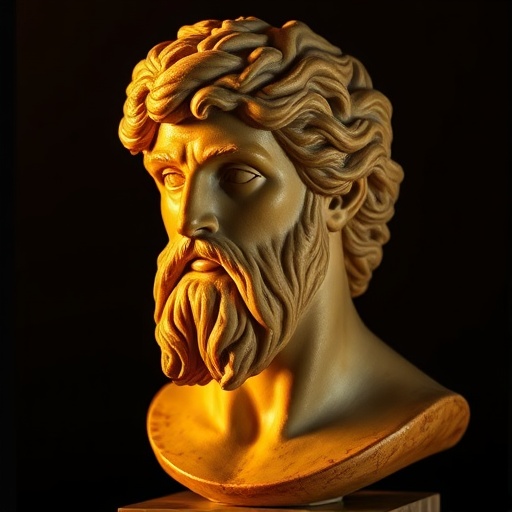
Pythagoras — "Respect yourself, and others will respect you."
Respect yourself, and others will respect you.
Respect yourself, and others will respect you.
Click any product to generate a realistic preview. Up to 3 at a time.
* Initial load can take up to 90 seconds — revising the preview in another color is nearly instant.
"Choose always the way that seems the best, however rough it may be; custom will soon render it easy and agreeable."
"The souls of animals called unreasoning are reasonable, not however with active reasoning powers, because of an imperfect mixture of the bodies and because they do not have the power of speech, as in …"
"Sooner throw a pearl at hazard than an idle or useless word; and do not say a little in many words, but a great deal in a few."
"Five represents marriage because it is the sum of two and three (the Pythagoreans believed that even numbers were masculine and odd numbers were feminine)."
"Do not look in a mirror by lamplight."
Greek philosopher and mathematician whose school in Croton combined geometry (the Pythagorean theorem), number-mysticism, and a religious-vegetarian way of life. Closely associated with Thales of Miletus (earlier pre-Socratic and the first philosopher). For an intellectual contrast, see Heraclitus, pre-Socratic Greek philosopher of flux — Heraclitus called Pythagoras 'the chief of swindlers' — among the founding insults of the philosophical-rivalry tradition. Their 'all is flux' vs 'all is number' poles still organize the philosophy of mathematics today (Platonist vs anti-realist).
Found in 1 providers: grok
1 source checked
Self-respect is the foundation of how others perceive and treat you. When you carry yourself with dignity, hold your values firmly, and refuse to demean yourself, you project a quiet confidence that others naturally respond to with respect. It is not about arrogance or demanding deference — it is about treating yourself as someone worthy of care, which signals to others that you expect to be treated the same way.
Pythagoras founded a strict philosophical brotherhood in Croton around 530 BCE, with codes governing diet, conduct, and intellectual discipline. Members followed ethical rules they believed elevated the soul. His worldview held that number and order underpin all reality, including virtue and character. Self-respect, for him, meant cultivating the soul through reason and rigorous living — a principle he personally embodied and demanded of every follower who joined his community.
In 6th-century BCE Greece, honor and reputation — timē — were central to social standing. Shame culture dominated: personal worth was judged publicly by peers, family, and the city-state. Dignity was not merely psychological but civic and sacred. Emerging Greek philosophy was challenging older tribal honor codes by shifting focus toward inner virtue over external status, making self-respect a genuinely radical concept carrying both spiritual and political weight at the time.
AI-generated insights based on extensive research and information for context. Factual errors? Email [email protected].
Your cart is empty