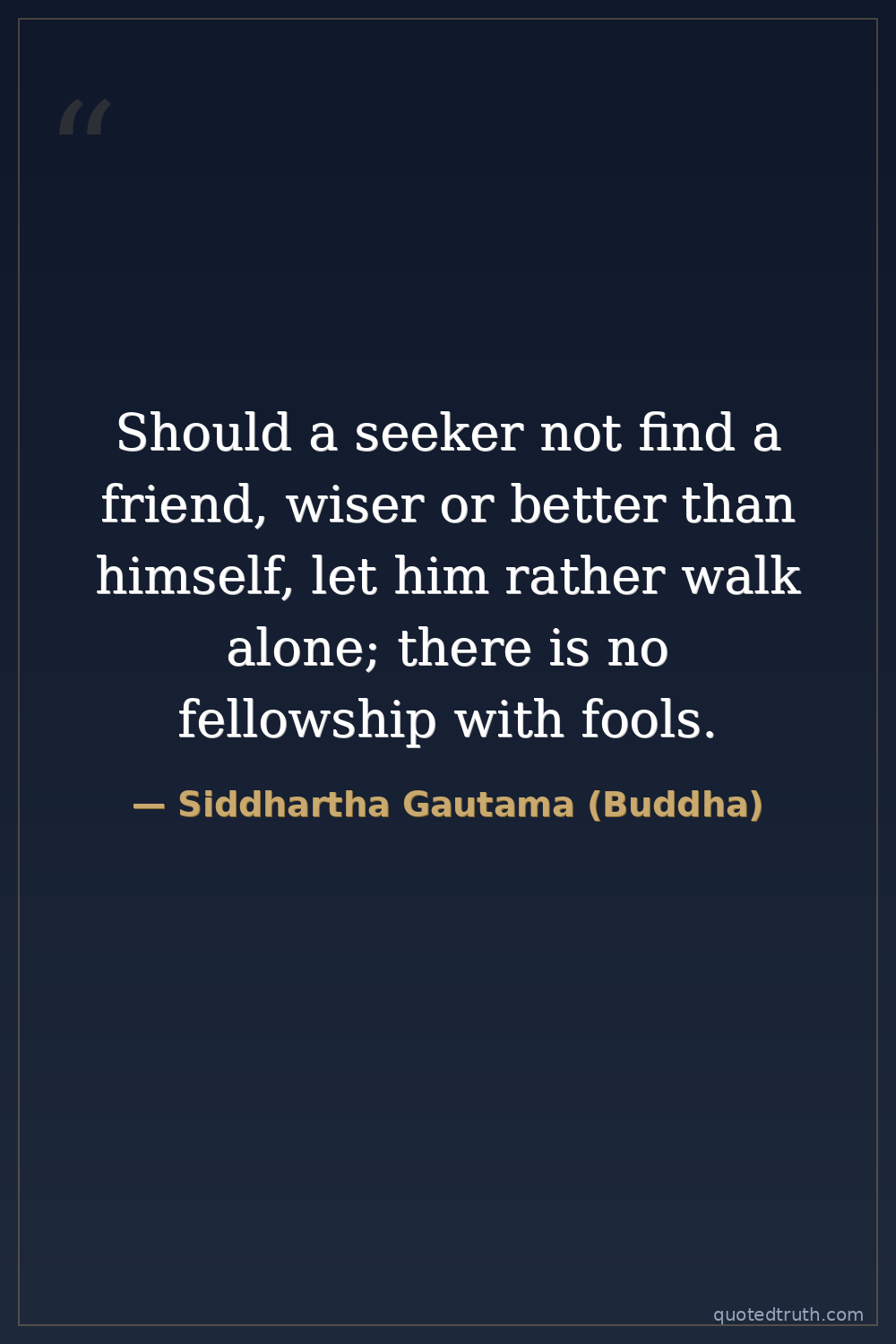
Siddhartha Gautama (Buddha) — "Should a seeker not find a friend, wiser or better than himself, let him rather …"
Should a seeker not find a friend, wiser or better than himself, let him rather walk alone; there is no fellowship with fools.
Should a seeker not find a friend, wiser or better than himself, let him rather walk alone; there is no fellowship with fools.
Click any product to generate a realistic preview. Up to 3 at a time.
* Initial load can take up to 90 seconds — revising the preview in another color is nearly instant.
"Believe nothing, no matter where you read it, or who said it, no matter if I have said it, unless it agrees with your own reason and your own common sense."
"There is no path to happiness: happiness is the path."
"It is in the nature of things that joy arises in a person free from remorse."
"Conquer the angry one by love. Conquer the evil one by good. Conquer the stingy one by generosity. Conquer the liar by truth."
"Happiness does not depend on what you have or who you are. It solely relies on how you think."
Found in 1 providers: grok
1 source checked
If you can't find a companion who is as wise as you or wiser, it's better to travel your path alone than to settle for foolish company. Weak or unwise friends will drag you down, distract you, and reinforce bad habits. Solitude beats harmful influence. Choose your inner circle carefully, because the people around you shape who you become, and bad company is worse than no company at all.
Buddha spent six years with teachers and ascetic companions before realizing none could guide him to awakening, then sat alone under the Bodhi tree. After enlightenment, he built the sangha, a community of monks, but insisted members uphold right conduct or be expelled. This saying reflects his lived experience: genuine spiritual friendship (kalyana-mitta) accelerates the path, while fools reinforce craving and delusion. He valued disciplined solitude over compromised company.
In 5th-century BCE northern India, wandering ascetics called sramanas roamed the Ganges plain challenging Vedic Brahmin authority. Spiritual seekers typically joined teacher-led communities or forest groups for protection, debate, and alms. Solitary wandering was risky but respected. Buddha spoke during this ferment of competing schools, including Jains, Ajivikas, and materialists, where choice of teacher and peers defined one's entire worldview. Warning against foolish fellowship was practical guidance for seekers navigating a crowded religious marketplace.
AI-generated insights based on extensive research and information for context. Factual errors? Email [email protected].
Your cart is empty