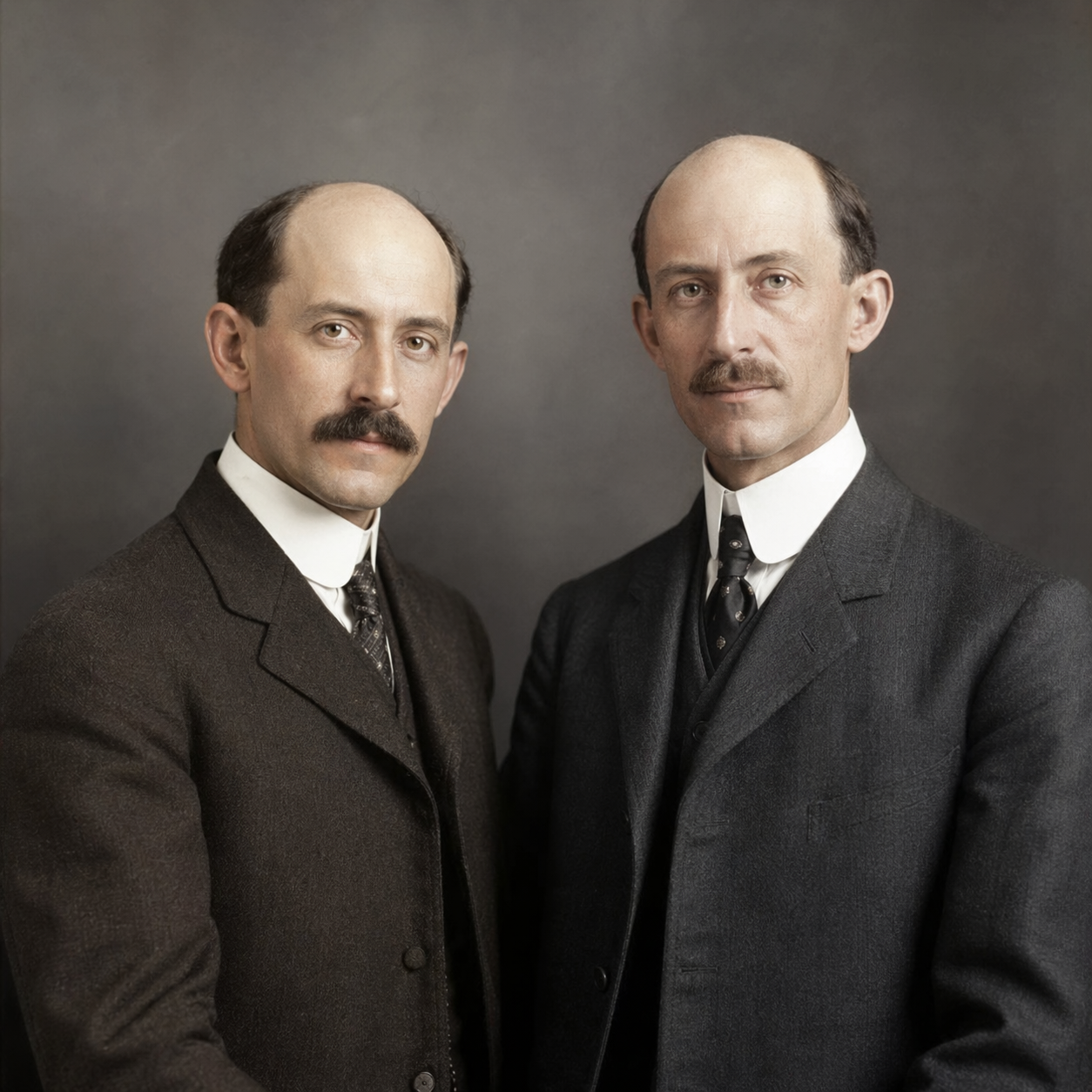
Wright Brothers (Orville & Wilbur) — "The aeroplane is not an invention, but a discovery."
The aeroplane is not an invention, but a discovery.
The aeroplane is not an invention, but a discovery.
Click any product to generate a realistic preview. Up to 3 at a time.
* Initial load can take up to 90 seconds — revising the preview in another color is nearly instant.
"The difficulties of the problem are so great that few have dared to attack it."
"The flying machine is a thing of the future, and it is a thing that will change the world."
"The airplane has forced us into a new relationship with each other."
"The machine has been proven to be a success beyond our most sanguine hopes."
"If we worked on the assumption that what is currently regarded as impossible is really impossible, we should never have made any progress."
American aviation pioneers who achieved the first sustained powered controlled airplane flight at Kitty Hawk, NC, on December 17, 1903. Closely associated with Octave Chanute (their gliding mentor and aeronautical correspondent). For an intellectual contrast, see Samuel Pierpont Langley, Smithsonian Institution Secretary and government-funded aviation researcher — Langley's Aerodrome crashed twice into the Potomac in October-December 1903 with $50,000 of War Department funding; the Wright Brothers' bicycle-shop empiricism beat Langley's institutional Big Science by 9 days. The most-cited example in engineering history of empirical-tinkerer beating institution-funded credentialism.
Found in 1 providers: grok
1 source checked
Invention implies creating something from nothing; discovery means finding what was always there. The Wright Brothers are saying powered flight wasn't conjured into existence — the natural laws enabling it (lift, drag, thrust, balance) were already embedded in physics and demonstrated by birds for millennia. Humanity simply hadn't yet understood how to harness them. Flight was waiting to be found, not built from scratch.
Orville and Wilbur spent years obsessively studying birds — buzzards, pigeons — to understand natural wing mechanics before building anything. They built a wind tunnel to test aerodynamic principles, not to invent new ones but to measure what physics already dictated. Their 1903 Kitty Hawk success grew from respecting nature's existing solutions to flight. This humility — approaching the problem as students of nature — defined their entire engineering philosophy.
The early 1900s glorified human invention as conquering nature — the Industrial Revolution had produced steam engines, telegraphs, and electricity, all framed as humanity mastering the physical world. The Wright Brothers achieved first powered flight in December 1903, during a frenzied race among inventors. By calling flight a discovery rather than invention, they quietly rejected the era's triumphalist narrative, positioning themselves as humble students of nature rather than conquerors of it.
AI-generated insights based on extensive research and information for context. Factual errors? Email [email protected].
Your cart is empty