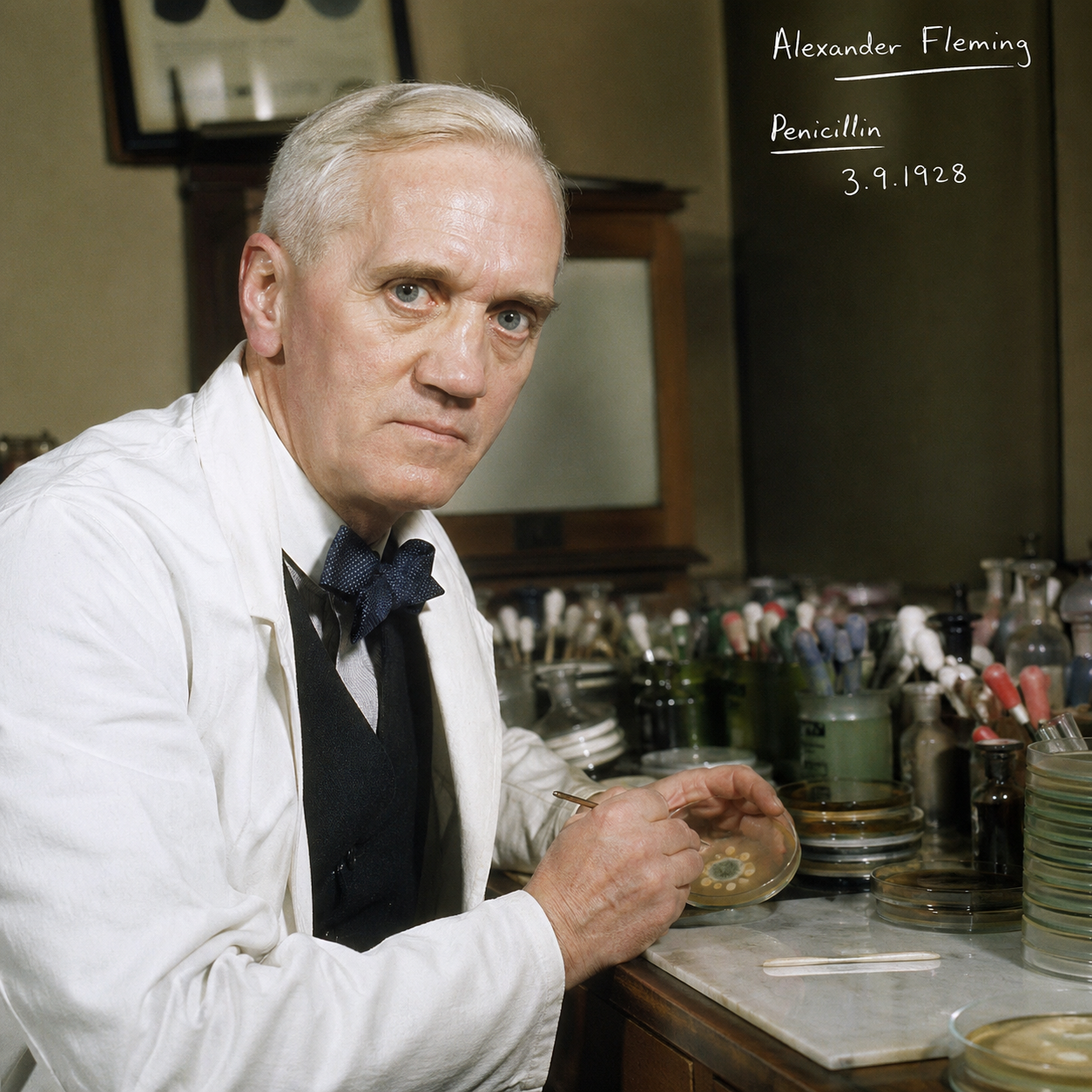
Alexander Fleming — "The bacteriologist must be a patient man."
The bacteriologist must be a patient man.
The bacteriologist must be a patient man.
Click any product to generate a realistic preview. Up to 3 at a time.
* Initial load can take up to 90 seconds — revising the preview in another color is nearly instant.
"It is the common lot of discoverers to be misunderstood."
"The thought that I might have discovered something which would be of value in treating disease was, of course, uppermost in my mind."
"The thoughtless person playing with penicillin treatment is morally responsible for the death of the man who succumbs to infection with the penicillin-resistant organism."
"It is not often that one finds a substance that is both highly bactericidal and non-toxic to animal tissues."
"I am very grateful for the recognition I have received, but the real credit belongs to the mould."
Found in 1 providers: grok
1 source checked
Bacteriology demands patience as a core professional trait, not just a personal virtue. Results don't come quickly — bacterial cultures grow on their own schedule, experiments fail repeatedly, and breakthroughs emerge only after long, careful observation. A scientist who rushes will misread or discard what matters. Success depends on tolerating uncertainty, waiting without forcing conclusions, and sustaining attention through stretches where nothing appears to be happening.
Fleming's most famous discovery came from a contaminated petri dish he nearly discarded — mold killing surrounding bacteria during a holiday absence. He had the patience to investigate rather than clean it up. He also spent over a decade documenting penicillin's properties without seeing it developed into medicine. His earlier lysozyme discovery similarly came from unhurried observation of tears and mucus. Patience was literally the mechanism behind his two greatest contributions.
In the early 20th century, bacteriology was still a young, painstaking discipline with no automation. Fleming worked through WWI and the interwar years, when bacterial infections — sepsis, pneumonia, wound contamination — killed more soldiers than combat. Every experiment involved manual culture, slow incubation, and microscopy by eye. There were no shortcuts. In that environment, patience wasn't philosophical advice; it was the only methodology available to anyone doing serious microbiological work.
AI-generated insights based on extensive research and information for context. Factual errors? Email [email protected].
Your cart is empty