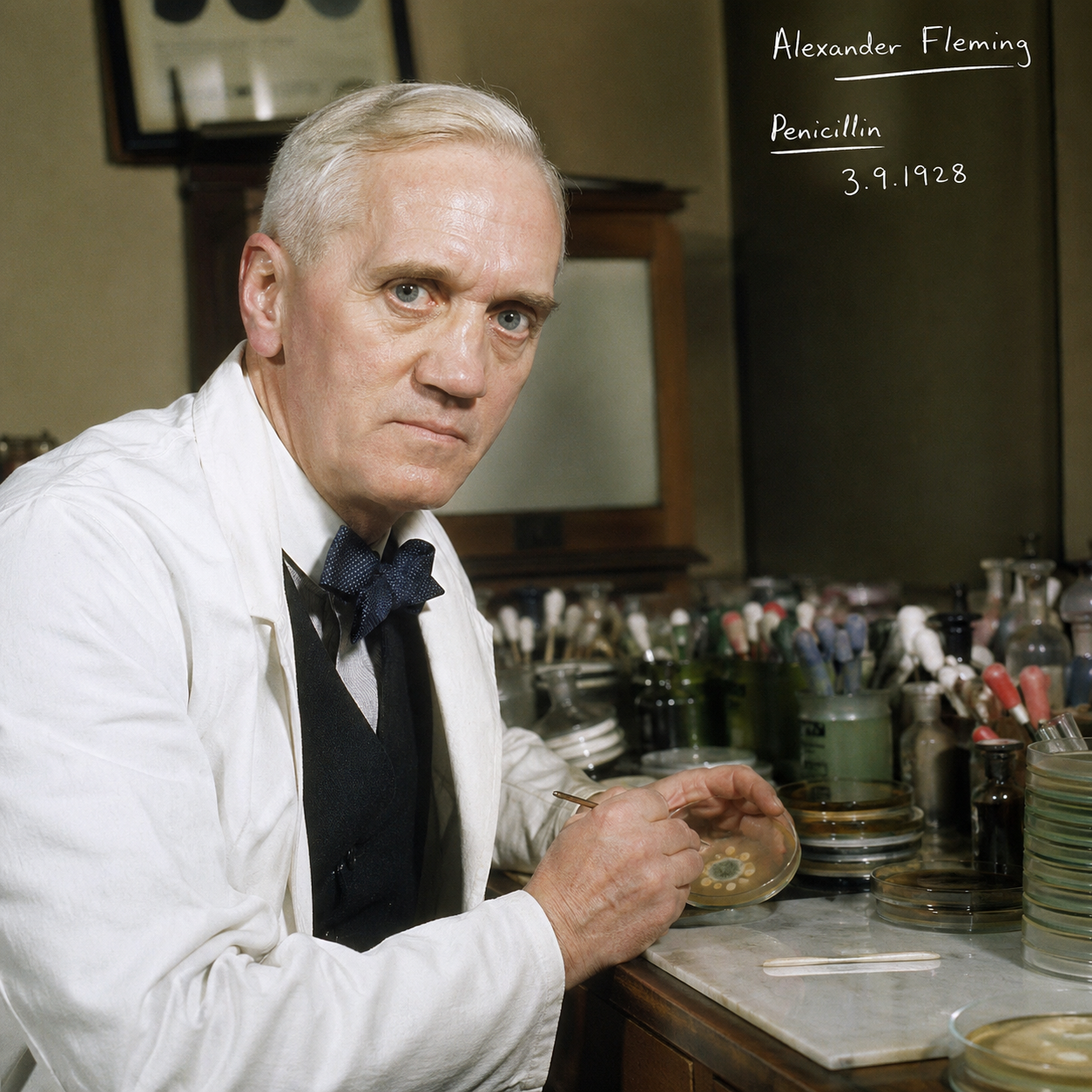
Alexander Fleming — "I have been fortunate in my life to have seen the benefits of my discovery."
I have been fortunate in my life to have seen the benefits of my discovery.
I have been fortunate in my life to have seen the benefits of my discovery.
Click any product to generate a realistic preview. Up to 3 at a time.
* Initial load can take up to 90 seconds — revising the preview in another color is nearly instant.
"I have been accused of being untidy. I confess to being untidy, but I have never allowed my untidiness to interfere with my work."
"I had no idea that I had stumbled on to a subject that would prove to be of such immense importance."
"The mere fact that a substance has bactericidal powers does not mean that it can be used for the treatment of septic infections."
"It is not wise to use penicillin as a prophylactic against every little infection."
"When I woke up just after dawn on September 28, 1928, I certainly didn't plan to revolutionize all medicine by discovering the world's first antibiotic, or bacteria killer. But I suppose that was exac…"
Found in 1 providers: grok
1 source checked
Fleming is expressing gratitude for living long enough to witness the real-world impact of what he discovered. Many inventors and scientists die before their ideas are proven useful or widely adopted. He is acknowledging that he got something rare: the chance to see his work move from a laboratory curiosity into something that actually saved lives, and to recognize that personal good fortune separately from the scientific achievement itself.
Fleming discovered penicillin in 1928 when a stray mold killed bacteria on a forgotten petri dish, but the compound was not mass-produced until Florey and Chain industrialized it in the early 1940s. He lived until 1955, long enough to be knighted in 1944, share the 1945 Nobel Prize, and watch penicillin save Allied soldiers and civilians worldwide. His humility about luck — both the contamination and the timing — shaped his public voice.
Fleming's productive era spanned two world wars and the antibiotic revolution. Before penicillin, a scratch could kill; pneumonia, sepsis, and battlefield wounds routinely turned fatal. By the late 1940s and early 1950s, mass-produced penicillin was reshaping medicine, surgery, and childbirth survival, and the public treated Fleming as a hero. Living through that transformation — from pre-antibiotic mortality to the dawn of modern pharmaceuticals — gave his statement its weight.
AI-generated insights based on extensive research and information for context. Factual errors? Email [email protected].
Your cart is empty