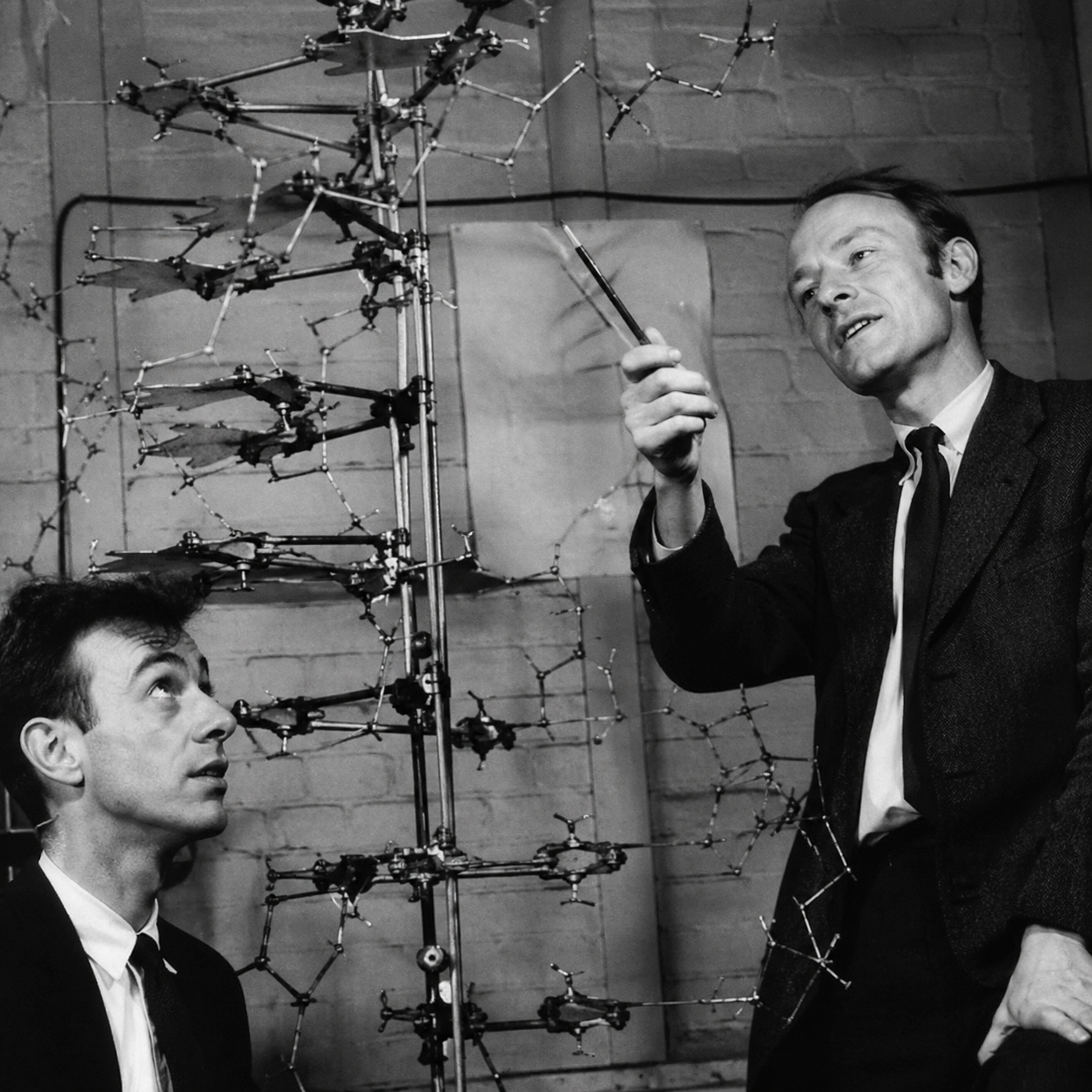
Francis Crick — "The brain is a machine assembled not to understand itself, but to survive."
The brain is a machine assembled not to understand itself, but to survive.
The brain is a machine assembled not to understand itself, but to survive.
Click any product to generate a realistic preview. Up to 3 at a time.
* Initial load can take up to 90 seconds — revising the preview in another color is nearly instant.
"The belief that we have immortal souls is a superstition."
"The brain is a machine that makes theories."
"It is always a good thing to be slightly eccentric."
"I enjoy being controversial."
"We are just a bunch of atoms and molecules."
Found in 1 providers: deepseek
1 source checked
The human brain evolved primarily for survival, not for understanding itself. Our cognitive blind spots, biases, and inability to fully introspect aren't design flaws — they're features shaped by natural selection. We aren't wired for philosophical truth or self-awareness by default; we're wired to find food, avoid threats, and reproduce. Any self-knowledge we achieve is an accidental byproduct of machinery built for something else entirely.
After co-discovering DNA in 1953, Crick spent his final decades studying consciousness at the Salk Institute — a brain literally trying to understand itself. His 1994 book The Astonishing Hypothesis argued the soul is simply neurons firing, a committed materialist stance. This quote embodies his conviction that biology, not philosophy, explains the mind. His own brilliance was, by his own logic, an accident of evolution rather than its intended endpoint.
Crick worked through the cognitive revolution of the 1960s and the U.S.-declared Decade of the Brain in the 1990s. Evolutionary psychology was reframing human behavior as survival machinery — Dawkins' selfish gene, Wilson's sociobiology debates polarized academia. Neuroscience was simultaneously confronting the hard problem of consciousness. The implication that the mind cannot fully audit itself was radical but increasingly backed by cognitive science, making this observation both timely and disruptive.
AI-generated insights based on extensive research and information for context. Factual errors? Email [email protected].
Your cart is empty