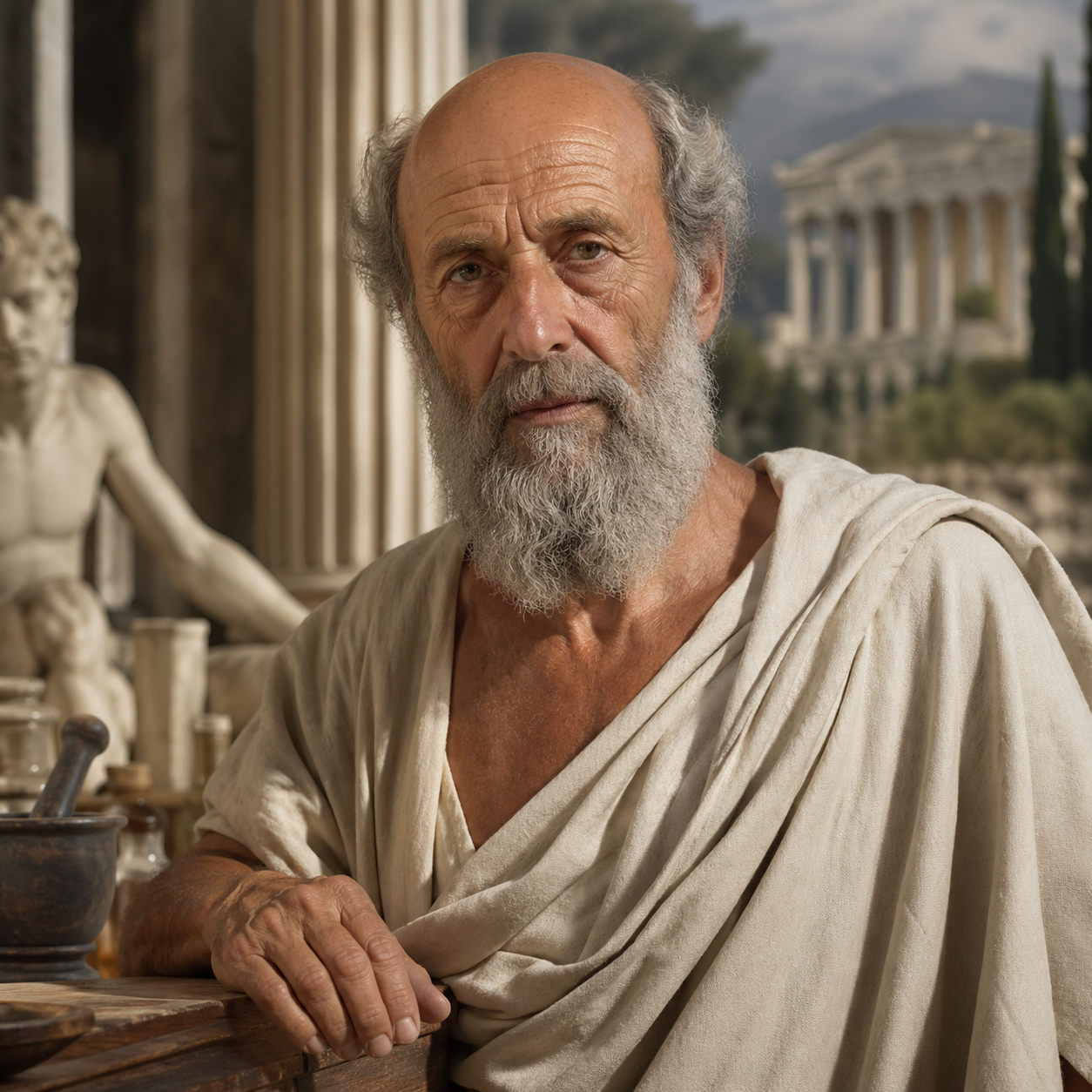
Hippocrates — "The causes of disease are in the air, the water, and the place."
The causes of disease are in the air, the water, and the place.
The causes of disease are in the air, the water, and the place.
Click any product to generate a realistic preview. Up to 3 at a time.
* Initial load can take up to 90 seconds — revising the preview in another color is nearly instant.
"Hot diseases are cured by cold, and cold diseases by hot."
"The art of medicine consists in amusing the patient while nature cures the disease."
"The physician must be able to tell the antecedents, know the present, and foretell the future."
"The art of healing comes from nature, not from the physician."
"When a fever is present, the bowels should be loose; when absent, they should be costive."
A statement on environmental factors in health, reflecting early epidemiological thought.
Date: c. 460-370 BCE (from 'Airs, Waters, Places')
Nature & WorldFound in 1 providers: gemini
1 source checked
Illness originates from environmental factors — the quality of air we breathe, the water we consume, and the geographic location where we live. Disease isn't random or divine punishment but tied to observable physical surroundings. This maps directly to modern concepts: air pollution, contaminated drinking water, and place-based health disparities. Where and how you live determines what you get sick from.
Hippocrates wrote the treatise 'On Airs, Waters, and Places,' instructing physicians to assess local environment before diagnosing patients. He traveled widely across Greece, recording how coastal, inland, and marshy regions produced distinct disease patterns. His rejection of supernatural causation and insistence on empirical observation defined the Hippocratic school at Cos, making environmental medicine the cornerstone of his practice and legacy.
In 5th-century BCE Greece, disease was commonly attributed to divine wrath or demonic forces, with temple priests dominating healing at Asclepieia shrines. Athens suffered a catastrophic plague around 430 BCE, killing thousands with no theological explanation satisfying the public. Hippocrates and his school challenged this framework by insisting disease had rational, observable causes — a radical secularization of medicine that fractured the religious monopoly on healing.
AI-generated insights based on extensive research and information for context. Factual errors? Email [email protected].
Your cart is empty