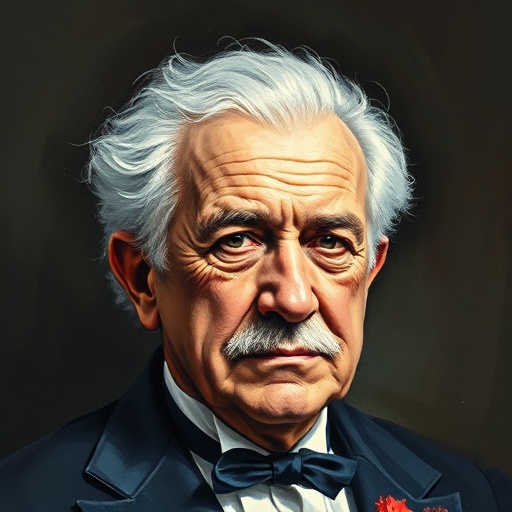
Thomas Edison — "The chief function of the body is to carry the brain around."
The chief function of the body is to carry the brain around.
The chief function of the body is to carry the brain around.
Click any product to generate a realistic preview. Up to 3 at a time.
* Initial load can take up to 90 seconds — revising the preview in another color is nearly instant.
"I make more mistakes than anyone I know, and sooner or later, I patent them all."
"My success is due to the fact that I never went to school and was never forced to learn anything but what I wanted to know."
"Anything that won't sell, I don't want to invent."
"Show me a thoroughly satisfied man and I will show you failure."
"I am not a spiritualist, but I am a firm believer in the fact that we can communicate with the beyond."
Reported in 'Edison: His Life and Inventions' by Frank Lewis Dyer and Thomas Commerford Martin
Date: 1910
GeneralFound in 2 providers: grok,gemini
2 sources checked
The body exists mainly as transportation for the mind. Physical existence matters less than intellectual activity—muscles, limbs, and organs are support infrastructure for thinking. What truly defines a person and drives progress is mental work: ideas, reasoning, invention, and problem-solving. Everything physical simply serves the brain's needs, letting it reach places, gather information, and act on its conclusions. The real engine of human achievement is cognition, not physicality.
Edison worked grueling 18-20 hour days at Menlo Park, famously subsisting on catnaps and dismissing sleep as wasted time. His 1,093 patents—phonograph, motion pictures, improved light bulb—came from relentless mental labor, not physical prowess. He prized thinking over athleticism, once saying genius was 99 percent perspiration, meaning mental effort. This quote captures his lifelong conviction that cerebral output defined a person's worth and that bodily needs were mere logistics.
Edison lived through the late 1800s and early 1900s, the Second Industrial Revolution, when inventors and industrialists reshaped daily life through electricity, telegraphs, telephones, and mass production. America shifted from agrarian muscle-labor to factory systems and knowledge work. Scientific rationalism and the cult of the inventor-hero dominated culture. Figures like Edison, Tesla, and Bell were celebrities precisely because mental innovation—not brute strength—was newly recognized as the engine of wealth and national progress.
AI-generated insights based on extensive research and information for context. Factual errors? Email [email protected].
Your cart is empty