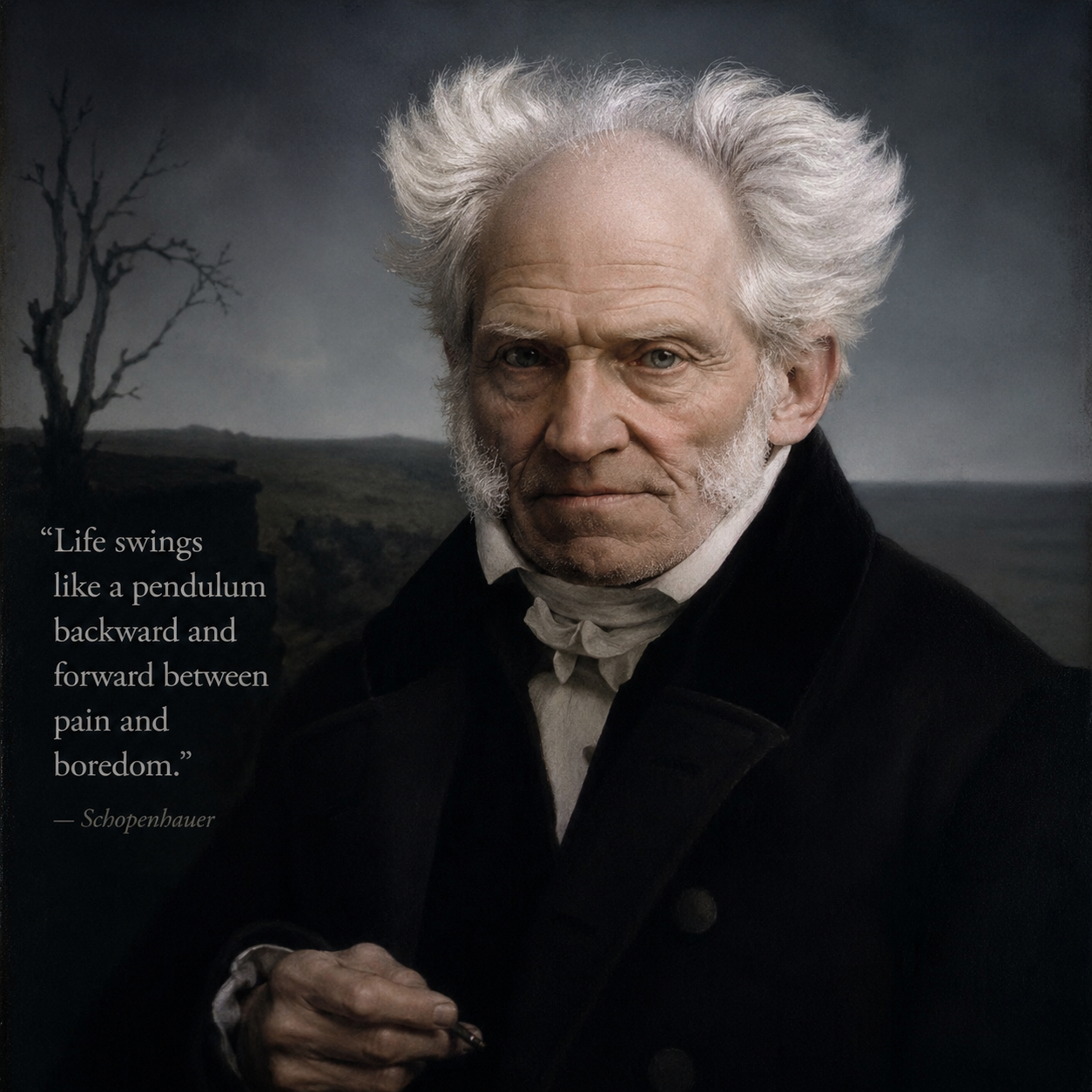
Arthur Schopenhauer — "The chief source of man's unhappiness is that he does not know how to stay quiet…"
The chief source of man's unhappiness is that he does not know how to stay quietly in his room.
The chief source of man's unhappiness is that he does not know how to stay quietly in his room.
Click any product to generate a realistic preview. Up to 3 at a time.
* Initial load can take up to 90 seconds — revising the preview in another color is nearly instant.
"Buying books would be a good thing if one could also buy the time to read them in: but as a rule the purchase of books is mistaken for the appropriation of their contents."
"The value of a man is not measured by the number of truths he has accumulated, but by the extent to which he has freed himself from error."
"The fundamental defect of the female character is a lack of a sense of justice. This originates first and foremost in their want of rationality and capacity for reflexion but it is strengthened by the…"
"If you want to know your true opinion of someone, watch the effect produced in you by the first sight of a letter from him."
"The world is not to be enjoyed, but to be overcome."
German philosopher of pessimism whose The World as Will and Representation (1819) defined the suffering-and-renunciation tradition. Closely associated with Immanuel Kant (the system Schopenhauer built on and revised). For an intellectual contrast, see G.W.F. Hegel, German Idealist of the rational unfolding of Spirit — Schopenhauer scheduled his Berlin lectures opposite Hegel's and spent decades attacking Hegel's optimistic system as deliberately mystifying nonsense — the foundational rivalry of 19th-century German philosophy.
The standard scholarly entry points to Arthur Schopenhauer's work: Bryan Magee (Oxford, populariser-philosopher) — The Philosophy of Schopenhauer (1983); Christopher Janaway (Southampton, Schopenhauer specialist) — Self and World in Schopenhauer's Philosophy (1989); David E. Cartwright (Wisconsin–Whitewater) — Schopenhauer: A Biography (2010). These are the works graduate seminars cite when teaching Arthur Schopenhauer.
Attributed, a common misattribution to Pascal, but Schopenhauer echoed similar sentiments on solitude and inner peace.
Date: Approx. 19th Century
ShockingFound in 1 providers: grok
1 source checked
Your cart is empty