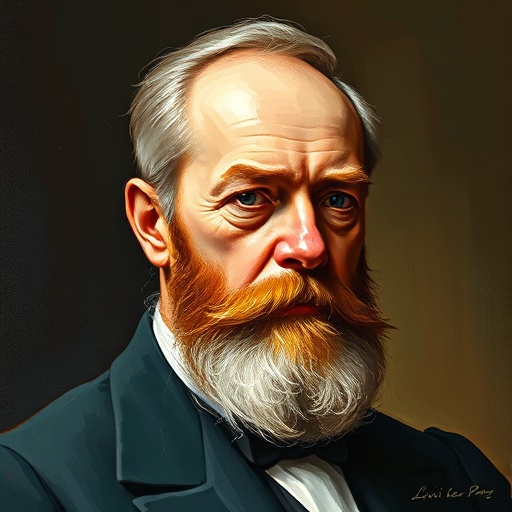
Louis Pasteur — "The day will come when the microbe is both friend and foe."
The day will come when the microbe is both friend and foe.
The day will come when the microbe is both friend and foe.
Click any product to generate a realistic preview. Up to 3 at a time.
* Initial load can take up to 90 seconds — revising the preview in another color is nearly instant.
"There are no such things as applied sciences, only applications of science."
"Do not let yourself be discouraged by the difficulties of research, and do not be afraid of a little suffering, for it is in this way that the truth will be revealed."
"The role of the infinitely small in nature is infinitely large."
"Life is a germ, and a germ is life. The living organism is the highest, the most complicated, and the most beautiful of all chemical machines."
"Wine is the most healthful and hygienic of beverages."
Attributed, foreshadowing the understanding of beneficial microbes.
Date: Late 19th Century (approx.)
WisdomFound in 1 providers: grok
1 source checked
Microorganisms are not simply enemies to destroy. The same invisible life that causes disease also performs essential work: fermenting food, enriching soil, breaking down waste, and keeping bodies healthy. A time is coming when people will recognize this dual nature and learn to partner with microbes rather than only fight them, harnessing beneficial ones while controlling the harmful.
Pasteur built his career proving microbes cause disease and spoilage, yet his earliest triumphs rescued beneficial microbes: he saved French wine, beer, and silk industries by identifying which organisms belonged and which did not. Pasteurization itself selectively kills harmful microbes while preserving useful fermentation. His vaccine work also used weakened microbes to protect against stronger ones, embodying the friend-and-foe insight at the heart of his science.
In the mid-to-late 1800s, Europe faced cholera, anthrax, rabies, and puerperal fever while still debating whether germs even existed. Industrial fermentation, public sanitation, and surgery were being transformed by microbiology. Lister was introducing antiseptics, Koch was isolating pathogens, and brewing and dairy industries were modernizing. Pasteur spoke as this new science was reshaping medicine, agriculture, and food, hinting that future generations would move beyond pure germ warfare toward deliberate microbial cooperation.
AI-generated insights based on extensive research and information for context. Factual errors? Email [email protected].
Your cart is empty