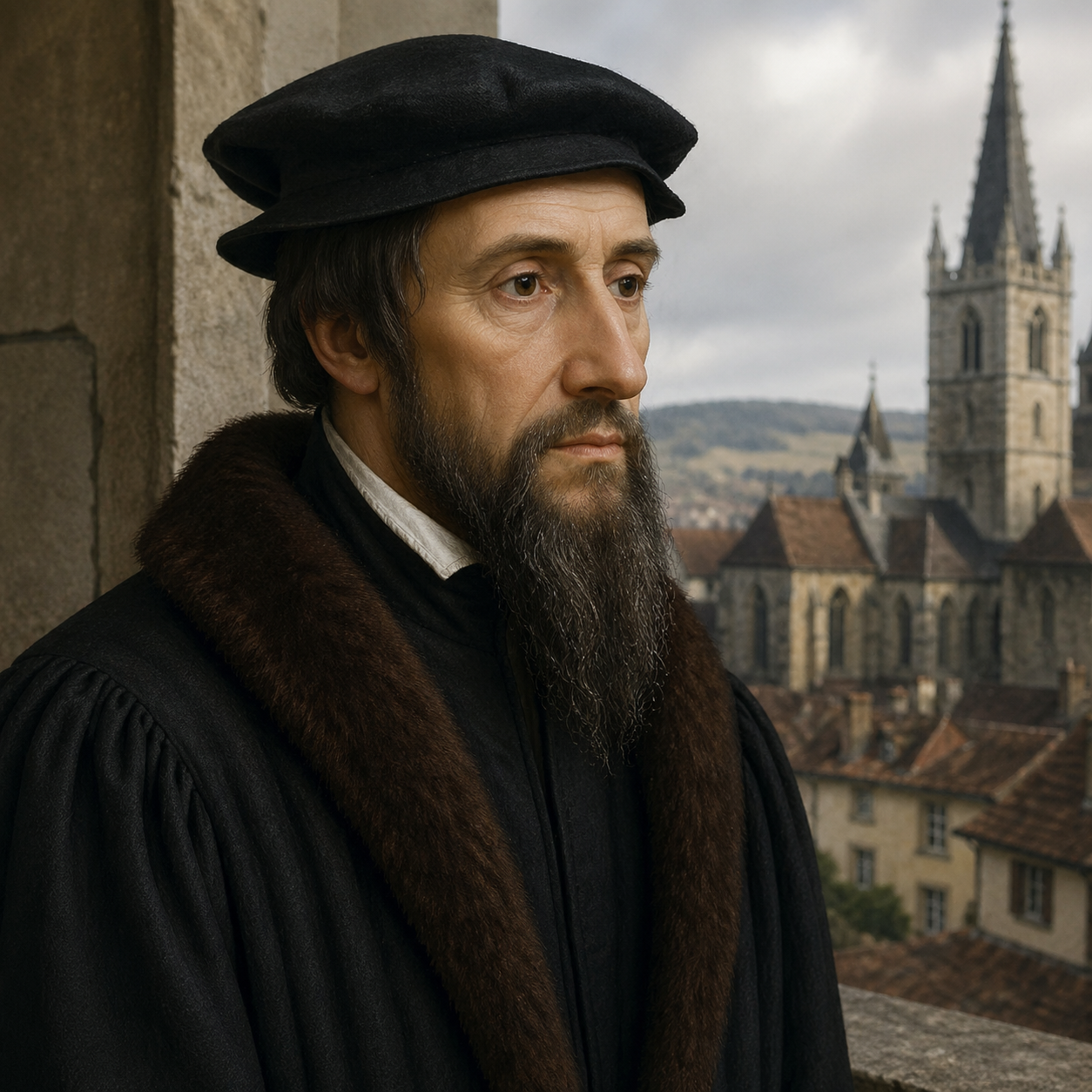
John Calvin — "The elect are saved by God's free grace, without any merit of their own."
The elect are saved by God's free grace, without any merit of their own.
The elect are saved by God's free grace, without any merit of their own.
Click any product to generate a realistic preview. Up to 3 at a time.
* Initial load can take up to 90 seconds — revising the preview in another color is nearly instant.
"The proper knowledge of God is when we know him to be our Father."
"The decree is dreadful, I confess. Yet no one can deny that God foreknew what end man was to have before he created him, and consequently foreknew because he so ordained by his decree."
"The true way to learn God's will is to listen to his Word."
"I am unwilling to pledge my word for his safety, for if he shall come [to Geneva], I shall never permit him to depart alive, provided my authority be of any avail."
"Without faith, it is impossible to please God."
French theologian whose Institutes of the Christian Religion (1536) systematized Protestant Reformed doctrine, including predestination. Closely associated with Martin Luther (Reformation founder, Calvin's predecessor). For an intellectual contrast, see Jacobus Arminius, Dutch Reformed theologian (1560-1609) — Arminius's rejection of strict double-predestination founded Arminianism — the theological tradition modern Methodism, most evangelicalism, and Pentecostalism descend from. The Calvinist-Arminian debate has divided Protestantism for 400 years.
Found in 1 providers: grok
1 source checked
Salvation belongs entirely to God's sovereign choice, not to anything humans do or deserve. God selects certain people — the elect — for eternal life based on divine will alone. No amount of good works, religious observance, or moral living can earn it. This is radical grace: salvation flows from God's decision, completely bypassing human effort or worthiness as contributing factors.
Calvin built his entire theology around God's absolute sovereignty. After breaking from Catholicism in 1530s France and establishing a theocratic Geneva, he codified predestination in his Institutes of the Christian Religion. His conviction — forged through persecution, exile, and reform battles — was that human pride in self-merit corrupted religion. Grace alone was Calvin's answer to an institutional church that sold salvation through indulgences and works.
The 16th-century Reformation erupted over precisely this question: can humans contribute to their salvation? The Catholic Church sold indulgences and taught meritorious works. Luther's break over faith alone ignited Europe, but Calvinist predestination went further, eliminating human agency entirely. Religious wars, including the French Wars of Religion, were partly fueled by these theological stakes, as salvation doctrine determined church authority and political legitimacy across Europe.
AI-generated insights based on extensive research and information for context. Factual errors? Email [email protected].
Your cart is empty