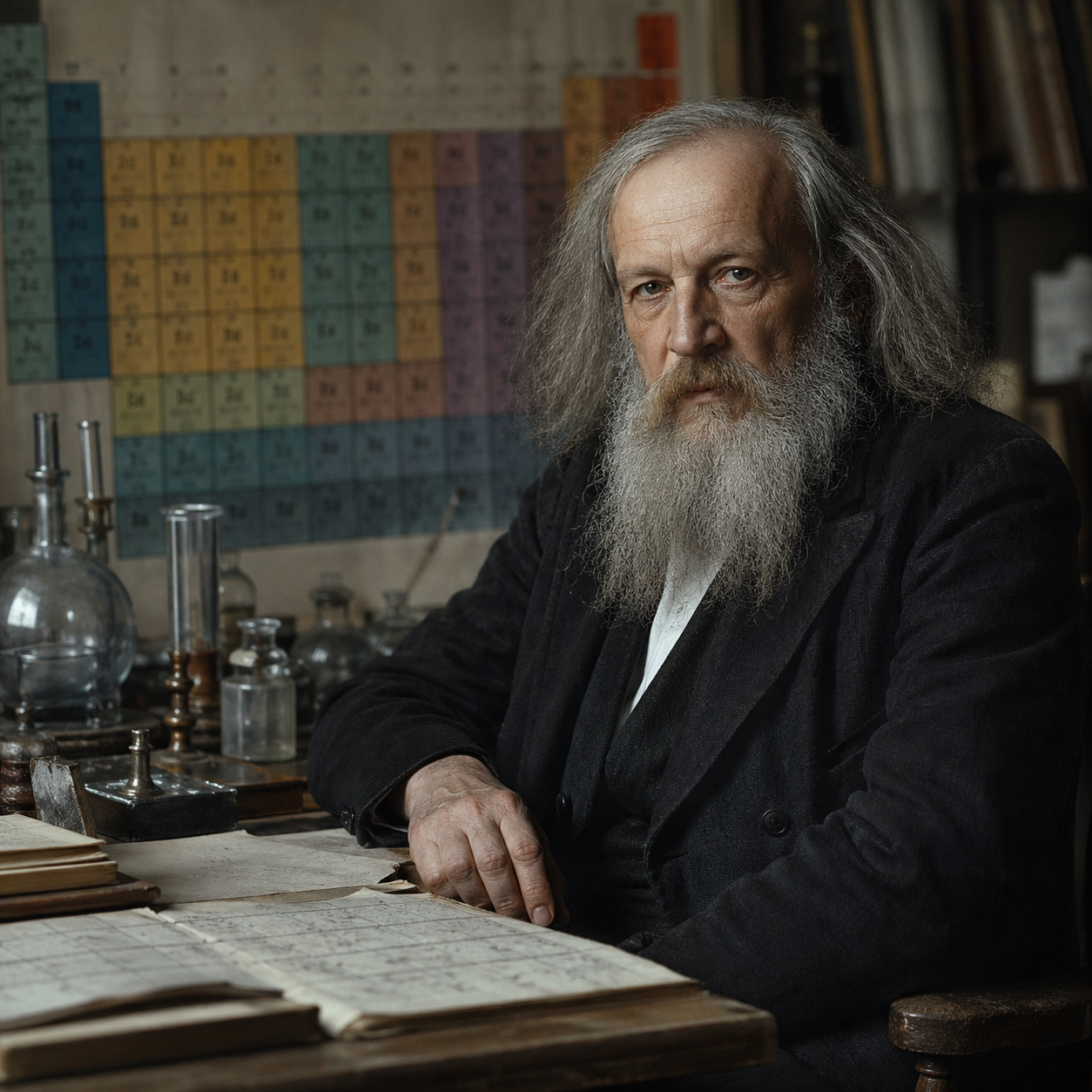
Dmitri Mendeleev — "The elements, if arranged according to their atomic weights, exhibit an apparent…"
The elements, if arranged according to their atomic weights, exhibit an apparent periodicity of properties.
The elements, if arranged according to their atomic weights, exhibit an apparent periodicity of properties.
Click any product to generate a realistic preview. Up to 3 at a time.
* Initial load can take up to 90 seconds — revising the preview in another color is nearly instant.
"The future of Russia is in its oil and its people."
"There will be new elements discovered, and they will fit into the empty spaces in my table."
"What has been sown for the field of science will grow up for the people's welfare."
"Pleasures flit by -- they are only for yourself; work leaves a mark of long-lasting joy, work is for others."
"There exists everywhere a medium in things, determined by equilibrium."
Found in 1 providers: deepseek
1 source checked
When you line up the chemical elements in order of how heavy their atoms are, you notice that certain properties keep repeating at regular intervals. Elements that seem unrelated actually share similar behaviors in a predictable rhythm. This pattern isn't random coincidence but a fundamental organizing principle of matter itself, revealing that nature follows an underlying mathematical order that can be mapped, predicted, and used to anticipate properties of elements not yet discovered.
This statement is the founding insight of Mendeleev's periodic table, published in 1869. A Russian chemist teaching in St. Petersburg, he noticed the pattern while writing a textbook and organizing element cards. His conviction in this periodicity led him to leave gaps for undiscovered elements like gallium and germanium, predicting their properties with startling accuracy. It captures his defining trait: trusting patterns enough to bet on the unseen.
In the 1860s, chemistry was drowning in data without structure. Around 63 elements were known but scattered, with competing classification attempts by Newlands, Meyer, and others failing to gain traction. The atomic weight concept itself had only been standardized at the 1860 Karlsruhe Congress, which Mendeleev attended. Industrial growth demanded better chemistry, and scientists across Europe were racing to find order. Mendeleev's framework won because it predicted, not just described.
AI-generated insights based on extensive research and information for context. Factual errors? Email [email protected].
Your cart is empty